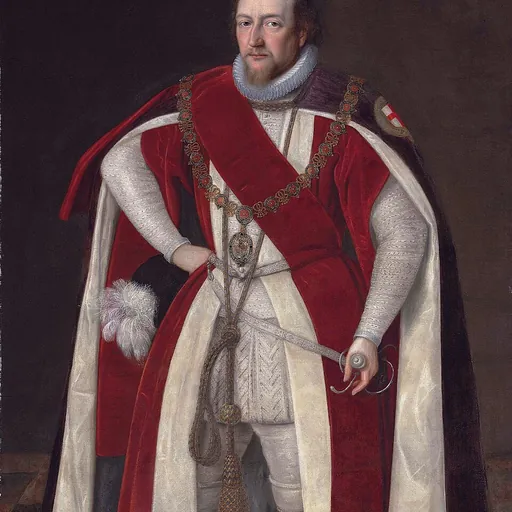
About Henry Brooke, 11th Baron Cobham
Lived 1564 – 1619 (aged 54). Henry Brooke, 11th Baron Cobham was a politician.
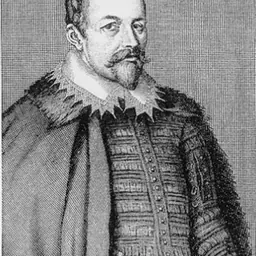
Henry Brooke, 11th Baron Cobham (22 November 1564 – 24 January 1618 (Old Style)/3 February 1618 (New Style), lord of the Manor of Cobham, Kent, was an English peer who was implicated in the Main Plot against the rule of James I of England.
Life
The son of William Brooke, 10th Baron Cobham, by second wife Frances, daughter of Sir John Newton, he was educated at King's College, Cambridge. In 1597 he succeeded his father as Lord Warden of the Cinque Ports under Queen Elizabeth I. Shortly after the accession of James I, he was implicated in the "Treason of the Main" in 1603. His brother George was executed, and Henry was imprisoned in the Tower of London by James I, probably in an attempt to obtain the Cobham estates for the Duke of Lennox.
He was the second husband of Lady Frances Howard, daughter of Charles Howard, 1st Earl of Nottingham and Katherine Carey, Countess of Nottingham.
He may have been the subject of a number of Elizabethan satires such as Thomas Nashe's Lenten Stuffe, Ben Jonson's Every Man in his Humour, and may have been the model of William Shakespeare's Falstaff, who was originally given the name "Oldcastle". Sir John Oldcastle shared the same title, Lord Cobham, as Henry Brooke.
Although Falstaff is more likely modelled on his father, William Brooke, 10th Baron Cobham (also descended from John Oldcastle), who was married to Frances Newton, whose family name was originally Caradock; referenced in Henry IV, Part 2 when Falstaff sings The Boy and the Mantle, a ballad in which Sir Caradoc's wife comes away with her fidelity and reputation intact (McKeen 1981).
Cobham and the Main Plot Contemporary accounts portray Cobham as a good natured but unintelligent man. He opposed the ascension of James I to the throne, along with Thomas Grey, 15th Baron Grey de Wilton. Cobham's dislike of James may have arisen from quarrels over religious policy, but Lord Grey was anti-Catholic. Cobham shows little political activity prior to James's time, and he seems generally to have been an uninvolved peer. His brother, Sir George Brooke, on the other hand, was involved in radical religious politics.
In 1603, the first year of James I's rule, both Brookes were involved in plots against the king. George Brooke entered into the Bye Plot with two Catholic priests, William Watson and William Clark, to kidnap the king and privy council, and force them to ease the political persecution of English Catholics.
At the very same time, Grey and Cobham entered into the Main Plot to raise a regiment of soldiers and force a coup d'etat. Cobham and Grey were to raise one-hundred and sixty thousand pounds (a figure that could be safely multiplied by twenty to convert to contemporary money) to bribe or hire an army. Cobham was to be the go-between with the Princely Count of Arenberg, who would do the actual negotiations with the Spanish court for the money. The conspirators, upon seizing government, would depose James and put Lady Arabella Stuart on the throne in his stead.
It is very likely that none of the offers from the Princely Count Arenberg were in good faith. It is plausible to concede that the Spanish court, already deeply in debt to banks in the Spanish Netherlands and the Dutch Republic, with the failure of the Spanish Armada years before, and having lost many of its galleons to English pirates, was in no position to offer such an astronomical sum to a somewhat improbable enterprise. However, Cobham believed the offers. He spoke with Sir Walter Raleigh about contacting Arenberg, and he was readying to set forth.
However, the Bye plot was discovered through its hireling "swordsmen", and the Bye plot conspirators were imprisoned. George Brooke may have sought to avoid a death sentence by informing on his brother. In any case, he provided information on the Main plot, and Grey, Cobham, and Raleigh were imprisoned in the Tower. During the trial, the evidence was shown to be inconsistent, especially in regard to Raleigh. The Bye plot conspirators were executed in 1603, and the Main plot conspirators were left in the Tower. In 1604 (new style), Cobham's honours in the Knights of the Garter were taken down and expelled.
Cobham, aged and sick, was released from the Tower in 1618, and died shortly after in a "dingy apartment in the Minories".
Marriage In 1601 he married Frances Howard (c.1572–1628), 2nd daughter of Charles Howard, 1st Earl of Nottingham and widow of Henry FitzGerald, Earl of Kildare. After her husband's attainder in 1603 the king granted her in 1604 a lease for her life of her husband's residence, Cobham Hall in Kent, where she lived "in solitary state" until her death in 1628, having in the meantime taken "no notice whatever of her husband after his trial".
Don’t just read it —
keep it.
Full-length biographies made to live with: read them, listen on the way to work, watch them tonight.
- E-book
- Audio
- Video
Instant download · yours to keep · every purchase keeps this site free
Important facts
People in Henry Brooke, 11th Baron Cobham's life
Named in this biography and alive at the same time



Related people
Same field, nearest in time



Contemporaries
People whose lives overlapped Henry Brooke, 11th Baron Cobham's


Frequently asked questions
Who was Henry Brooke, 11th Baron Cobham?
English peer (1564-1619)
When was Henry Brooke, 11th Baron Cobham born?
Henry Brooke, 11th Baron Cobham was born on 22 November 1564.
When did Henry Brooke, 11th Baron Cobham die?
Henry Brooke, 11th Baron Cobham died on 3 February 1619 in Tower of London, Minories.
What was Henry Brooke, 11th Baron Cobham's occupation?
Henry Brooke, 11th Baron Cobham was a politician.
Sources & further reading
· Wikipedia: Henry Brooke, 11th Baron Cobham
· DBpedia: Henry Brooke, 11th Baron Cobham
Cite this page
APA: Biography.guide. (2026). Henry Brooke, 11th Baron Cobham. https://biography.guide/henry-brooke-11th-baron-cobham/
MLA: "Henry Brooke, 11th Baron Cobham." Biography.guide, https://biography.guide/henry-brooke-11th-baron-cobham/.
Chicago: "Henry Brooke, 11th Baron Cobham." Biography.guide. https://biography.guide/henry-brooke-11th-baron-cobham/.
Data last updated: 2026-09-23 · Spot an error? Report a correction.
Portrait: Wikimedia Commons · author & licence
Page generated 2026-09-27 05:06 UTC