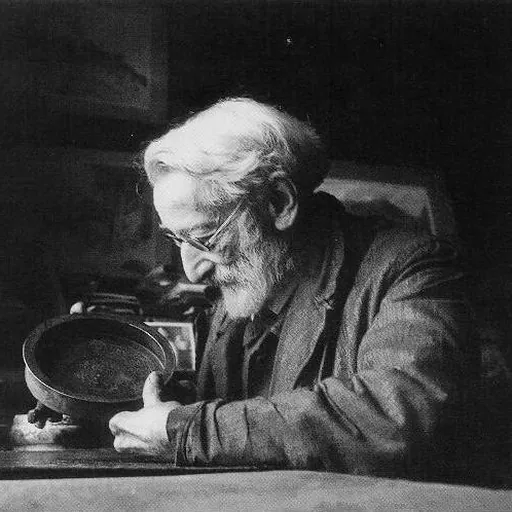
About Henri Rivière
Lived 1864 – 1951 (aged 87). Henri Rivière was a French painter, engraver, draftsperson, printmaker, photographer and graphic artist.
Henri Rivière (March 11, 1864 – August 24, 1951) was a French artist and designer best known for his creation of a form of shadow play at the Chat Noir cabaret, and for his post-Impressionist illustrations of Breton landscapes and the Eiffel Tower.
Biography
Early life and education Rivière was born in Paris. His father, Prosper Rivière, was an embroidery merchant from the Pyrénées. His mother, Henriette Thérese Leroux Rivière, was a Parisienne "from a petit bourgeois family". Rivière had one brother, Jules, born 1866.
In 1870, fleeing from the advancing Prussians during the Franco-Prussian War, his father moved the family back to Ax-les-Thermes, his childhood home in the Pyrenees. Rivière's time spent in the rural environment helped develop his love of nature, later a strong theme in his art.
After working for one week at an ostrich-feather importation business, a job his mother had arranged for him, he left work and went to paint at the Butte Montmartre, a habit he had developed. His mother, frustrated with Rivière, complained to his step-father, who spoke to his friend and art teacher, Emile Bin. Bin, after seeing Rivière's work, offered to teach him and Rivière began his formal training at Bin's studio. From 1882, Rivière worked as part of the editorial team on the weekly Chat Noir journal, which published light verse, short stories and illustrations. Rivière edited and contributed art and reviews to the journal until 1885.
According to historians Phillip Cate and Mary Shaw, Rivière's work involved both aesthetic and technical innovations,
Essentially, Rivière created a system in which he placed silhouettes of figures, animals, elements of landscapes, and so forth, within a wooden framework at three distances from the screen: the closest created an absolutely black silhouette, and the next two created gradations of black to gray, thus suggesting recession into space. Silhouettes could be moved across the screen on runners within the frame. He later experimented with colour woodcuts and chromolithography in the late 1880s. Rivière first visited Brittany in 1884, spending most of his summers there until 1916. Together with bustling Parisian life, rural Brittany constituted the majority of the subjects of his landscape works.
Rivière’s prints were generally intended to be published as collections. These include forty images used in Breton Landscapes, created between 1890 and 1894. He also made colour woodcuts for The Sea: Studies of Waves, and prepared other sequences that remained unfinished, including 36 Views of the Eiffel Tower, which were eventually published as lithographs. These were influenced by the vogue for Japonisme at the time, modernising the famous prints by Hiroshige and Hokusai of 36 Views of Mount Fuji.
His colour lithographic series' include:
The Aspects of Nature (1897 to 1899), 16 images The Beautiful Land of Brittany (1897 to 1917), 20 images Parisian Landscapes (1900), 8 images The Magic Hours (1901 to 1902), 16 images Thirty-Six Views of the Eiffel Tower (1902), 36 images The Noirot Wind (1906), 4 images
Rivière ceased making prints in 1917, effectively retiring as a professional artist, but continued to work on watercolours in his later years. He died on August 24, 1951.
Don’t just read it —
keep it.
Full-length biographies made to live with: read them, listen on the way to work, watch them tonight.
- E-book
- Audio
- Video
Instant download · yours to keep · every purchase keeps this site free
Important facts
more
Henri Benjamin Jean Pierre Riviere, Henri Benjamin Jean RivièrePeople in Henri Rivière's life
Named in this biography and alive at the same time

Related people
Same field, nearest in time

Contemporaries
People whose lives overlapped Henri Rivière's




Frequently asked questions
Who was Henri Rivière?
French artist and designer (1864-1951)
When was Henri Rivière born?
Henri Rivière was born on 11 March 1864 in 2nd arrondissement of Paris.
When did Henri Rivière die?
Henri Rivière died on 24 August 1951 in Sucy-en-Brie.
What was Henri Rivière's occupation?
Henri Rivière was a painter, engraver, draftsperson, printmaker, photographer and graphic artist.
What nationality was Henri Rivière?
Henri Rivière was French.
Sources & further reading
· DBpedia: Henri Rivière (painter)
Cite this page
APA: Biography.guide. (2026). Henri Rivière. https://biography.guide/henri-riviere-painter/
MLA: "Henri Rivière." Biography.guide, https://biography.guide/henri-riviere-painter/.
Chicago: "Henri Rivière." Biography.guide. https://biography.guide/henri-riviere-painter/.
Data last updated: 2026-09-23 · Spot an error? Report a correction.
Portrait: Wikimedia Commons · author & licence
Page generated 2026-09-27 05:05 UTC