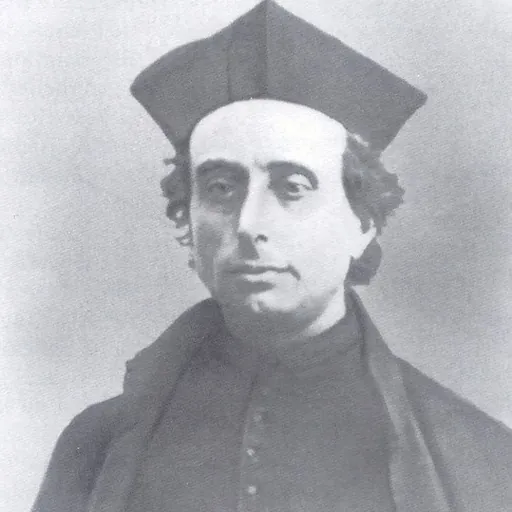
About Henri Ramière
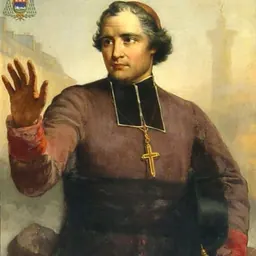
Lived 1821 – 1884 (aged 62). Henri Ramière was a French catholic priest, writer, essayist, university teacher, philosopher and catholic theologian.
Henri Ramière (also spelled Henry Ramière; 10 July 1821 – 3 January 1884) was a French Jesuit priest, theologian, spiritual writer, essayist, and editor. He was one of the major nineteenth-century promoters of devotion to the Sacred Heart of Jesus and played a central role in transforming the Apostleship of Prayer from a local Jesuit initiative into an international Catholic movement.
Ramière is also known for his nineteenth-century edition of Abandonment to Divine Providence, the influential work of spiritual theology traditionally attributed to Jean-Pierre de Caussade.
Biography
Formation and early years
After studying at two Jesuit colleges, first at Pasaia in Spain and then at Fribourg in Switzerland, Ramière entered the novitiate of the Society of Jesus on 15 June 1839. He studied sacred eloquence in Paris and pursued theological studies from 1844 to 1847. He was ordained priest on 10 January 1847 at Vals-près-le-Puy.
At the end of his studies, he went to England, where he taught philosophy and theology at Stonyhurst College from 1847 to 1850. He became especially known as a theologian.
Devotion to the Heart of Jesus
In 1853 Ramière was recalled to France by his superiors and entrusted with the direction of higher studies at the Jesuit house of studies at Vals-près-le-Puy. He remained there until 1864 and contributed to the renewal of scholastic theology against the ontologism that had previously influenced the house. During this period he founded a sanctuary dedicated to the Heart of Jesus at prayer.
His personal attachment and devotion to Jesus led him to found, in 1861, Le Messager du Cœur de Jésus, a monthly publication that he directed until the end of his life. The journal achieved wide circulation and was printed in nine or ten languages; the Toulouse edition alone reportedly had more than 20,000 subscribers. Before leaving Vals in 1855, Gautrelet entrusted the apostolate to Ramière and asked him to rework the movement’s foundational text; under Ramière’s direction the movement quickly achieved international success.
Ramière also published Abandonment to Divine Providence, a short work of spiritual theology traditionally attributed to Jean-Pierre de Caussade. The text had remained in manuscript form before Ramière published it in 1861.
First Vatican Council
While in Toulouse, Ramière was invited to participate in the First Vatican Council of 1869–1870. He served as theologian, as ecclesiastical adviser to Bishop Joseph Gignoux of the Diocese of Beauvais, and as procurator for Cardinal Alexis Billiet, Archbishop of Chambéry, whose age and infirmities prevented him from attending the council personally. In Rome he wrote the Bulletin du concile.
He also wrote Les doctrines romaines sur le libéralisme, envisagé au point de vue du dogme chrétien et de l'ordre social, for which he received the congratulations of Pope Pius IX. From 1872 to 1875 he lived in Lyon as assistant director of the journal Études religieuses. A prolific writer, he published numerous articles intended to address contemporary questions in light of traditional Christian thought. His views were generally associated with ultramontanism.
Return to Toulouse
Ramière took part in various congresses. In 1875 he returned to Vals-près-le-Puy as director of higher Catholic studies, but in 1877 the foundation of the Institut catholique de Toulouse brought him back to Toulouse to occupy the chairs of natural law and moral theology in the school of theology opened there.
As his health declined, he gave up his place at the Institut catholique and withdrew to the house of the Messager du Cœur de Jésus, where he continued to oversee the journal’s development. Ramière died of congestion on 3 January 1884 at Toulouse, at the offices of the journal at 13 rue Saint-Remézy, reportedly while preparing to celebrate Mass.
He emphasized that ordinary activities, study, work, suffering, and prayer could acquire apostolic significance when offered in union with Jesus Christ. Scholars have situated this aspect of the Apostleship of Prayer within the broader history of Jesuit Sacred Heart spirituality and nineteenth-century Catholic devotional culture.
Ramière also contributed to the development of modern Sacred Heart devotion as a theological and social movement. His writings presented devotion to the Sacred Heart not merely as private piety, but as participation in Christ’s redemptive mission and in the spiritual renewal of society.
Editor of Abandonment to Divine Providence
Ramière played a major role in the nineteenth-century dissemination of Abandonment to Divine Providence. The work was not originally known under that title, but circulated as Le traité où l’on découvre la vraie science de la perfection du salut. It first appeared publicly in 1861 when Ramière published it as L’abandon à la providence divine.
Ramière attributed the work to Caussade, apparently relying on manuscript traditions associated with the Visitation convent at Nancy. Modern scholarship has noted that concern about accusations of Quietism led Ramière to revise the manuscript substantially in order to remove formulations that could appear controversial.
Ramière’s edition became foundational for the work’s modern reception. It went through several nineteenth-century editions and was later translated into English under titles such as Abandonment to Divine Providence and The Joy of Full Surrender. Later scholars, including Michel Olphe-Galliard, Jacques Gagey, and Dominique Salin, have questioned or rejected Caussade’s authorship of the work, while continuing to regard it as an important witness to eighteenth-century French spirituality.
Dominique and Murielle Tronc have interpreted the text as part of the survival and transformation of the spirituality of pure love associated with Madame Guyon after the Quietist controversies. Through his editorial work, Ramière thus became one of the nineteenth-century mediators through whom earlier French traditions of abandonment and interior prayer entered modern Catholic devotional life.
Succession in the Apostleship of Prayer
At the time of Ramière’s death, the Apostleship of Prayer, whose centre was established at Toulouse and which he had directed for twenty-five years, reportedly counted thirteen million associates. By a decision dated 20 January 1884, Pope Leo XIII appointed Émile Régnault as his successor. Régnault also assumed direction of the Messager du Cœur de Jésus and the Petit Messager du Cœur de Marie, the two monthly reviews that served as official organs of the Apostleship.
Works
Les Espérances de l'Église (Paris, 1861) Le Mois du Sacré-Cœur Le Directoire du chrétien, ou Recueil des principaux moyens de sanctification, à l'usage des personnes appelées à vivre dans le monde (1859) L'Église et la civilisation moderne (1861) L'École de la réforme sociale (1875) Le Règne social du Cœur de Jésus La Prière dans l'économie du salut des hommes L'Abandon à la Providence divine, traditionally attributed to Jean-Pierre de Caussade, edited by Ramière L'Apostolat de la prière, en union avec le Cœur de Jésus Le Rosaire des âmes zélées offert aux associés du Rosaire vivant et de l'Apostolat de la prière (1856)
Other writings by Ramière include:
L'Abbé Gratry et Mgr Dupanloup La Mission du Concile révélée par le P. Gratry L'Abbé Gratry, le Pseudo-Isidore et le Défenseur de l'Église
These writings also received praise from Pope Pius IX.
Don’t just read it —
keep it.
Full-length biographies made to live with: read them, listen on the way to work, watch them tonight.
- E-book
- Audio
- Video
Instant download · yours to keep · every purchase keeps this site free
Important facts
People in Henri Ramière's life
Named in this biography and alive at the same time

Related people
Same field, nearest in time

Contemporaries
People whose lives overlapped Henri Ramière's




Frequently asked questions
Who was Henri Ramière?
French cleric and writer (1821–1884)
When was Henri Ramière born?
Henri Ramière was born on 10 July 1821 in Castres.
When did Henri Ramière die?
Henri Ramière died on 3 January 1884 in Toulouse.
What was Henri Ramière's occupation?
Henri Ramière was a catholic priest, writer, essayist, university teacher, philosopher and catholic theologian.
What nationality was Henri Ramière?
Henri Ramière was French.
Sources & further reading
Cite this page
APA: Biography.guide. (2026). Henri Ramière. https://biography.guide/henri-ramiere/
MLA: "Henri Ramière." Biography.guide, https://biography.guide/henri-ramiere/.
Chicago: "Henri Ramière." Biography.guide. https://biography.guide/henri-ramiere/.
Data last updated: 2026-09-22 · Spot an error? Report a correction.
Portrait: Wikimedia Commons · author & licence
Page generated 2026-09-27 05:01 UTC