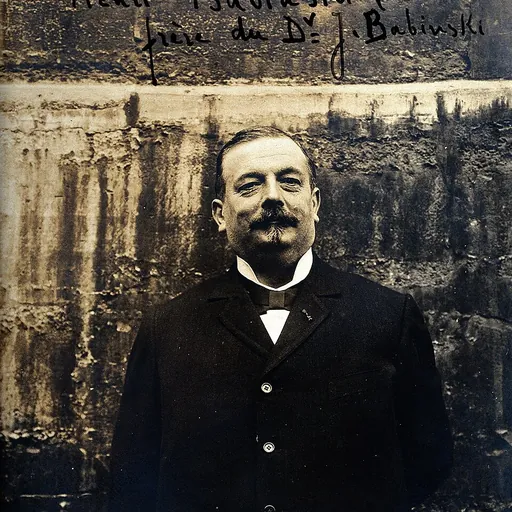
About Henri Babinski
Lived 1855 – 1931 (aged 76). Henri Babinski was a French mining engineer, writer and author.
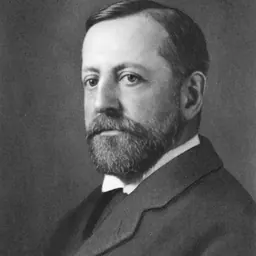
Henri Babinski (2 July 1855 – 20 August 1931), who wrote under the pen-name Ali-Bab, was a French gastronome and food writer. After a successful career as a mining engineer he retired to his native Paris, where he wrote ("Practical Gastronomy").
Born to Polish refugees, Babinski, together with his younger brother Joseph, was educated at the Polish school in Paris. Babinski then studied at the National School of Mines, before working in three continents as a consultant mining engineer. On retirement he joined his brother in a flat in Paris, where he wrote his book. It was his only book, but such was its success that he revised it for four new editions between its first publication in 1907 and 1928, and it ran to more than a thousand pages.
The book was not translated into English until 1974, when it was hailed in The New York Times as a major contribution to gastronomic literature.
Life and career Early years Henri Joseph Séverin Babinski was born in Montparnasse, Paris on 2 July 1855, the elder son of Alexandre Babinski and his wife Henriette, Weren. The couple, originally known as Aleksander and Henryeta, were born and married in Poland and fled to Paris after the Polish uprising in 1848. A younger son, Joseph, was born in 1857. Alexandre found employment working for the Paris municipal authorities as a surveyor-engineer, but in 1863 he returned to Poland to take part in a new uprising, leaving his wife and sons in Paris. The two boys were enrolled at the École polonaise – an establishment later described by Henri as one of ferocious austerity – and, from 1870, at the Lycée René Descartes. Joseph remained there until 1875, receiving his baccalauréat; Henri left before him, entering the (National School of Mines) in 1874.
Mining engineer
Babinski graduated as a civil mining engineer in 1878 and in 1880 started to travel extensively, studying mineral deposits in many countries. He worked in South America, in the Equatorial region; in the western United States; in French Guiana and northern Italy. In 1893, returning to Chile, he set up a system for towing the coal barges through the Strait of Magellan using locally mined coal to power the tugs. In 1896 he went to Brazil to examine diamond mines in the state of Bahia, where he set up a successful mining venture. |
Retirement
After more than twenty years working as a successful mining consultant in places as far apart as Siberia and the Transvaal Babinski retired to Paris. His mother had died in 1897 and his father in 1899, leaving Joseph – by now a leading neurologist – in sole occupation of the family apartment at 170 Boulevard Haussmann. Henri joined him there, and, as a 2009 biography puts it, "Within their bachelor quarters, Henri took the lead, compensating for all the years spent in camping conditions". Another theory is that the name alludes to Babinski's visits to Turkey, drawing on the name of Ali Baba, of the One Thousand and One Nights. In 1960, Elizabeth David wrote of the seventh and final edition, "The proportions and ingredients for every recipe are given, with the precision of a scientist writing a formula, down to the last gramme. It is a remarkable work by any standards; for an amateur cook it is a quite extraordinary achievement".
Ali-Bab divided the book into sections. It opens with a survey of cooking from prehistoric times to the present, in Europe and elsewhere. A section on the principles of cooking, and then sections on stocks and sauces, soups, mushrooms – a long section of 20 pages, wine (all French) and entertaining. There are then sections on menus for luncheons and dinners ranging from the small and informal to large and grand, and then, the bulk of the book, detailed recipes, divided into the familiar sections followed in 19th and 20th-century cookery books: soups, hors d'oeuvres, eggs, seafood, fish, game, meat, poultry, potatoes and other vegetables, desserts, preserves and drinks. The last section deals with diets for overweight gourmands, and received the approval of several medical journals.
His recipes are not exclusively French: they include Italian pasta dishes and risottos, as well as Yorkshire pudding and plum pudding from England, and grog in both American and Indian versions.
After was published, Ali-Bab was dubbed "the Brillat-Savarin of the 20th century". |group=n Craig Claiborne in The New York Times hailed the publication as "An event that is to our minds almost as important as the publication of the English language version of Larousse Gastronomique in 1961". Julia Child wrote, "Ali-Bab is, I think, immediately appealing to anyone who loves cooking because his is the work of a devoted and tremendously well informed amateur chef who is addressing himself to people of like mind. In fact he unhesitatingly assumes that the reader will be glad indeed to go to any reasonable lengths to produce a magnificent dish". |
In London, Truth commented:
Babinski was buried in the in the family tomb. His brother, who died a year later, was also interred there.
Notes, references and sources
Don’t just read it —
keep it.
Full-length biographies made to live with: read them, listen on the way to work, watch them tonight.
- E-book
- Audio
- Video
Instant download · yours to keep · every purchase keeps this site free
Important facts
People in Henri Babinski's life
Named in this biography and alive at the same time


Related people
Same field, nearest in time


Contemporaries
People whose lives overlapped Henri Babinski's




Frequently asked questions
Who was Henri Babinski?
French mining engineer and writer (1855-1931)
When was Henri Babinski born?
Henri Babinski was born on 2 July 1855 in Paris.
When did Henri Babinski die?
Henri Babinski died on 20 August 1931 in Paris.
What was Henri Babinski's occupation?
Henri Babinski was a mining engineer, writer and author.
What nationality was Henri Babinski?
Henri Babinski was French.
Sources & further reading
Cite this page
APA: Biography.guide. (2026). Henri Babinski. https://biography.guide/henri-babinski/
MLA: "Henri Babinski." Biography.guide, https://biography.guide/henri-babinski/.
Chicago: "Henri Babinski." Biography.guide. https://biography.guide/henri-babinski/.
Data last updated: 2026-09-24 · Spot an error? Report a correction.
Portrait: Wikimedia Commons · author & licence
Page generated 2026-09-27 05:08 UTC