
About Henare Tomoana
Lived 1820 – 1904 (aged 83–84). Henare Tomoana was a New Zealand politician.
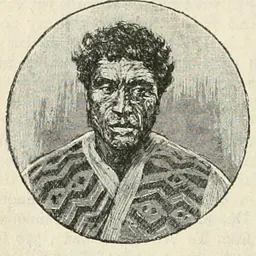
Henare Tomoana (1820/30s – 20 February 1904) was a prominent Māori leader and politician from the Hawke's Bay area in the North Island, New Zealand. He was of Ngāti Kahungunu and Ngāti Te Whatu-i-Apiti tribal lineage. In 1879 he was elected to the New Zealand Parliament for the Eastern Maori electorate, and in 1898 was appointed to the New Zealand Legislative Council. He was a convenor of Te Kotahitanga, the movement for an independent Māori Parliament.
Early life Tomoana was born in the 1820s or early 1830s, probably on the Heretaunga Plains, near the present day city of Hastings. He was the third son of Te Rotohenga (also called Winipere) from her second marriage to Hira Te Ota. Through his mother's first marriage, Tomoana was a younger half-brother of Karaitiana Takamoana and Te Meihana Takihi. His whakapapa links him to Ngāti Hawea as his principal hapu, with connections also to Ngāti Hinetahu, Ngāti Te Rehunga, and Ngāti Hori.
Little is known of Tomoana's early life or education. Around the time of his childhood, several wars were fought to repel invasions of Heretaunga, and many people from that area took refuge at Māhia Peninsula, not returning to Heretaunga until after 1838.
Marriages and children By 1852 Tōmoana had become a Christian, taking the name Hēnare at baptism. The identity of his first wife is unknown, however his second wife, whom he married on 18 October 1852, was Ataneta Rukarei. They had no children. His third wife, Ākenehi Patoka, was a landowner and an important leader in her own right. Together they had 13 children, including Paraire Tomoana, who later became a prominent Māori leader, composer and scholar. Only two of his 13 children survived him.
In 1869, Tomoana again led troops in pursuit of Te Kooti, who was now being pursued in the area around Taupō. On 10 September 1869, he was camped at Tauranga-Taupō with 120 men when Te Kooti's force of about 280 mounted a pre-emptive strike against him. Te Kooti succeeded in capturing Tomoana's horses and much of his equipment, but was forced to retreat under heavy fire. On 25 September, Tomoana joined forces with Hohepa Tamamutu of Ngāti Tūwharetoa, and succeeded in driving Te Kooti from Te Ponanga near Lake Rotoaira. On 4 October, he led the Ngāti Kahungunu contingent against Te Kooti's redoubt at the Battle of Te Pōrere. The battle was a joint effort by Tomoana, Te Keepa Te Rangihiwinui of Te Arawa, and Major Thomas McDonnell who led the government forces. The storming of the redoubt was successful, and Te Kooti was wounded during the battle. Tomoana then returned to Napier due to a lack of supplies.
For his campaigns against Te Kooti, Tomoana (who had been commissioned as a captain of militia) received a Sword of Honour. However, he did not receive regular pay, as the Hawke's Bay superintendent, John Davies Ormond, claimed that the government could not afford it. By this time Tomoana was deeply in debt, at least some of which had been incurred in equipping his troops. By December 1869 he owed more than £3,000. He was subsequently forced to sell his share of the Heretaunga block in order to settle his debt. He had been one of ten chiefs granted joint ownership of the Heretaunga block by the Native Land court. The sale of his share led to the eventual loss of the entire Heretaunga block, where the city of Hastings now stands.
Tomoana's greatest contribution to repudiation was to set up, publish and edit a Māori newspaper called Te Wananga, at Pakowhai. The first issue emerged on 5 August 1874, and it continued, usually weekly, until December 1878. From sometime in 1875 it was edited by John White. The first few numbers, published in Māori only, contained Tomoana's explanations of the paper's purpose. It was hoped to educate its readers about European business practices, and provide contact between Māori and European concepts. The paper discussed land selling and leasing, mortgages, reserves and Crown grants. Controversial land cases were reported, many of which concerned Tomoana.
Don’t just read it —
keep it.
Full-length biographies made to live with: read them, listen on the way to work, watch them tonight.
- E-book
- Audio
- Video
Instant download · yours to keep · every purchase keeps this site free
Important facts
Family & relationships
People in Henare Tomoana's life
Named in this biography and alive at the same time


Related people
Same field, nearest in time



Contemporaries
People whose lives overlapped Henare Tomoana's





Frequently asked questions
Who was Henare Tomoana?
New Zealand politician
When was Henare Tomoana born?
Henare Tomoana was born in 1820 in Heretaunga Plains.
When did Henare Tomoana die?
Henare Tomoana died on 20 February 1904.
What was Henare Tomoana's occupation?
Henare Tomoana was a politician.
What nationality was Henare Tomoana?
Henare Tomoana was New Zealand.
Sources & further reading
Cite this page
APA: Biography.guide. (2026). Henare Tomoana. https://biography.guide/henare-tomoana/
MLA: "Henare Tomoana." Biography.guide, https://biography.guide/henare-tomoana/.
Chicago: "Henare Tomoana." Biography.guide. https://biography.guide/henare-tomoana/.
Data last updated: 2026-09-25 · Spot an error? Report a correction.
Page generated 2026-09-27 05:11 UTC