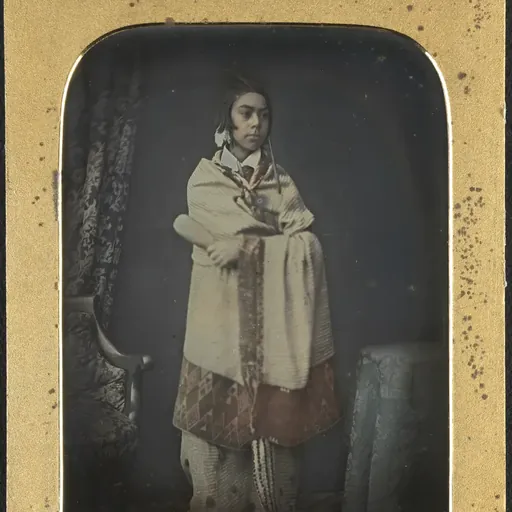
Hemi Pomara
Māori person, of chiefly status, taken to Europe in the mid 1840s
About Hemi Pomara
Born 1830. Hemi Pomara was a New Zealand.
Hēmi Pōmare (born ; sometimes spelled Pomara) was a man of Māori chiefly descent. He was taken to Sydney in the early 1840s, then London in 1845–46, was shipwrecked in Barbados while on a voyage, and then returned to New Zealand in 1847, all while in his youth. A daguerreotype of Pōmare is the oldest known photograph of any Māori person. A novel and a planned film are based on his life.
Early life
Hēmi Pōmare was born in around 1830 or 1831. It was said that he was a grandson of Pōmare Ngātata, a chief of Ngāti Mutunga, an (tribe) who were living around Wellington Harbour at the time. On one occasion, a newspaper report said he was the son of Pōmare Ngātata. One source said that he was "a half-caste", his mother being Māori. according to information collected by Percy Smith, migrated with Ngāti Mutunga to the Chatham Islands in 1835, where he died in 1851. when his family were all killed by a hostile tribe, with his father being eaten by the killers. In December 1846 the unnamed newspaper writer said that Pōmare was "a half-caste", his mother being Māori, and that he was "the adopted son of Mr. David Scott, by whom he was maintained, and at whose expense he was educated at Sydney."
After Angas travelled around New Zealand for three months in 1844, doing sketches and watercolours of Māori and their material culture and customs, and collecting cultural objects,
England and the Caribbean
Departing on the Royal Tar on 10 September 1845, Angas took Pōmare to England, They arrived at Gravesend on 23 February 1846. Angas wrote to editors of the newspapers with one point of correction, saying that he had not been the one who took Pōmare to Sydney. and was introduced to an audience that included Charles Dickens, Charles Darwin, and Antoine Claudet. A woodcut depicting Pōmare was published in The Illustrated London News, 18 April 1846 edition, where he was named as "James Pomara", "a grandson of Pomara, a chief of the Chatham Islands", who "has been educated in New South Wales, speaks English fluently, and is a very intelligent person." The ship departed the Thames on 17 July and arrived at Barbados on 1 September. A gale, the strongest to strike Barbados for some years, arose on 12 September and the wind and waves drove ashore some of the ships that were in the roadstead. The Caleb Angas went onto a reef and was totally destroyed. All those aboard were rescued;
Return to New Zealand By November 1846 it had been decided that Pōmare would return to New Zealand with Edward John Eyre, who had been appointed Lieutenant-Governor and Piri Kawau of Te Āti Awa. The Glentanner arrived in Sydney on 18 June. There they boarded the Pestonjee Bomanjee, which arrived in Auckland on 10 July.
Little or nothing is known of Pōmare after his arrival in Auckland.
Don’t just read it —
keep it.
Full-length biographies made to live with: read them, listen on the way to work, watch them tonight.
- E-book
- Audio
- Video
Instant download · yours to keep · every purchase keeps this site free
Important facts
Frequently asked questions
Who was Hemi Pomara?
Māori person, of chiefly status, taken to Europe in the mid 1840s
When was Hemi Pomara born?
Hemi Pomara was born in 1830.
What nationality was Hemi Pomara?
Hemi Pomara was New Zealand.
Sources & further reading
Cite this page
APA: Biography.guide. (2026). Hemi Pomara. https://biography.guide/hemi-pomara/
MLA: "Hemi Pomara." Biography.guide, https://biography.guide/hemi-pomara/.
Chicago: "Hemi Pomara." Biography.guide. https://biography.guide/hemi-pomara/.
Data last updated: 2026-09-22 · Spot an error? Report a correction.
Portrait: Wikimedia Commons · author & licence
Page generated 2026-09-27 05:01 UTC