
About Hélène Cixous
Born 1937. Hélène Cixous is a French poet, essayist, playwright, scholar of English, women's rights activist and philosopher of language.
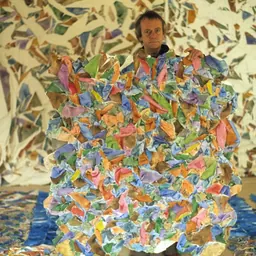
Hélène Cixous ( ; ; born 5 June 1937) is a French writer, playwright and literary critic. During her academic career, she was primarily associated with the Centre universitaire de Vincennes (today's University of Paris VIII), which she co-founded in 1969 and where she created the first centre of women's studies at a European university. Known for her experimental writing style and great versatility as a writer and thinker, she has written more than seventy books dealing with multiple genres: theatre, literary and feminist theory, art criticism, autobiography and poetic fiction. which established her as one of the early thinkers in post-structural feminism. She has collaborated with several artists and directors, such as Adel Abdessemed, Pierre Alechinsky, Simone Benmussa, Jacques Derrida, Simon Hantaï, Daniel Mesguich and Ariane Mnouchkine. She is considered a strong contender for the Nobel Prize in Literature.
Life and career
Personal life Cixous was born in Oran, French Algeria, to Jewish parents, Eve Cixous, née Klein, (1910–2013) and Georges Cixous (1909–1948). Georges Cixous, a physician who had written his dissertation on tuberculosis, died of the disease in 1948. Eve Cixous became a midwife in Algiers following his death, "until her expulsion with the last French doctors and midwives in 1971." and her Doctorat ès lettres in 1968. Her main focus, at this time, was English literature and the works of James Joyce. Cixous became assistante at the University of Bordeaux in 1962, served as maître assistante at the Sorbonne from 1965 to 1967, and was appointed maître de conférence at Paris Nanterre University in 1967.
In 1968, following the French student riots, Cixous was charged with founding the University of Paris VIII, "created to serve as an alternative to the traditional French academic environment." Cixous would, in 1974, found the University's centre for women's studies, the first in Europe.
Publications In 1968, Cixous published her doctoral dissertation L'Exil de James Joyce ou l'Art du remplacement (The Exile of James Joyce, or the Art of Displacement) and the following year she published her first novel, Dedans (Inside), a semi-autobiographical work that won the Prix Médicis. Cixous wrote a book on Derrida titled Portrait de Jacques Derrida en jeune saint juif (Portrait of Jacques Derrida as a Young Jewish Saint). Her reading of Derrida finds additional layers of meaning at a phonemic rather than strictly lexical level. In addition to Derrida and Joyce, she has written monographs on the work of the Brazilian writer Clarice Lispector, on Maurice Blanchot, Franz Kafka, Heinrich von Kleist, Michel de Montaigne, Ingeborg Bachmann, Thomas Bernhard, and the Russian poet Marina Tsvetaeva. Cixous is also the author of essays on artists, including Simon Hantaï, Pierre Alechinsky and Adel Abdessemed to whom she has devoted two books.
Along with Luce Irigaray and Julia Kristeva, Cixous is considered one of the mothers of poststructuralist feminist theory. In the 1970s, Cixous began writing about the relationship between sexuality and language. Like other poststructuralist feminist theorists, Cixous believes that our sexuality is directly tied to how we communicate in society. In 1975, Cixous published her most influential article "Le Rire de la Méduse" ("The Laugh of the Medusa"), which was revised by her, translated into English by Paula Cohen and Keith Cohen, and released in English in 1976.
Accolades and awards Cixous holds honorary degrees from Queen's University and the University of Alberta in Canada; University College Dublin in Ireland; the University of York and University College London in the UK; and Georgetown University, Northwestern University, and the University of Wisconsin–Madison in the USA. In 2008 she was appointed as A.D. White Professor-at-Large at Cornell University until June 2014. On 13 October 2020, Cixous was awarded the Prix de la Principauté by Les Rencontres Philosophiques de Monaco and the Prince Pierre Foundation for her entire body of work and lifetime of achievement.
Influences on Cixous' writing Some of the most notable influences on her writings have been Jacques Derrida, Sigmund Freud, Jacques Lacan and Arthur Rimbaud.
Sigmund Freud Psychoanalyst Sigmund Freud established the initial theories that would serve as a basis for some of Cixous' arguments in developmental psychology. Freud's analysis of gender roles and sexual identity concluded with separate paths for boys and girls through the Oedipus complex and Electra complex, theories of which Cixous was particularly critical. She joined other scholars in positing The Freudian Coverup.
Jacques Derrida Contemporaries, lifelong friends, and intellectuals, Jacques Derrida and Cixous both grew up as French Jews in Algeria and share a "belonging constituted of exclusion and nonbelonging"—not Algerian, rejected by France, their Jewishness concealed or acculturated. In Derrida's family, "one never said 'circumcision' but 'baptism,' not 'Bar Mitzvah' but 'communion.'" Judaism cloaked in Catholicism is one example of the undecidability of identity that influenced the thinker whom Cixous calls a "Jewish Saint". Her book Portrait of Jacques Derrida as a Young Jewish Saint addresses these matters.
Through deconstruction, Derrida appropriated and employed the term logocentrism (which is not his coinage although he adapted it substantially for his needs). This is the concept that explains how Western metaphysics use of language relies on a hierarchical system that values the spoken word over the written word in Western culture. The idea of binary opposition is essential to Cixous' position on language.
Cixous and Luce Irigaray combined Derrida's logocentric idea and Lacan's primary signifier for desire (the phallus), creating the term phallogocentrism. This term focuses on Derrida's social structure of speech and binary opposition as the centre of reference for language, with the phallic being privileged and how women are only defined by what they lack; not A vs. B, but, rather A vs. ¬A (not-A).
In a dialogue between Derrida and Cixous, Derrida said about Cixous: "Helene's texts are translated across the world, but they remain untranslatable. We are two French writers who cultivate a strange relationship, or a strangely familiar relationship with the French language – at once more translated and more untranslatable than many a French author. We are more rooted in the French language than those with ancestral roots in this culture and this land."
Major works "The Laugh of the Medusa" (1975)
Cixous' critical feminist essay "The Laugh of the Medusa", originally written in French as "Le Rire de la Méduse" in 1975, was (after she revised it) translated into English by Paula Cohen and Keith Cohen in 1976.
Don’t just read it —
keep it.
Full-length biographies made to live with: read them, listen on the way to work, watch them tonight.
- E-book
- Audio
- Video
Instant download · yours to keep · every purchase keeps this site free
Important facts
People in Hélène Cixous's life
Named in this biography and alive at the same time





Related people
Same field, nearest in time


Contemporaries
People whose lives overlapped Hélène Cixous's




Frequently asked questions
Who is Hélène Cixous?
French philosopher and writer
When was Hélène Cixous born?
Hélène Cixous was born on 5 June 1937 in Oran.
What is Hélène Cixous's occupation?
Hélène Cixous is a poet, essayist, playwright, scholar of English, women's rights activist and philosopher of language.
What nationality is Hélène Cixous?
Hélène Cixous is French.
Sources & further reading
Cite this page
APA: Biography.guide. (2026). Hélène Cixous. https://biography.guide/helene-cixous/
MLA: "Hélène Cixous." Biography.guide, https://biography.guide/helene-cixous/.
Chicago: "Hélène Cixous." Biography.guide. https://biography.guide/helene-cixous/.
Data last updated: 2026-09-20 · Spot an error? Report a correction.
Page generated 2026-09-27 05:20 UTC