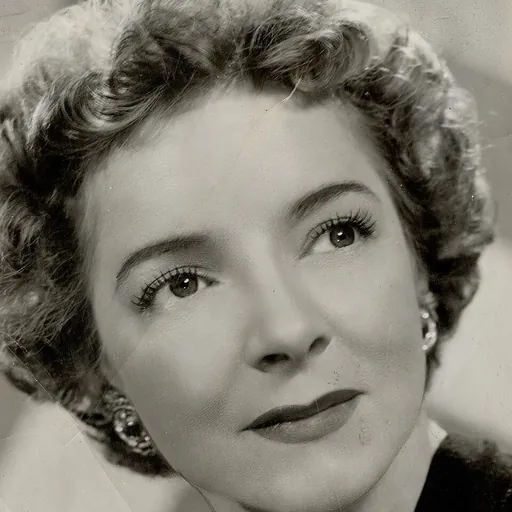
About Helen Hayes
Lived 1900 – 1993 (aged 92). Helen Hayes was an American film actor, autobiographer, stage actor, television actor, ziegfeld girl and actor.
Helen Hayes MacArthur (; October 10, 1900 – March 17, 1993) was an American actress. Often referred to as the "First Lady of American Theatre", she was the second person and first woman to win the EGOT (an Emmy, a Grammy, an Oscar, and a Tony Award), and the first person to win the Triple Crown of Acting. Hayes also received the Presidential Medal of Freedom, America's highest civilian honor, from President Ronald Reagan in 1986. In 1988, she was awarded the National Medal of Arts.
The annual Helen Hayes Awards, which have recognized excellence in professional theatre in greater Washington, D.C., since 1984, are her namesake. In 1955, the former Fulton Theatre on 46th Street in New York City's Theatre District was renamed the Helen Hayes Theatre. When that venue was demolished in 1982, the nearby Little Theatre was renamed in her honor. Helen Hayes is regarded as one of the greatest leading ladies of the 20th-century theatre. Her career spanned 82 years.
A leading philanthropist in later decades, Hayes was most proud of her 49-year association with the Helen Hayes Hospital, a non-profit rehabilitative center overlooking the Hudson River in West Haverstraw, New York.
Early life Helen Hayes Brown was born in Washington, D.C., on October 10, 1900. Her mother, Catherine Estelle "Essie" (née Hayes), was an aspiring actress who worked in touring companies. Her father, Francis van Arnum Brown, worked at a number of jobs, including as a clerk at the Washington Patent Office and as a manager and salesman for a wholesale butcher. Hayes's Catholic maternal grandparents emigrated from Ireland during the Great Famine. Hayes attended Dominican Academy's prestigious primary school, on Manhattan's Upper East Side, from 1910 to 1912, appearing there in The Old Dutch, Little Lord Fauntleroy, and other performances. She attended the Academy of the Sacred Heart Convent in Washington and graduated in 1917.
Career Hayes began a stage career as a five-year-old singer at Washington's Belasco Theatre, on Lafayette Square, across from the White House. By age 10, she had made a short silent film, Jean and the Calico Doll (1910).
Her sound film debut was The Sin of Madelon Claudet, for which she won the Academy Award for Best Actress. She followed that with starring roles in Arrowsmith (with Ronald Colman); A Farewell to Arms (with Gary Cooper); The White Sister (opposite Clark Gable); Another Language (opposite Robert Montgomery); What Every Woman Knows (a reprise of her Broadway hit); and Vanessa: Her Love Story also with Robert Montgomery. But Hayes did not prefer film to the stage.
Hayes eventually returned to Broadway in 1935, where for three years she played the title role in Gilbert Miller's production of Victoria Regina, with Vincent Price as Prince Albert, first at the Broadhurst Theatre and later at the Martin Beck Theatre.
In 1951, she was involved in the Broadway revival of J.M. Barrie's play Mary Rose at the ANTA Playhouse. In 1953, she was the first-ever recipient of the Sarah Siddons Award for her work in Chicago theatre, repeating as the winner in 1969. She returned to Hollywood in the 1950s, and her film star began to rise. She starred in My Son John (1952) and Anastasia (1956), and won the Academy Award for Best Supporting Actress for her role as an elderly stowaway in the disaster film Airport (1970). She followed that up with several roles in Disney films such as Herbie Rides Again, One of Our Dinosaurs Is Missing and Candleshoe. Her performance in Anastasia was considered a comeback — she had suspended her career for several years due to her daughter Mary's death and her husband's failing health.
In 1955, the Fulton Theatre was renamed for her. In the 1980s, business interests wished to raze that theatre and four others to construct a large hotel that included the Marquis Theatre. Hayes's consent to raze the theatre named for her was sought and given, though she had no ownership interest in the building. Parts of the original Helen Hayes Theatre on Broadway were used to construct the Shakespeare Center on the Upper West Side of Manhattan, which Hayes dedicated with Joseph Papp in 1982. In 1983 the Little Theater on West 44th Street was renamed the Helen Hayes Theatre in her honor, as was a theatre in Nyack, which has since been renamed the Riverspace-Arts Center. In early 2014, the site was refurbished and styled by interior designer Dawn Hershko and reopened as the Playhouse Market, a quaint restaurant and gourmet deli.
Hayes, who spoke with her good friend Anita Loos almost daily on the phone, told her, "I used to think New York was the most enthralling place in the world. I'll bet it still is and if I were free next summer, I would prove it." With that, she convinced Loos to embark on an exploration of all five boroughs of New York. They visited and explored the city; Bellevue Hospital at night, a tugboat hauling garbage out to sea, parties, libraries, and Puerto Rican markets. They spoke to everyday people to see how they lived their lives and what made the city tick. The result of this collaborative effort was the book Twice Over Lightly, published in 1972.
It is unclear when or by whom Hayes was called the "First Lady of the Theatre". Her friend, actress Katharine Cornell, also held that title, and each thought the other deserved it. One critic said Cornell played every queen as though she were a woman, whereas Hayes played every woman as though she were a queen.
In 1982, with friend Lady Bird Johnson, she founded the National Wildflower Research Center, now the Lady Bird Johnson Wildflower Center, in Austin, Texas. The center protects and preserves North America's native plants and natural landscapes.
The Helen Hayes Award for theater in the Washington, D.C., area is named in her honor. She has a star on the Hollywood Walk of Fame at 6220 Hollywood Blvd. Hayes is also in the American Theatre Hall of Fame.
Personal life Hayes was a Catholic and a Republican who attended many Republican National Conventions (including the one held in New Orleans in 1988), but she was not as politically vocal as several other Republicans (e.g., Adolphe Menjou, Ginger Rogers, John Wayne, Ronald Reagan, etc.) in the Hollywood community of that time.
Hayes delivered a seconding speech to George H. W. Bush's nomination during the roll call at the 1988 Republican National Convention.
Hayes wrote three memoirs: A Gift of Joy, On Reflection, and My Life in Three Acts. Some of these books' themes include her return to Roman Catholicism (she had been denied communion from the Church for the duration of her marriage to Charles MacArthur, who was a divorced Protestant); and the polio-related death of her 19-year-old daughter, Mary (1930–1949), an aspiring actress. Hayes's adopted son, James MacArthur (1937–2010), had a successful career in acting, including as co-star to Jack Lord in Hawaii Five-O. Hayes guest-starred on Hawaii Five-O in the 1975 episode "Retire in Sunny Hawaii... Forever". She and her son appeared in The Love Boat episode "No Girls for Doc/Marriage of Convenience/The Caller/The Witness".
Hayes was hospitalized a number of times for asthma, which was aggravated by stage dust, forcing her to retire from theater in 1971, at age 71. She spent most of her last years writing and raising money for organizations that fight asthma.
Philanthropy
Hayes was a generous donor of time and money to a number of causes and organizations, including the Riverside Shakespeare Company of New York City. Along with Mildred Natwick, she became a founding member of the company's Board of Advisors in 1981. and in 1985 she returned to the New York stage in a benefit for the company with a reading of A Christmas Carol with Raul Julia, Len Cariou, Mary Elizabeth Mastrantonio, Carole Shelley, Celeste Holm and Harold Scott, directed by W. Stuart McDowell. The next year Hayes performed a second benefit for the Riverside Shakespeare Company, this time at the Marquis Theatre, the construction of which had been made possible by the demolition of the Helen Hayes Theatre three years before. The production featured Rex Smith, Ossie Davis and F. Murray Abraham, and was produced by McDowell and directed by Robert Small, with Hayes narrating.
Helen Hayes Hospital
According to her daughter-in-law, HB MacArthur, Hayes took the most pride in her philanthropic work with Helen Hayes Hospital, a physical rehabilitation hospital located in West Haverstraw, New York. She was extremely proud of the strides the hospital made toward the rehabilitation of people with disabilities, saying: "I've seen my name in lights on theater marquees and in letters 20 feet tall on Broadway billboards, but nothing has ever given me greater sense of pride and satisfaction than my 49-year association with this unique hospital."
Hayes became involved with the hospital in the 1940s and was named to the Board of Visitors in 1944. In 1974, the hospital was renamed in her honor. She served on the Helen Hayes Hospital Board of Visitors for 49 years, until her death in 1993. In that time, she advocated tirelessly for the hospital and successfully led a fight to prevent its relocation to Albany in the 1960s. In the 1970s, she was instrumental in lobbying for funding to transform the hospital into a state-of-the-art facility.
Hayes also contributed her enthusiastic support to hospital events and fund-raising efforts, including handing out diplomas to the children upon graduation when the hospital was still a pediatric care facility. She also faithfully attended the hospital's annual Classic Race, leading it in a classic car, handing out awards to runners, hand cyclists, and wheelchair racers, and offering the use of her home, Pretty Penny, for a dinner to launch the hospital's endowment fund. Hayes was interred in Oak Hill Cemetery in Nyack
Acting credits Theatre
Film Year Film Role Notes 1910 Jean and the Calico Doll and one subsequent Vitagraph film Juvenile lead 1917 The Weavers of Life Peggy 1928 The Dancing Town Olive Pepperall Short subject 1931 The Sin of Madelon Claudet Madelon Claudet Academy Award for Best Actress Volpi Cup for Best Actress Arrowsmith Leora Arrowsmith 1932 A Farewell to Arms Catherine Barkley The Son-Daughter Lian Wha 'Star Blossom' 1933 The White Sister Angela Chiaromonte Another Language Stella 'Stell' Hallam Night Flight Madame Fabian 1934 Crime Without Passion Extra in hotel lobby Uncredited This Side of Heaven Actress on screen in theatre Uncredited What Every Woman Knows Maggie Wylie 1935 Vanessa: Her Love Story Vanessa Paris 1938 Hollywood Goes to Town Herself, uncredited Short subject 1943 Stage Door Canteen Herself 1952 My Son John Lucille Jefferson 1953 Main Street to Broadway Herself 1956 Anastasia Dowager Empress Maria Feodorovna Nomination- Golden Globe Award for Best Actress in a Motion Picture – Drama 1959 Third Man on the Mountain Tourist Uncredited 1961 The Challenge of Ideas Narrator Short subject 1970 Airport Ada Quonsett Academy Award for Best Supporting Actress 1974 Herbie Rides Again Mrs. Steinmetz Nomination - Golden Globe Award for Best Actress – Motion Picture Comedy or Musical 1975 One of Our Dinosaurs Is Missing Hettie 1977 Candleshoe Lady Gwendolyn St. Edmund 1987 Divine Mercy: No Escape Narrator Final film role
Television
Awards and honors Year Award Category Nominated work Result 1931 Academy Awards Best Actress The Sin of Madelon Claudet 1970 Best Supporting Actress Airport 1956 Golden Globe Awards Best Actress in a Motion Picture – Drama Anastasia 1974 Best Actress – Motion Picture Comedy or Musical Herbie Rides Again 1977 Grammy Awards Best Spoken Word Album Great American Documents 1980 Orson Welles & Helen Hayes at Their Best 1951 Primetime Emmy Awards Best Actress 1952 1953 1958 Best Single Performance by an Actress The Alcoa Hour 1959 The United States Steel Hour 1972 Do Not Fold, Spindle or Mutilate 1974 Best Actress in a Limited Series The Snoop Sisters 1976 Outstanding Single Appearance in a Drama or Comedy Series Hawaii Five-O 1978 Outstanding Lead Actress in a Drama or Comedy Special A Family Upside Down 1947 Tony Awards Best Actress in a Play Happy Birthday 1958 Time Remembered 1970 Harvey 1980 Lawrence Langer Award
Brandeis University granted Hayes an honorary doctorate in 1964.
Hayes was in the inaugural class of inductees to the American Theater Hall of Fame in 1972.
In 1972, she received the Golden Plate Award of the American Academy of Achievement. The following year, in 1973, Hayes was inducted into the National Women's Hall of Fame. In 1979, the Supersisters trading card set was produced and distributed; one of the cards featured Hayes's name and picture. In 1983, Hayes received the Award for Greatest Public Service Benefiting the Disadvantaged, an award given out annually by Jefferson Awards. In 1979, she received the Laetare Medal from the University of Notre Dame.
Don’t just read it —
keep it.
Full-length biographies made to live with: read them, listen on the way to work, watch them tonight.
- E-book
- Audio
- Video
Instant download · yours to keep · every purchase keeps this site free
Important facts
Family & relationships
People in Helen Hayes's life
Named in this biography and alive at the same time




Related people
Same field, nearest in time


Contemporaries
People whose lives overlapped Helen Hayes's


Frequently asked questions
Who was Helen Hayes?
American actress (1900–1993)
When was Helen Hayes born?
Helen Hayes was born on 10 October 1900 in Washington, D.C..
When did Helen Hayes die?
Helen Hayes died on 17 March 1993 in Nyack.
What was Helen Hayes's occupation?
Helen Hayes was a film actor, autobiographer, stage actor, television actor, ziegfeld girl and actor.
What nationality was Helen Hayes?
Helen Hayes was American.
Sources & further reading
Cite this page
APA: Biography.guide. (2026). Helen Hayes. https://biography.guide/helen-hayes-film-actor/
MLA: "Helen Hayes." Biography.guide, https://biography.guide/helen-hayes-film-actor/.
Chicago: "Helen Hayes." Biography.guide. https://biography.guide/helen-hayes-film-actor/.
Data last updated: 2026-09-20 · Spot an error? Report a correction.
Page generated 2026-09-27 05:10 UTC