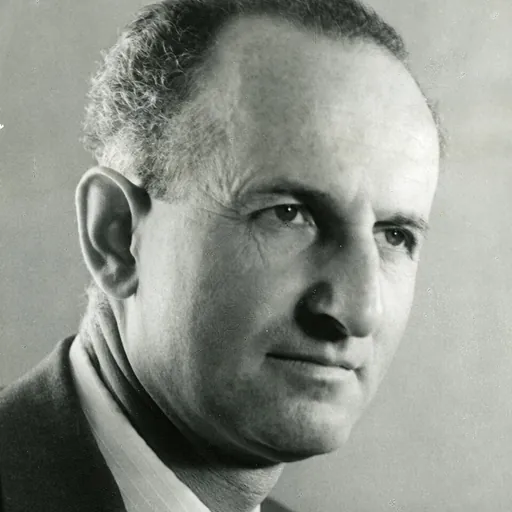
About Heinz Steinitz
Lived 1909 – 1971 (aged 62). Heinz Steinitz was an Israeli marine biologist, ichthyologist, herpetologist, university teacher and zoologist.
Three professors of the Department of Zoology, The Hebrew University, Jerusalem, 1955. From left to right: Herpetologist and paleontologist Georg Haas, geneticist Elisabeth Goldschmidt and Heinz Steinitz. Three colleagues of Heinz Steinitz. From left to right: Dr. Otto H. Oren, Prof. Eugenie Clark, Prof. Adam Ben-Tuvia, 1962 Marine Biology Laboratory near Eilat, 1969. Courtesy of Dr. D. Darom The Interuniversity Institute for Marine Sciences (IUI) near Eilat, 2016. Courtesy of Prof. Amatzia Genin Heinz Steinitz (; April 26, 1909 – April 28, 1971) was a senior Israeli marine biologist and herpetologist, Professor and Chairman of the Department of zoology at the Hebrew University in Jerusalem. He laid the foundation for research and teaching in marine biology and oceanography in Israel. In 1968 he founded the Marine Biology Laboratory of the Hebrew University near Eilat, serving as its first director. He also served as a founding member of the Zoological Society of Israel and a co-founder of the Society for the Protection of Nature in Israel.
Biography Heinz Steinitz was born in Breslau, German Empire (now Wrocław, Poland) on April 26, 1909, to Walter Steinitz (1882–1963), a cardiologist and zoologist, and Marta Schindler Steinitz (1885–1926). He grew up in Breslau and was greatly inspired by his father to study science and to be an active Zionist. He studied medicine from 1927 to 1933 in the universities of Breslau, Freiburg and Berlin. Although he passed the Medical Board examination in 1933, and would have started work in a hospital in Berlin and in the Jewish hospital in Breslau, he was prohibited from practicing by the Nazi regime which came to power that same year. Together with his wife Ruth Aber Steinitz (1907–1995), a medical student as well, he left Germany in 1933 and immigrated to Palestine. eventually became the experimental basis for his doctoral thesis. In 1938, Steinitz was the first to obtain a Ph.D. degree in zoology at the Hebrew University of Jerusalem, and he took his place in the founders and pioneers of zoology in Israel. The Hebrew University, the first university in Israel, was established only a decade before Steinitz's arrival in Jerusalem; thus, his academic career parallels the early history of zoology research and teaching in the Israeli academia.
In the first decade of his career, including the years of World War II, he acted in the department as a teaching and research assistant, and concurrently, during 1943–1946, he lectured zoology at the Kibbutzim College of Education. Other research interests included experimental embryology, neurohistology, and anatomical microscopy of the amphibian eye. Geographically, his studies were conducted along the Syrian-African Great Rift valley, from Lake Hula and Lake Kinneret (The Sea of Galilee) in the north of Israel, through the Dead Sea in the center of the country, down to the Gulf of Eilat and the Red Sea in the south. Other parts of his work were carried out in the south east Mediterranean Basin and along the coasts of the Sinai Peninsula. In 1940, the two researchers discovered the rare Hula painted frog (Latonia nigriventer), the only living member of the genus Latonia, an amphibian endemic to the Hula marshes. Lake Hula and its marshland were drained in the 1950s. The frog, considered to be extinct for about half a century due to the destruction of its habitat, was rediscovered in 2011. It is considered a living fossil, and it is included in the list of endangered species. Steinitz also explored fish species living in the unique ecological niche of Ein Feshkha. This site — the deepest continental point on Earth — is a saline wetland in the desert, on the northwestern shore of the Dead Sea, nourished by a spring of brackish water. Fish in this special habitat evolved isolated from fish populating other habitats.
On a first study of the southeast Mediterranean Basin, published in 1947 jointly with Prof. Georg Haas, they observed fish of Indo-Pacific origin. Later, Steinitz published dozens of papers on fish, the fauna and the ecology of the southeast Mediterranean Sea and the Red Sea. In 1967, together with Dr. William Aron from the Smithsonian Institution in Washington DC, Steinitz launched a joint program on the role of the Suez Canal as a waterway for the passage of marine species between the Red Sea and the Mediterranean Sea. The phenomenon of the continuous flow of marine biota across the Suez Canal is termed Lessepsian migration. To this day, hundreds species native to the Red Sea have been identified in the Mediterranean Sea, and probably others are yet unidentified. This human-mediated invasion has significantly impacted the Mediterranean ecosystem and endangered many local and endemic Mediterranean species.
Steinitz carried out research on a number of fish families, among them the Blenniidae, Cichlidae and Cyprinodontidae . He published nearly sixty papers in his different research fields, including on the discovery of fish new to science like the Kinneret-Sardine Acanthobrama terraesanctae, Garra Barreimiae (together with Henry Weed Fowler), and Tristramella sacra intermedia (together with A. Ben-Tuvia). Some of his publications appeared in special platforms he initiated and edited like the Contributions to the Knowledge of the Red Sea, Israel South Red Sea Expedition Scientific Reports, and Contributions to the Knowledge of Lake Tiberias. Together with Otto Haim Oren he published a Regional Bibliography of the Mediterranean coast of Israel and the adjacent Levant countries and Bibliography on Lake Kinnereth (Lake Tiberias).
Research-supporting activities
Parallel to research and teaching at the university, Steinitz was involved in three types of research-supporting long term pursuits: (a) Participation, organization and management of scientific expeditions; (b) building-up and curation of a fish collection; (c) planning, founding and managing a marine research station near Eilat.
Scientific expeditions
In his earliest expeditions, in 1938–1940, Steinitz explored the fauna of Lake Hula and its surrounding marshland. Immediately following the outbreak of the Suez Crisis of 1956, Steinitz organized and headed an expedition examining the marine fauna along the Red Sea coasts of the Sinai Peninsula and the Suez Canal. In 1962 he led the first Israeli South Red Sea Expedition (ISRSE) which was based on the islands of the Dahlak Archipelago of Eritrea. The ISRSE was part of the first International Indian Ocean Expedition (IIOE) from 1962 to 1965. It was an interdisciplinary marine sciences research effort to survey the south Red Sea and to collect biological specimens and data from the region. Otto Haim Oren from the Haifa Sea Fishery Research Station and Lev Fishelson from the Tel Aviv University, both at that time doctoral students of Steinitz, assisted in organizing the project. The expedition team included a crew of researchers from universities and research institutes in Israel, as well as scientists from the Netherlands, USA and Ethiopia. Steinitz added specimens from the very beginning of his work in the department. During the 1950s, the collection of fish specimens was carried out also by Prof. Adam Ben-Tuvia from the Sea Fishery Research Station in Haifa, a former student of Steinitz. A considerable augmentation of the collection occurred with the harvest of the expeditions to Sinai in 1956 and the Israeli South Red Sea Expeditions in the 1960s, when over 3,000 lots of fish were deposited. The taxonomic and zoogeographic identification of specimens was often conducted by correspondence between Steinitz and ichthyologists and curators of research institutes and science museums around the world. As a consequence, the collection became recognized as having major international importance, serving as a reference collection for the international community of ichthyologists.
A special facet of Steinitz's international activities was building-up contacts and collaborations with West Germany's scientists, institutions and organizations. He commenced doing so years prior to the establishment, in 1965, of diplomatic relations between Germany and Israel. In 1946, working on the fish collection, he exchanged information and biological material with the German zoologist and geneticist Curt Kosswig. Prof. Kusswig emigrated in 1937 from Nazi Germany to Turkey, where he established the Department of Zoology at the Istanbul University. He returned to West Germany in 1955, was appointed head of the Zoological Institute and the Zoological Museum of the University of Hamburg, and visited Steinitz at the Hebrew University of Jerusalem. From the early 1960s Steinitz was invited several times to visit as a guest professor at the University of Hamburg and other German universities. He also visited and tied connections with museums of science, zoological museums and marine biology research stations in West Germany. He became acquainted with Dr. Günther Böhnecke, an oceanographer who played a central role after World War II in rehabilitating Germany's scientific relationships with countries worldwide. Dr. Böhnecke was an advisor to the German Research Foundation, the Deutsche Forschungsgemeinschaft (DFG), in the field of oceanography. The personal acquaintance and mutual appreciation between Steinitz and Böhnecke led to the support by the DFG for building and operating a marine biology laboratory near Eilat.
Founding a marine biology research laboratory near Eilat
Doctor Walter Steinitz, father of Heinz Steinitz, published in 1919 his vision and proposal to establish a marine biology research station on the Mediterranean coast of Palestine. The Hebrew University, and scholars in Palestine and in other countries, supported the plans of the project, but attempts to raise funds for it failed. Inspired by his father's vision, Heinz Steinitz resumed the effort to carry out the concept. However, he decided in the 1950s that the station would be better situated if it were built on the coast of the Red Sea, in the Gulf of Eilat (Gulf of Aqaba). He had three reasons for this preferred location: (a) Being by that time knowledgeable about the marine life in both the Mediterranean Sea and the Red Sea, Heinz Steinitz recognized the higher richness and the notable biodiversity of the latter, which still remained widely uninvestigated. (b) First reports about the presence of fishes of Indo-Pacific origin in the eastern Mediterranean Sea began to appear in the beginning of the twentieth century. Indo-Pacific fishes were also observed along the coast of Palestine for the first time by Walter Steinitz. The findings were indicative for intrusion of alien fishes into the eastern Mediterranean Sea via the Suez Canal that was constructed and opened only several decades prior to those first observations. Heinz Steinitz believed that a research base in the Golf of Eilat would be best placed to conduct investigations into the phenomenon of migration of marine biota from the Indian Ocean and the Red Sea (a northern branch of the Indian Ocean) through the Suez Canal to the Mediterranean Sea. Furthermore, a marine station in the Gulf of Eilat would facilitate analysis of the environmental and ecological changes resulting from man-made connection between the two global water bodies. (c) Polluting spills from the cities of Eilat and Aqaba into the Gulf waters, and pollutants discharged by ships and oil tankers that traffic along the Red Sea and cross the Suez Canal, constituted environmental perils. The marine research station staff in Eilat would be able to monitor impacts of anthropogenic activities on ecological processes and on the very sensitive marine ecosystems of the region.
In preparation for the construction of the marine research station, Steinitz visited during the 1950s and the 1960s dozens of oceanographic research stations and marine aquariums in Europe, the US and in the Caribbean Islands in order to learn from other's experience managing such facilities. Since the Gulf of Eilat is in the geographical periphery of Israel and remote from any academic center, and considering that the Israeli nucleus of marine biologists was at that time still very small, Steinitz developed relationships with colleagues abroad and convinced them to come and conduct some of their research in the planned station. He also reinforced the local station's research and management staff with an international scientific advisory board of oceanographers from Europe, Australia and the US in order to strengthen and sustain the nascent activity. In this way he guaranteed that the laboratory, from its inception, would be run at levels meeting international standards.
Steinitz received support and collaboration for his initiative from colleagues at other Israeli universities and research institutions, from the Israel Oceanographic and Limnology Research (IOLR) and from the German Research Foundation (DFG). The vision of Walter Steinitz was ultimately realized in 1968, five years after he died, when the Marine Biology Laboratory (MBL) of The Hebrew University near Eilat was inaugurated. Launching the laboratory was a peak in the career of Heinz Steinitz as an Israeli zoologist and as an internationally recognized senior marine biologist. He died in 1971 while being the first director of the laboratory; in his honor, the laboratory was renamed The Heinz Steinitz Marine Biology Laboratory.
In 1965 Steinitz became member of the Israel Academy of Sciences and Humanities, and of the Academy's committee publishing the Fauna of Israel.
He was co-editor of the Bulletin of the Sea Fisheries Research Station in Haifa, and a board member of Bamidge, the journal of Israel's fishery research and development.
Honors
The national and international reputation of Heinz Steinitz is reflected by names in his honor given to more than twenty newly discovered fishes, marine organisms and amphibians, listed in the Biographical Etymology of Marine Organism Names. Some names were given years after he died.
The fish species Tylognathus steinitziorum (discovered and named by Dr. Curt Kosswig in 1950, now called Hemigrammocapoeta nana) was dedicated to Walter Steinitz and his son Heinz Steinitz.
Animal species named after Heinz Steinitz include: The wasp Aphanogmus steinitzi (Priesner, 1936); The mole crab Albunea steinitzi (Holthuis, 1958) (Lipke Holthuis); Elasmopus steinitzi (Ruffo, 1959); The isopod crustacean Typhlocirolana steinitzi (Strouhal, 1961); The sea cucumber Bohadschia steinitzi (Cherbonnier, 1963); Pseudocyclops steinitzi (Por, 1968); The worm Hydroides steinitzi (Ben-Eliahu, 1972); The combtooth blenny Istiblennius steinitzi (Lotan, 1969) (synonym of Istiblennius flaviumbrinus (Rüppell, 1830)); The scorpion fish Scorpaenodes steinitzi Klausewitz & Frøiland, 1970; Steinitz's goby Gammogobius steinitzi (Bath, 1971); The Flashlight Fish Photoblepharon steinitzi (T. Abe & Haneda, 1973); Steinitz' prawn goby Amblyeleotris steinitzi (Klausewitz, 1974); The Combtooth Blenny Omobranchus steinitzi (V. G. Springer & M. F. Gomon, 1975); Cocotropus steinitzi (Eschmeyer & Dor, 1978); The Red Triplefin Blenny Helcogramma steinitzi (Clark, 1980); Rubratella steinitzi (Pawlowski & Lee, 1991); a synonym of H. japonica that has been apparently introduced into Israel.
Don’t just read it —
keep it.
Full-length biographies made to live with: read them, listen on the way to work, watch them tonight.
- E-book
- Audio
- Video
Instant download · yours to keep · every purchase keeps this site free
Important facts
People in Heinz Steinitz's life
Named in this biography and alive at the same time






Related people
Same field, nearest in time


Contemporaries
People whose lives overlapped Heinz Steinitz's



Frequently asked questions
Who was Heinz Steinitz?
Israeli biologist (1909–1971)
When was Heinz Steinitz born?
Heinz Steinitz was born on 26 April 1909 in Wrocław.
When did Heinz Steinitz die?
Heinz Steinitz died on 28 April 1971 in Jerusalem.
What was Heinz Steinitz's occupation?
Heinz Steinitz was a marine biologist, ichthyologist, herpetologist, university teacher and zoologist.
What nationality was Heinz Steinitz?
Heinz Steinitz was Israeli.
Sources & further reading
Cite this page
APA: Biography.guide. (2026). Heinz Steinitz. https://biography.guide/heinz-steinitz/
MLA: "Heinz Steinitz." Biography.guide, https://biography.guide/heinz-steinitz/.
Chicago: "Heinz Steinitz." Biography.guide. https://biography.guide/heinz-steinitz/.
Data last updated: 2026-09-22 · Spot an error? Report a correction.
Portrait: Wikimedia Commons · author & licence
Page generated 2026-09-27 05:04 UTC