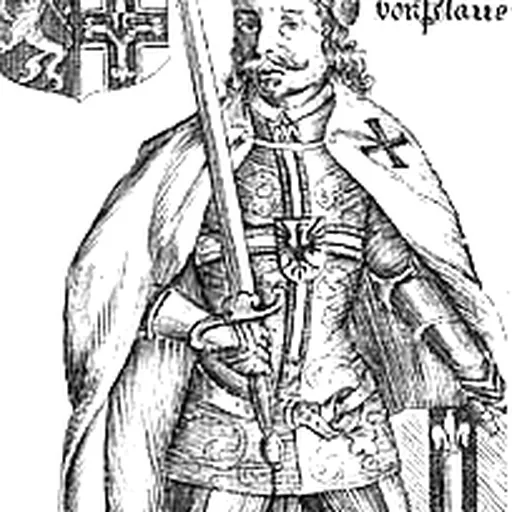
Heinrich von Plauen
Grand Master of the Teutonic knights
About Heinrich von Plauen
Lived 1370 – 1429 (aged 58–59). Heinrich von Plauen was a German.
Heinrich von Plauen (the Elder) ( – 1429) was the 27th Grand Master of the Teutonic Knights, serving from November 1410 to October 1413. Having becoming grandmaster in the wake of the Battle of Grunwald, he was a stern proponent of prolonging the war with Lithuania and Poland. Because all male members of his family were baptized as Heinrich (Henry), he is sometimes known as Heinrich von Plauen the Elder to differentiate from his relative, Heinrich von Plauen the Younger (died ca. 1441).
Early career Von Plauen was born in Vogtland, between Thuringia and Saxony around 1370. He arrived in Prussia around 1390 as the Order's guest, but later became a full member. He did not hold any important positions until 1402 when he became the Komtur of Nessau (Nieszawa). He was promoted to Komtur of Schwetz (Świecie) in 1407.
Von Plauen did not take part in the Battle of Grunwald on 15 July 1410. Upon receiving the news of the Order's defeat, he took the initiative and assembled an army of 3,000 men to defend Marienburg, the capital of the Order. Von Plauen arrived at Marienburg on time and energetically organized the defense. The Siege of Marienburg started on 26 July and remained until 19 September 1410. The King of Poland, Jogaila, did not expect strong resistance and was not prepared for a long-term siege. The siege, holding Jogaila's army in place, helped to organize defensive forces in other parts of Prussia and gave time for relief to arrive from the Livonian Order and Germany. Jogaila had to retreat. Von Plauen ordered his forces to pursue the retreating Polish army and recaptured all fortresses (except those on the Polish–Prussian border) by the end of October.
In November 1410 for his services in the defense of Marienburg and Prussia, von Plauen was chosen as the 27th Grand Master of the Order, overtaking other officials of the Order with higher positions, like Werner von Tettingen, the Order's Minister of Diplomacy and the Komtur of Elbing (Elbląg), who fought in the Battle of Grunwald. Von Plauen inherited a difficult task of rebuilding Order's fortresses, restoring the economy, recruiting new Knights, and defending the Order's reputation in Europe.
Grand Master
Von Plauen's major diplomatic accomplishment was signing the Peace of Thorn on 1 February 1411. The peace was rather favorable to the Order: it retained its core territories. The Order assigned Samogitia to Grand Duke of Lithuania Vytautas the Great for his and Jogaila's lifetime.
To raise the money for the first installment, von Plauen called representatives of Prussian cities to Osterode (Ostróda) in February 1411. Von Plauen decided to enforce the assessment. Thorn capitulated without much resistance, while Danzig resisted blockade until 5 April 1411.
Von Plauen actively fought off the opposition of the Lizard Union. In 1411 von Plauen discovered a plot by Georg von Wirsberg, Komtur of Rehden (Radzyń Chełmiński), and ordered the beheading of Nicholas von Renys, one of the four knights who formed the Lizard Union, for helping the Poles. The execution took place in Graudenz (Grudziądz), which brought him even less popularity.
The first two installment payments were made on time. When von Plauen saw that he could not make the third payment on time he asked Sigismund, Holy Roman Emperor for help. Sigismund agreed to mediate and the parties met in Breslau (Wrocław) in March 1412. In August 1412 the emperor delivered his decision that the Peace of Thorn was just and that a commission should negotiate a reduction to the war indemnity. Another commission would decide the border between Samogitia and Prussia and inhabitants of the region would be given a choice to remain in Samogitia and become part of the Grand Duchy of Lithuania or to relocate to Prussia and become part of the monastic state of the Teutonic Knights. To universal surprise von Plauen made the final payment on time in January 1413. The commission regarding Samogitian borders did meet. On 3 May 1413 Benedict Makrai, appointed by Sigismund, decided that the right bank of the Neman River, including Memel (Klaipėda), should belong to Lithuania.
Despite the Order's financial troubles and weakened military capability after the defeat of 1410, von Plauen started preparations for another war with the Kingdom of Poland. He rejected decision by Benedict Macra and by late summer 1413 gathered 6,000 men near the border with Pomerania and 15,000 on the border with Dobrzyń Land and Masovia (commended by Michael Küchmeister von Sternberg). The time seemed right as Jogaila was busy in the south while Vytaut waged a war against Novgorod. Küchmeister attacked northern Poland, but returned only after 16 days. Attack on Pomerania was similarly stopped by disobedient Knights.
Removal from office Von Plauen was removed from his office on 9 October 1413 by Michael Küchmeister von Sternberg, the Grand Marshal and Komtur of Königsberg (Kaliningrad). Küchmeister disapproved of von Plauen's decision to wage another war and supported further peace talks with the Kingdom of Poland and the Grand Duchy of Lithuania. The general chapter convened five days later. Herman Gans was appointed as an interim Grand Master until a formal general assembly would meet in January 1414. Von Plauen officially resigned and Küchmeister was appointed as the next Grand Master. Von Plauen was first appointed as a Komtur to a minor fortress, but was soon arrested when Jogaila did not support the new regime and demanded the return of von Plauen to his office. Küchmeister unsuccessfully reopened diplomatic talks with Poland and a brief Hunger War broke out in summer 1414.
Heinrich von Plauen was released from Danzig jail in 1418. At that time he became the procurator of Lochstädt (Pavlovo) near Königsberg, where he died in 1429.
Don’t just read it —
keep it.
Full-length biographies made to live with: read them, listen on the way to work, watch them tonight.
- E-book
- Audio
- Video
Instant download · yours to keep · every purchase keeps this site free
Important facts
People in Heinrich von Plauen's life
Named in this biography and alive at the same time




Contemporaries
People whose lives overlapped Heinrich von Plauen's



Frequently asked questions
Who was Heinrich von Plauen?
Grand Master of the Teutonic knights
When was Heinrich von Plauen born?
Heinrich von Plauen was born in 1370 in Vogtland.
When did Heinrich von Plauen die?
Heinrich von Plauen died in 1429 in Castle of Lochstädt.
What nationality was Heinrich von Plauen?
Heinrich von Plauen was German.
Sources & further reading
· Wikipedia: Heinrich von Plauen
· DBpedia: Heinrich von Plauen
Cite this page
APA: Biography.guide. (2026). Heinrich von Plauen. https://biography.guide/heinrich-von-plauen/
MLA: "Heinrich von Plauen." Biography.guide, https://biography.guide/heinrich-von-plauen/.
Chicago: "Heinrich von Plauen." Biography.guide. https://biography.guide/heinrich-von-plauen/.
Data last updated: 2026-09-20 · Spot an error? Report a correction.
Portrait: Wikimedia Commons · author & licence
Page generated 2026-09-27 04:58 UTC