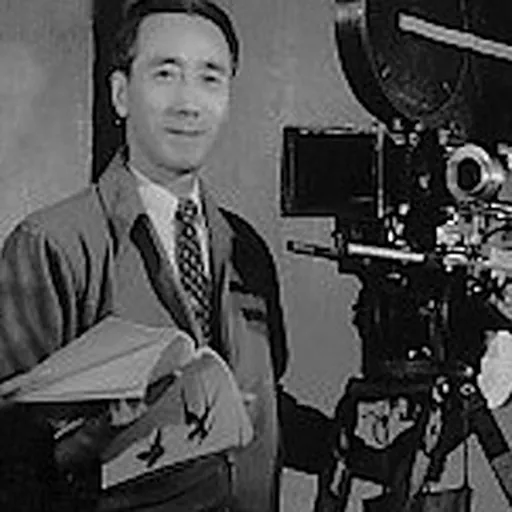
About Heinosuke Gosho
Lived 1902 – 1981 (aged 79). Heinosuke Gosho was a Japanese film director and screenwriter.
was a Japanese film director and screenwriter who directed Japan's first successful sound film, The Neighbor's Wife and Mine, in 1931. His films are mostly associated with the shōshimin-eiga (lit. "common people drama") genre. Among his most noted works are Where Chimneys Are Seen, An Inn at Osaka, Takekurabe and Yellow Crow.
Life Gosho was born on January 24, 1902, in Kanda, Tokyo, to merchant Heisuke Gosho and his father's geisha mistress. At the age of five, after Heisuke's eldest son died, Gosho left his mother to be the successor to his father's wholesale business. He studied business at Keio University, graduating in 1923. Together with Shirō Toyoda, Gosho was one of the first directors to adapt the works of the junbungaku ("pure literature") movement for the screen, which opposed "popular" literature in favour of "serious" literature and a more complex handling of its subjects. A prominent example is The Dancing Girl of Izu (1933), a successful adaptation of Yasunari Kawabata's story of the same name, about the unfulfilled love between a student and a young country woman. Of his 36 1930s films, only slightly more than a half-dozen are extant. His best-known works of this era are the social realist marriage drama Where Chimneys Are Seen (1953), which was shown in competition at the Berlin International Film Festival, and Yellow Crow (1957), the portrait of a troubled father-son-relationship, which received the Golden Globe Award for Best Foreign Language Film. Although his films grew darker in tone by the mid-1950s, evident in works like An Inn at Osaka, about a group of Osaka residents struggling with an unrestrained materialistic environment, he stayed true to his ideals of "tolerance, compromise and rationality". Although having repeatedly worked with internationally known actresses and actors like Kinuyo Tanaka, few of his films have been seen in the Western world. In 1989–1990, a retrospective of his work was held by the Japan Society and the Museum of Modern Art, New York.
Selected filmography Year English Title Japanese Title Romanisation Alternate titles 1930 Record of Love and Desire 愛慾の記 Aiyoku no kiDesire of Night 1931 The Neighbor's Wife and Mine マダムと女房 Madamu to nyōbō 1933 The Dancing Girl of Izu 恋の花咲く 伊豆の踊子 Koi no hana saku Izu no odoriko 1934 Everything That Lives 生きとし生けるもの Ikitoshi ikeru mono 1935 Burden of Life 人生のお荷物 Jinsei no onimotsu Somniloquy of the Bridegroom 花婿の寝言 Hanamuko no negoto Song of the Flower Basket 花籠の歌 Hanakago no uta 1936 Woman of the Mist 朧夜の女 Oboroyo no onna The New Road (Part one) 新道前篇 Shindō zenhen The New Road (Part two) 新道後篇 Shindō kōhen 1940 Incompatible Relations 木石 Bokuseki 1942 New Snow 新雪 Shinsetsu 1947 Once More 今ひとたびの Ima hitotabi no 1951 Dispersed Clouds わかれ雲 Wakare-gumo 1953 Where Chimneys Are Seen 煙突の見える場所 Entotsu no mieru bashoFour Chimneys 1954 An Inn at Osaka 大阪の宿 Ōsaka no yado The Valley Between Love and Death 愛と死の谷間 Ai to shi no tanima The Cock Crows Twice 鶏はふたゝび鳴く Niwatori wa futatabi naku 1955 Growing Up たけくらべ TakekurabeAdolescence Growing Up Twice a.k.a. Child's Play 1956 Twice on a Certain Night ある夜ふたたび Aru yo futatabi 1957 Yellow Crow 黄色いからす Kiiroi karasu Elegy of the North 挽歌 BankaNorthern Elegy a.k.a. Dirge 1958 Ragpicker's Angel 蟻の街のマリア Ari no machi no Maria 1961 Hunting Rifle 猟銃 Ryōju As the Clouds Scatter 雲がちぎれる時 Kumo ga chigireru toki 1962 Mother, Get Married かあちゃん結婚しろよ Kaachan kekkon shiroyo 1965 An Innocent Witch 恐山の女 Osorezan no onna 1966 Our Wonderful Years かあちゃんと11人の子ども Kaachan to jūichinin no kodomo 1967 Rebellion of Japan 宴 Utage 1968 A Woman and the Beancurd Soup 女と味噌汁 Onna to Misoshiru Four Seasons of the Meiji Period 明治春秋 Meiji haru aki
Don’t just read it —
keep it.
Full-length biographies made to live with: read them, listen on the way to work, watch them tonight.
- E-book
- Audio
- Video
Instant download · yours to keep · every purchase keeps this site free
Important facts
People in Heinosuke Gosho's life
Named in this biography and alive at the same time

Related people
Same field, nearest in time



Contemporaries
People whose lives overlapped Heinosuke Gosho's



Frequently asked questions
Who was Heinosuke Gosho?
Japanese film director (1902–1981)
When was Heinosuke Gosho born?
Heinosuke Gosho was born on 24 January 1902 in Chiyoda, Kanda-ku.
When did Heinosuke Gosho die?
Heinosuke Gosho died on 1 May 1981 in Mishima.
What was Heinosuke Gosho's occupation?
Heinosuke Gosho was a film director and screenwriter.
What nationality was Heinosuke Gosho?
Heinosuke Gosho was Japanese.
Sources & further reading
Cite this page
APA: Biography.guide. (2026). Heinosuke Gosho. https://biography.guide/heinosuke-gosho/
MLA: "Heinosuke Gosho." Biography.guide, https://biography.guide/heinosuke-gosho/.
Chicago: "Heinosuke Gosho." Biography.guide. https://biography.guide/heinosuke-gosho/.
Data last updated: 2026-09-24 · Spot an error? Report a correction.
Portrait: Wikimedia Commons · author & licence
Page generated 2026-09-27 05:08 UTC