
About He Bayue
Lived 450 – 534 (aged 83–84). He Bayue was a Chinese politician.
Heba Yue (died February or March 534), Xianbei nickname Adouni, was a Tiele military general of the Northern Wei dynasty during the Northern and Southern dynasties. During the rebellion of the Six Garrisons, he joined the Wei commander, Erzhu Rong and followed Erzhu Tianguang in his campaign to pacify the Guanzhong region. After the Erzhu clan's defeat in 532, he seized control over the Guanzhong and later colluded with Emperor Xiaowu of Northern Wei to wrest power away from Gao Huan, who held paramountcy over the imperial court. In 534, through Gao Huan's instigation, Heba was assassinated by his trusted friend, Houmochen Yue.
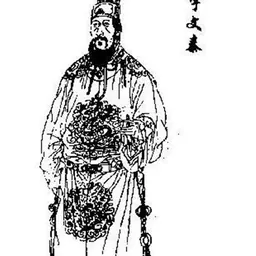
Modern historian, Chen Yinke accredit the founding of the Guanlong Group to Heba Yue. After his death, his subordinate, Yuwen Tai assumed leadership over the group and founded the Western Wei, which was later succeeded by the Northern Zhou, Sui and Tang dynasties, all of which were politically dominated by the group.
Background and early career Heba Yue was an ethnic Tiele whose family lived in Jianshan County (尖山縣), Shenwu Commandery (神武郡; in present-day Shenchi County, Shanxi), and his father was Heba Duba (賀拔度拔), the commander of Wuchuan garrison under the Northern Wei. He studied in the Imperial Academy when he was young, and after reaching adulthood, he was able to use the bow with either one of his hands. He was described as courageous, having great ambitions and drawn to befriending the heroes of his time. Although Heba did not read the Art of War, his tactics were said to be in accordance with the book's teaching, which amazed the people who knew him.
In 523, when the Six Garrisons broke out in rebellion, Heba Yue followed his father to reinforce Yang Jun (楊鈞), the commander of the Huaishuo garrison (懷朔鎮; northeast of Guyang County, Inner Mongolia). At the time, the rebel general, Wei Kegu (衛可孤) was overlooking the battle from the west, more than 300 steps away from the city. Heba Yue spotted Wei Kegu and shot his arm with an arrow from the city wall, shocking the rebel army. In 524, Wei Kegu captured Huaishuo along with Heba Duba and Heba Yue. However, the Heba family remained loyal to Northern Wei, so they secretly conspired with the other captives (including the father of Yuwen Tai, Yuwen Gong (宇文肱)) and killed Wei Kegu in an ambush. Later, Heba Yue was promoted to the office of General of the Strong Crossbow, and along with his brother Heba Sheng, he was assigned to guard Heng province (恆州; roughly present-day Datong, Shanxi).
For his strategic contributions, Heba Yue was promoted to General of the Front and Palace Counsellor. He was also bestowed the title of Baron of Fancheng. Not long after the Heyin Incident, he was appointed Chief Controller of the Front Army and partook in the decisive victory over the rebel, Ge Rong at Fukou (滏口; northwest of present-day Ci County, Hebei), for which he was awarded the office of General Who Pacifies the East and Grand Master of the Palace with Golden Seal and Purple Ribbon. He was dismissed for an unspecified crime, but soon reinstated through an imperial decree. In 529, he followed Erzhu Rong to recapture Luoyang from Yuan Hao and Chen Qingzhi, and he was promoted to Left Household Counsellor and General of the Military Guards.
Pacifying the Guanzhong
Deferring command to Erzhu Tianguang Previously in 528, one of the major rebels, Moqi Chounu proclaimed himself emperor in the Guanzhong region, which worried the imperial court. In 530, Erzhu Rong commissioned for Heba Yue to pacify the region. However, during a private meeting with Heba Sheng, he expressed concern that failing his duty would have him convicted, but succeeding would also draw suspicion from Erzhu Rong, especially with Gao Huan close by to spread accusations. Heba Sheng agreed and suggested to Erzhu Rong that he give the commanding role to a relative while relegating his brother to a deputy. Erzhu Rong was pleased by Heba's deferral and appointed his cousin, Erzhu Tianguang to lead the campaign. Heba Yue served as Erzhu Tianguang's Left Chief Controller, while his close friend, Houmochen Yue served as the Right Chief Controller.
Early in the campaign, the roads at Chishui (赤水; in present-day Weinan, Shaanxi) were blocked by bandits from the Shu region. Erzhu Tianguang only had less than 2,000 troops with him and was reluctant to advance. Heba Yue encouraged him to fight, but Tianguang refused and entrusted Heba with clearing out the bandits. Heba advanced and routed the bandits north of the Wei River, acquiring 2,000 war horses and increasing the prestige of their army.
Capturing Yuchi Pusa In March or April 530, Moqi Chounu led his army to invade Qi province and ordered his generals, Yuchi Pusa (尉遲菩薩) and Moqi Wu (万俟仵), to cross the Wei River from Wugong to attack the Northern Wei camp. Heba Yue went to provide reinforcements for the camp, but by the time he arrived, Yuchi had captured it and returned to Qi. Instead, Heba led 800 cavalries, including Yuwen Tai, Li Hu, Houmochen Chong, Zhao Gui, Yu Jin, Kou Luo, Wang Xiong, Helian Da, Daxi Wu and Ruogan Hui, to cross north of the Wei River to attack Moqi's officials and people. Yuchi was provoked and brought 20,000 troops to pursue Heba to the north bank of the Wei River.
Conflict with Gao Huan and death
Forming the Guanlong Group Gao Huan, now the paramount general of the empire, installed another member of the imperial family, Yuan Xiu to the throne, posthumously known as Emperor Xiaowu of Northern Wei. Relations were strained between the new emperor and Gao Huan, as both sides sought to assert their dominance over the government. Meanwhile, Heba Yue retained control over a significant portion over the Guanzhong, becoming Grand Branch Censorate of the region shortly after Xiaowu's ascension. Seeing Heba's influence in the west, in 533, the new emperor thus issued a secret order for him to eliminate Gao Huan, pricking his own flesh before his heart and sending his blood to him. Along with the office of Grand Chief Controller, Heba was also made the Chief Controller of military affairs in provinces of the Two Yongs, Two Huas, Two Qis, Bin, Four Liangs, Three Yis, Ba, Two Xias, Wei, Ning, and Jing.
Accepting his order, Heba travelled to the northern border to organize his defences. He also set up camps dozens of miles west of Pingliang, ostensibly to have his horses graze in Yuan province (原州; roughly in modern Guyuan, Ningxia), but actually to better defend himself. Many of the local leaders such as Moqi Luo and Hedouling Yili (紇豆陵伊利) submitted to him, while the provincial inspectos of Qin, Southern Qin, He and Wei converged at Pingliang, where they affirmed their willingness to follow Heba's orders. Among the major governors in the west, only the Inspector of Ling province, Cao Ni (曹泥), refused to follow Heba and supported Gao Huan.
Hequ Incident and death Gao Huan had long been wary of Heba Yue and his brothers as they were not fully under his control. He dispatched his official, Zhai Song (翟嵩) to sow discord between Heba Yue and Houmochen Yue, who was serving as the Inspector of Qin province. Houmochen was successfully enticed into siding with Gao Huan while Heba was kept unaware, continuing to value his close relationship with Houmochen through long conversations and banquets.
In February or March 534, Heba Yue planned a northward campaign against Cao Ni with Houmochen serving as his vanguard in spite of warnings from Yuwen Tai regarding his trustworthiness. Heba ordered Houmochen to proceed ahead first, but the next day at dawn, he appeared at Heba's camp at Hequ instead and invited him over to his tent to discuss military affairs. Heba obliged, but during their discussions, Houmochen pretended to suffer from a stomach ache and got up from his seat. Distracted, Houmochen's son-in-law, Yuan Hongjing (元洪景) then assassinated Heba in the tent.
Heba Yue's death sent shock waves among his followers, but they soon rallied around Yuwen Tai and killed Houmochen Yue in the end. Zhao Gui managed to retrieve his body from Houmochen and provided him a burial with royal rites at Shi'an Plains (石安原; northeast of present-day Xianyang, Shaanxi). The imperial court was devastated by his death and posthumously awarded him the offices of Palace Attendant, Grand Tutor, Manager of the Affairs of the Masters of Writing, Chief Controller of military affairs in twenty provinces of the Guanzhong, General-in-Chief and Inspector of Yong province. He was also given the posthumous name of "Wuzhuang".
Heba Yue had two sons, Heba Zhonghua (賀拔仲華) and Heba Wei (賀拔緯), while his brother Heba Sheng became a prominent general of the Western Wei. Despite Heba Yue's influence, Yuwen Tai would effectively succeed him as leader of the Guanlong group, while his family were willing to accept subordinate roles under the Western Wei and then the Northern Zhou.
Don’t just read it —
keep it.
Full-length biographies made to live with: read them, listen on the way to work, watch them tonight.
- E-book
- Audio
- Video
Instant download · yours to keep · every purchase keeps this site free
Important facts
People in He Bayue's life
Named in this biography and alive at the same time




Related people
Same field, nearest in time

Contemporaries
People whose lives overlapped He Bayue's


Frequently asked questions
Who was He Bayue?
Northern Wei general (died 534)
When was He Bayue born?
He Bayue was born in 450.
When did He Bayue die?
He Bayue died in 534.
What was He Bayue's occupation?
He Bayue was a politician.
What nationality was He Bayue?
He Bayue was Chinese.
Sources & further reading
Cite this page
APA: Biography.guide. (2026). He Bayue. https://biography.guide/he-bayue/
MLA: "He Bayue." Biography.guide, https://biography.guide/he-bayue/.
Chicago: "He Bayue." Biography.guide. https://biography.guide/he-bayue/.
Data last updated: 2026-09-20 · Spot an error? Report a correction.
Page generated 2026-09-27 05:15 UTC