
About Hayashi Tadasu
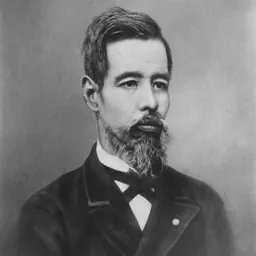
Lived 1850 – 1913 (aged 63). Hayashi Tadasu was a Japanese diplomat, politician and cabinet of Japan.
was a Japanese career diplomat and cabinet minister of Meiji-era Japan.
Early life He was born Satō Shingoro in Sakura city, Shimōsa Province (present-day Chiba prefecture), as the son of Satō Taizen, a physician practising "Dutch medicine" for the Sakura Domain. He sometimes referred to himself as "Satō Tosaburō". He was adopted as a child by Hayashi Dokai, a physician in the service of the Tokugawa shogunate, from whom he received the name Hayashi Tadasu. He learned English at the Hepburn Academy (the forerunner of Meiji Gakuin University) in Yokohama.
From 1866 to 1868, Hayashi studied in Great Britain at University College School and King's College London as one of fourteen young Japanese students (including Kikuchi Dairoku) sent by the Tokugawa government on the advice of the then British foreign minister Edward Stanley, 15th Earl of Derby.
Hayashi returned home in the midst of the Boshin War of the Meiji Restoration, and joined with Tokugawa loyalists led by Enomoto Takeaki, whom he accompanied to Hokkaidō with the remnants of the Shogunate Army and its Navy. He was captured by the Imperial forces after the final defeat of the Republic of Ezo at the Battle of Hakodate and imprisoned in Yokohama.
Released in 1871 by Kanagawa governor Mutsu Munemitsu, he was recruited to work for the Meiji government in 1871, and because of his language abilities and previous overseas experience was selected to accompany the Iwakura Mission to Europe and the United States in 1871–1873. He returned home with the staff led by Henry Dyer as the principal, and endeavoured to set up the Imperial College of Engineering, Tokyo as an officer of the Engineering Institution of the Ministry of Public Works.
Political career After the Ministry of Public Works was abolished, he moved to the Ministry of Post and Telecommunication, then was appointed governor of Kagawa Prefecture, and then of Hyōgo Prefecture. In 1891, he was appointed Vice-Minister for Foreign Affairs. He was elevated to the title of baron (danshaku) in the kazoku peerage in 1895.
Hayashi was appointed as resident minister to the court of Qing dynasty China at the Japanese legation in Beijing, then resident minister to Russia in St Petersburg, and finally resident minister to Great Britain. While serving in London from 1900, he worked to successfully conclude the Anglo-Japanese Alliance and signed on behalf of the government of Japan on 30 January 1902. At that time Sir Claude MacDonald was Hayashi's opposite number in Tokyo.
On becoming Foreign Minister in the first Saionji cabinet in 1906, Hayashi concluded agreements with France (the Franco-Japanese Agreement of 1907) and Russia (the Russo-Japanese Agreement of 1907 and Russo-Japanese Agreement of 1910). He served as Minister of Communications in the second Saionji cabinet and as interim Foreign Minister (1911–12). He was elevated to the title of count (hakushaku) in 1907. They had a daughter and a son, Kiku and Masanosuke.
Hayashi became a master mason in 1904, initiated in 1903 in Empire Lodge No. 2108, in London. He resigned from the lodge in 1907. Count (14 September 1907)
Decorations Grand Cordon of the Order of the Sacred Treasure (31 October 1895) Grand Cordon of the Order of the Rising Sun (27 December 1899) Grand Cordon of the Order of the Rising Sun with Paulownia Flowers (1 April 1906) Knight Grand Cross of the Royal Victorian Order (GCVO) (4 July 1905)
Honorary degrees LL.D. (honorary) University of Cambridge – May 1902 D.C.L. (honorary) University of Oxford – June 1902
Order of precedence Third rank (21 July 1901) Senior third rank (May 1910)
Don’t just read it —
keep it.
Full-length biographies made to live with: read them, listen on the way to work, watch them tonight.
- E-book
- Audio
- Video
Instant download · yours to keep · every purchase keeps this site free
Important facts
Family & relationships
People in Hayashi Tadasu's life
Named in this biography and alive at the same time



Related people
Same field, nearest in time

Contemporaries
People whose lives overlapped Hayashi Tadasu's


Frequently asked questions
Who was Hayashi Tadasu?
Japanese diplomat (1850-1913)
When was Hayashi Tadasu born?
Hayashi Tadasu was born on 11 April 1850 in Sakura.
When did Hayashi Tadasu die?
Hayashi Tadasu died on 10 July 1913 in Hayama.
What was Hayashi Tadasu's occupation?
Hayashi Tadasu was a diplomat, politician and cabinet of Japan.
What nationality was Hayashi Tadasu?
Hayashi Tadasu was Japanese.
Sources & further reading
Cite this page
APA: Biography.guide. (2026). Hayashi Tadasu. https://biography.guide/hayashi-tadasu/
MLA: "Hayashi Tadasu." Biography.guide, https://biography.guide/hayashi-tadasu/.
Chicago: "Hayashi Tadasu." Biography.guide. https://biography.guide/hayashi-tadasu/.
Data last updated: 2026-09-20 · Spot an error? Report a correction.
Page generated 2026-09-27 05:20 UTC