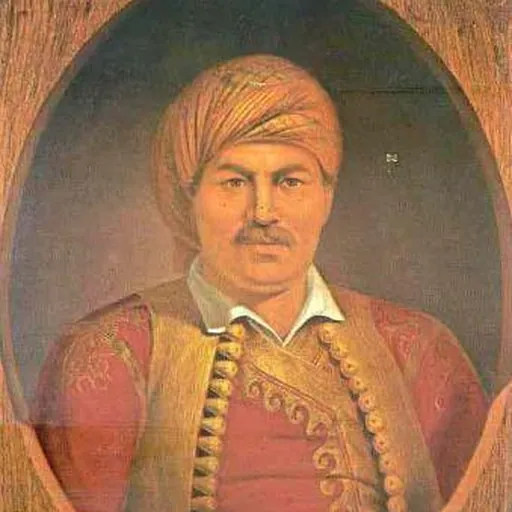
About Hatzimichalis Dalianis
Lived 1775 – 1828 (aged 52–53). Hatzimichalis Dalianis was a Greek and Turkish military personnel.
Hatzimichalis Dalianis (, 1775 – 17 March 1828) was a Greek revolutionary leader of the Greek War of Independence and commander in Crete in 1828.
Early life According to some Greek historians, the Greek speaking towns of Argyrokastro, Vouliarates, Premeti, and Delvinaki argue over his origin. Some believe he was born in the Greek-speaking town of Delvinaki, Epirus, when the region was under Ottoman rule.
He grew up in Trieste, where his father worked as a merchant. In 1816 he became a member of the Greek patriotic organization Filiki Etaireia.
Greek War of Independence
In March 1826, while the War of Independence was in full swing, he participated, together with other revolutionary leaders, in an attempt to create an alliance with the Emir of Lebanon, Bashir Shihab II, against the Ottoman Empire. However, when Dalianis landed in Beirut to incite a revolt there, the local emir was far from certain that he would defy the Ottomans.
Back in Greece, Dalianis fought in the Battle of Phaleron (1827). In January 1828, he became the leader of an expeditionary force to assist the faltering uprising in Crete. In an attempt to revive the revolution there, Dalianis, with 700 men (600 on foot, 100 with horses and mules), After several days, the fortress fell back into Ottoman hands, and Dalianis perished along with 385 men. Mustafa's force also lost 800 men.
It is said that Hatzimichalis Dalianis was buried by a nun at the nearby monastery of Saint Charalambos. Mustafa's Turkish troops were ambushed on their return at a nearby gorge by a group of Cretan freedom fighters from Sfakia and suffered around 1,000 casualties. According to the local Cretan tradition, the spirits of the fallen revolutionaries return each year to Frangokastello. This unexplained phenomenon usually occurs on the anniversary of the battle where images of advancing troops (Drosoulites) appear at dawn to hover above the tragic location. The subject has been investigated and various scientific interpretations have been suggested.
Later, in the early 20th century, volunteer groups from Crete, in order to repay the sacrifice of Dalianis and his Epirote men in 1828, joined the Epirus front of the First Balkan War, as well as the armed struggle for the establishment of the Autonomous Republic of Northern Epirus, against annexation to Albania.
Don’t just read it —
keep it.
Full-length biographies made to live with: read them, listen on the way to work, watch them tonight.
- E-book
- Audio
- Video
Instant download · yours to keep · every purchase keeps this site free
Important facts
Related people
Same field, nearest in time



Contemporaries
People whose lives overlapped Hatzimichalis Dalianis's




Frequently asked questions
Who was Hatzimichalis Dalianis?
Greek revolutionary
When was Hatzimichalis Dalianis born?
Hatzimichalis Dalianis was born in 1775 in Delvinaki.
When did Hatzimichalis Dalianis die?
Hatzimichalis Dalianis died in 1828 in Sfakia Municipality.
What was Hatzimichalis Dalianis's occupation?
Hatzimichalis Dalianis was a military personnel.
What nationality was Hatzimichalis Dalianis?
Hatzimichalis Dalianis was Greek and Turkish.
Sources & further reading
· Wikipedia: Hatzimichalis Dalianis
· DBpedia: Hatzimichalis Dalianis
Cite this page
APA: Biography.guide. (2026). Hatzimichalis Dalianis. https://biography.guide/hatzimichalis-dalianis/
MLA: "Hatzimichalis Dalianis." Biography.guide, https://biography.guide/hatzimichalis-dalianis/.
Chicago: "Hatzimichalis Dalianis." Biography.guide. https://biography.guide/hatzimichalis-dalianis/.
Data last updated: 2026-09-22 · Spot an error? Report a correction.
Portrait: Wikimedia Commons · author & licence
Page generated 2026-09-27 05:03 UTC