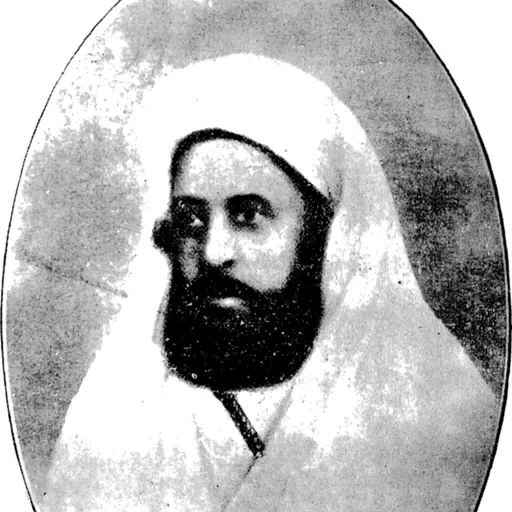
About Hassan I of Morocco
Lived 1836 – 1894 (aged 57–58). Hassan I of Morocco was a Moroccan politician.
Reign
Early reign and rebellion in Fez Hassan I in Meknes. Mawlay Hassan was proclaimed sultan of Morocco on the death of his father in 1873. His first action was to crush an urban revolt in the capital Fez in 1874, which he had to besiege for a few months. The tanners rose up in protest "raging like lions and tigers" through the streets of Fez, pillaging the house of Muhammad Bennis, the Minister of Finance, turning Fez into a battleground. Hassan I, who was on campaign sent letters calling for the pacification of the city. Shortly after, the hated tax collectors were withdrawn, and the rebellion halted. The tax collectors soon reappeared, leading to the rebellion commencing again more violently. The local Fez militiamen took up positions in minarets of Fes el Bali and fired down on the army, but the two sides later negotiated peace and the rebellion was definitely terminated. Of strong Arab culture, he did not know any foreign language, although Hassan I was a conservative ruler, he realised the need for modernization and the reform policy of his father.
Relations with Europe Sultan Hassan I managed to maintain the independence of Morocco while neighbouring states fell under European influence, such as Tunis which was conquered by France in 1881 and Egypt which was occupied by Britain in 1882.
Both Spain and France hoped for a weak Makhzen government of Morocco, while the British hoped for the opposite, a reformed Moroccan state which could stand on its own. Aware of this, Hassan called for an international conference on the issue, and the Treaty of Madrid was signed on 3 July 1880 to limit the practice, an important event of Hassan's reign. Instead of reducing foreign interference, the Makhzen had to grant concessions such as granting foreigners rights to own land in the countryside, something which Great Britain was pushing for all along. This was followed by French incursions into the region of Touat in the south, which was considered Moroccan territory. This treaty effectively gave international approval and protection for lands which had been captured by foreign powers. This set the stage for the French protectorate in Morocco beginning in 1912. Since 1879, the British occupied Tarfaya and built a fortification there in 1882 known as Port Victoria. It was not until 1886 that the sultan sent a military expedition there, damaging the fort and forcing Donald MacKenzie to leave. The sultan's expedition to Sus in 1886 was followed a year later by the Spanish occupation of Dakhla on the Saharan coast. Hassan responded by appointing a khalifa (governor) over the Sahara, Ma al-'Aynayn. In 1888 Timbuktu requested that Hassan send a governor to help the town against the French forces advancing into the Niger basin.
Military reform Hassan I continued to expand the military reforms started by his father Muhammad IV. The new and reformed 'Askar al-Nizami introduced by sultan Abd al-Rahman in 1845 after the Battle of Isly was expanded by Hassan I to the size of 25,000 men and 1,000 artillery. The sultan also enhanced the Moroccan coastal defences with batteries of large caliber cannon, and in 1888 built an arms factory in Fez known as Dar al-Makina, however production in it was little and costly. To train the reformed Moroccan army, Hassan I sent students to London, but in 1876, the sultan hired Harry MacLean, a British officer based in Gibraltar, who designed a military uniform in Arab-style, and learned to speak excellent Arabic.
Every year from spring to fall, Hassan I was on campaign, and lead expeditions to all parts of the kingdom. One of Hassan's campaigns was dealing with the Darqawa uprising near Figuig in the fall of 1887, which was quickly suppressed. The Krupp cannon he gave on this occasion to the qaid of Telouet (member of the now famous Glaoua family) is still on display in the center of Warzazat. In 1881 he founded Tiznit.
Hassan decided to reinstate the old Moroccan administration in the Gourara-Touat-Tidikelt. The first Moroccan envoys reached the Saharan oases in 1889 and in 1890. In 1891 Hassan called on the oases peoples to begin paying taxes, thus formalizing the recognition of his suzerainty. That same year the Touat and the oases which lay along the Oued Saoura were placed under the authority of the son of the Moroccan khalifa who resided in the Tafilalt. Then, in 1892, a complete administrative organization was established in all of the Gourara-Touat-Tidikelt. The Moroccan Government even went so far as to extend to the qaids of the Touareg of the Ahenet and the Hoggar a formal recognition that they were dependent subjects of the Sultan. In 1892 and 1893, the Moroccans further solidified their control in the Guir-Zouzfana basin and along the oued Saoura by investing with official authority the qaids from all of the nomadic and sedentary tribes of the region (this included the Doui Menia and Oulad Djerir tribes, the most important nomads of the Guir-Zousfana basin; the oasis of Igli; and the sedentary Beni Goumi people who lived along the banks of the Oued Zouzfana).
Death The death of Hassan I, as imagined by an the engraver Fortuné Méaulle, on the cover of Le Journal illustré. On 9 June 1894, Hassan I died from illness near Wadi al-Ubayd in the region of Tadla. Since the army was still in enemy territory, his chamberlain and Grand Wazir Ahmad bin Musa kept the death a secret, ordering the ministers to not reveal the news. The sultan's body was taken to Rabat and buried there, in a qubba next to Dar al-Makhzen which also contains the tomb of his ancestor Sidi Mohammed III. He has also been described as the "last great sultan" of Morocco before colonialism.
Appearance and personality
Italian traveller Edmondo De Amicis gave a description of Hassan I: whom he married in 1875. Together they had:
Sidi Mohammed the eldest son of Moulay Hassan I, he was his father's heir until his rebellion, when he was evicted; Moulay Zain al-Abdine.
Lalla Aliya al-Settatiya, Together they had:
Sultan Moulay Abd al-Hafid.
Lalla Khadija bint al-Arbi, Originally, a Circassian slave concubine purchased from Hajj Lʿarbi al-Humaydi Bricha alongside another Circassian concubine, Amina. She became Hassan's favorite wife towards the end of his life and held political influence after his death. Their children are:
Lalla Oum Kelthoum; Lalla Nezha; Sultan Moulay Abdelaziz; Lalla Chérifa; Moulay Abdelkébir.
Lalla Kinza al-Daouia: she divorced from the sultan and remarried to Abdallah al-Daouia then to Mohammed el-Talba. From her marriage to the sultan, she had:
Moulay al-Mamun, he is the father of Princess Lalla Hanila bint Mamoun; Moulay al-Amin; Moulay Othman; Moulay Mohammed al-Anwar.
Lalla Oum al-Khair, her last name is not retained; together, they had:
Moulay Abdallah, he died on December 15, 1883; Moulay Jaafar; Sidi Mohammed el Sghir; Moulay Talib;
Lalla Oum Zayda, her last name is not retained; together, they had:
Moulay Mohammed al-Mehdi; another son named Abdallah; Lalla Abla.
Sultan Moulay Hassan I is also the father of:
Princess Lalla Fatima Zahra (died in 1894), a woman of letters and faqīha who donated a large part of her princely literary collection for the library of the University of al-Qarawiyyin in Fez.
Moulay Hassan I had a harem of slave concubines (jawari), but the precise number of his slave concubines is largely unknown, leaving room for speculation.
Aisha (Ayesha): she was a slave concubine of Georgian origin. Purchased in Istanbul in 1876 by the vizier Sidi Gharnat, she was the favorite of Sultan Moulay Hassan I during the sixteen years she remained in his harem.
Amina was a Circassian concubine bought alongside Lalla Ruqayya from Hajj Lʿarbi al-Humaydi Bricha. She was the mother of Yusef of Morocco
Suchet adds a "batch" of four other Circassian women of great beauty and accomplished talents purchased for 100,000 francs in 1878 in Cairo and another three other Circassian slave concubines, without further details.
Don’t just read it —
keep it.
Full-length biographies made to live with: read them, listen on the way to work, watch them tonight.
- E-book
- Audio
- Video
Instant download · yours to keep · every purchase keeps this site free
Important facts
Family & relationships
People in Hassan I of Morocco's life
Named in this biography and alive at the same time

Related people
Same field, nearest in time




Contemporaries
People whose lives overlapped Hassan I of Morocco's
Frequently asked questions
Who was Hassan I of Morocco?
Moroccan Sultan (1836-1894)
When was Hassan I of Morocco born?
Hassan I of Morocco was born in 1836 in Fez.
When did Hassan I of Morocco die?
Hassan I of Morocco died on 7 June 1894 in Marrakech.
What was Hassan I of Morocco's occupation?
Hassan I of Morocco was a politician.
What nationality was Hassan I of Morocco?
Hassan I of Morocco was Moroccan.
Sources & further reading
· Wikipedia: Hassan I of Morocco
· DBpedia: Hassan I of Morocco
Cite this page
APA: Biography.guide. (2026). Hassan I of Morocco. https://biography.guide/hassan-i-of-morocco/
MLA: "Hassan I of Morocco." Biography.guide, https://biography.guide/hassan-i-of-morocco/.
Chicago: "Hassan I of Morocco." Biography.guide. https://biography.guide/hassan-i-of-morocco/.
Data last updated: 2026-09-26 · Spot an error? Report a correction.
Portrait: Wikimedia Commons · author & licence
Page generated 2026-10-04 11:32 UTC