
Harry Orlinsky
American Bible scholar
About Harry Orlinsky
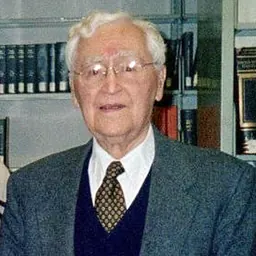
Lived 1908 – 1992 (aged 84). Harry Orlinsky was an American biblical scholar, bible translator and religious studies scholar, known for New Jewish Publication Society of America Tanakh.
Harry M. Orlinsky (14 March 1908 21 March 1992) was an American scholar, who was the editor-in-chief of the Jewish Publication Society (NJPS) translation of the Torah.
Early life and education Harry Orlinsky was born in 1908 to Yiddish-speaking parents in Owen Sound, Ontario on March 17. Growing up, pool was one of his favorite pastimes. He attended the University of Toronto and began his religious studies with a Bible class taught by Theophile Meek. Under Meek’s mentorship, Orlinsky went on to earn his PhD at Philadelphia’s Dropsie College for his work on the translation of the Septuagint, the Jewish Greek translation of the Bible. While there, he met his future wife Donya Fein. Orlinsky then completed a year of post-doctoral work at the Hebrew University in Jerusalem. Upon his return to the United States, he started working at the Baltimore Hebrew Teachers College (1936-1944). During this time he also studied at Johns Hopkins University with William F. Albright. Because of World War II, Albright was unable to secure the necessary funds for Orlinsky to become a permanent member of the faculty at Hopkins. Instead, Orlinsky, with the help of Albright, was able to secure a post with the Jewish Institute of Religion in 1943 (now merged with the Hebrew Union College) and it is here that Orlinsky spent the rest of his career.
Orlinsky married Donya Fein in 1934 and they had two sons, Walter (Velvel) and Seymour (Zeke). Orlinsky died on Saturday 21 March 1992 at North Oaks Retirement Community in Owings Mills, Maryland. He was 84 years old. He was buried at Mount Lebanon Cemetery in Collingdale, Pennsylvania.
Work as a translator Perhaps the greatest result of Orlinsky’s work on Torah translation was the creation of a gender-free translation of the Bible. Since the translator must interpret and explain the text, it behooves him (or her) to understand why certain words were used. If a language has a preference for masculine pronouns, is that because the reference is really to males, or does it have to do with the way a language functions? A similar example from modern times is the use of "guys" to refer to a group of people in general, regardless of gender. If the rest of the text did not use a masculine pronoun but rather used a more gender-neutral term such as "one," then Orlinsky felt it was safe to say that the translator can use that term as well for the masculine pronouns within a given text.
Orlinsky's work earned him the position as a key translator on not one but two new Bible translations. Starting 1952, he helped the Protestant National Council with their Revised Standard Version (RSV) of the Bible and then again with the New Revised Standard Version (1989). Walter Harrelson, the vice-chairman of the 1989 translation committee, said that Orlinsky was instrumental in the translation. He helped to keep the committee on track in using the older Massoretic text rather than the easier-to-translate Septuagint, which is a Greek translation. Harrelson recalls Orlinsky's constant reminder, "We’re translating Hebrew Scriptures. We're not translating from the Greek Hebrew Scriptures."
Following the success of the RSV in 1952, Orlinsky turned his attention to a new translation of the Bible for Jews. He urged the Jewish Publication Society of America (JPS) to take up the task, since it was they who were responsible for the 1917 version still in use at the time. Orlinsky became the editor-in-chief for the Torah, which was published in 1962. He was also instrumental in helping to get The Prophets (1978) and The Writings (1982) published as well. Orlinsky helped move the translation of the Bible away from the literalism of the King James Version to the exegesis that was the hallmark of JPS’s 1917 translation and Orlinsky’s translation work.
Written works Ancient Israel. 1954. Cornell University. Studies on the Second Part of the book of Isaiah: The So-Called "Servant of the Lord" and "Suffering Servant" in Second Isaiah. 1967, (enlarged edition 1977). Leiden: Brill. Understanding the Bible Through History and Archaeology. 1969. Ktav Publishing House. Essays in Biblical and Jewish Culture and Bible Translation. 1973. Ktav.
Don’t just read it —
keep it.
Full-length biographies made to live with: read them, listen on the way to work, watch them tonight.
- E-book
- Audio
- Video
Instant download · yours to keep · every purchase keeps this site free
Important facts
People in Harry Orlinsky's life
Named in this biography and alive at the same time

Related people
Same field, nearest in time




Contemporaries
People whose lives overlapped Harry Orlinsky's



Frequently asked questions
Who was Harry Orlinsky?
American Bible scholar (1908-1992)
When was Harry Orlinsky born?
Harry Orlinsky was born on 14 March 1908 in Owen Sound.
When did Harry Orlinsky die?
Harry Orlinsky died on 21 March 1992 in Owings Mills.
What was Harry Orlinsky's occupation?
Harry Orlinsky was a biblical scholar, bible translator and religious studies scholar.
What was Harry Orlinsky known for?
Harry Orlinsky was known for New Jewish Publication Society of America Tanakh.
What nationality was Harry Orlinsky?
Harry Orlinsky was American.
Sources & further reading
Cite this page
APA: Biography.guide. (2026). Harry Orlinsky. https://biography.guide/harry-orlinsky/
MLA: "Harry Orlinsky." Biography.guide, https://biography.guide/harry-orlinsky/.
Chicago: "Harry Orlinsky." Biography.guide. https://biography.guide/harry-orlinsky/.
Data last updated: 2026-09-22 · Spot an error? Report a correction.
Page generated 2026-09-27 04:58 UTC