
About Harry F. Olson
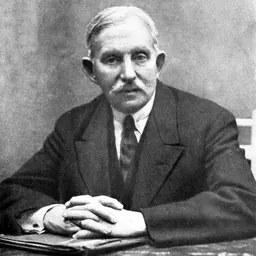
Lived 1901 – 1982 (aged 80). Harry F. Olson was an American inventor and engineer.
Dr Harry Ferdinand Olson, E.E., Ph.D. (December 28, 1901 – April 1, 1982) was a prominent engineer and inventor with RCA Victor, the Acoustic Research Director of RCA Laboratories, Princeton, and a pioneer in the field of 20th century acoustical engineering notably in the fields of high-fidelity, digital music synthesis, microphones, loudspeakers, acoustics, radar, submarine communication, magnetic tape and noise reduction.
Olson wrote ten books including Dynamical Analogies, on electrical-mechanical-acoustical analogies, and had over one hundred patents.
Biography Harry F. Olson was born in Mount Pleasant, Iowa, to Swedish immigrant parents. Technically inclined from an early age, he built and flew model airplanes, constructed a steam engine and invented a wood-fired boiler that drove a 100-volt DC generator. Olson designed and built an amateur radio transmitter, gaining enough proficiency to be granted an operator's license. Olson went on to earn a bachelor's degree in electrical engineering from the University of Iowa then continued to earn a master's degree with a thesis on acoustic wave filters in solids and a doctorate in physics, working with polarization of resonance radiation in mercury.
Immediately after completing his course of study in 1928, Olson moved to New Jersey to work for RCA Laboratories. Olson would remain at RCA for almost four decades.
An RCA 44-series ribbon microphone that was used by CBS. In 2005, Mix Foundation honored Harry F. Olson and Les Anderson of RCA with induction to the TECnology Hall of Fame for their development of the Model 44 microphone in 1931. Olson had a continuing interest in music, acoustics, and sound reproduction, and, by 1934, he was placed in charge of acoustical research at RCA. At RCA, Olson worked on a wide range of projects, which included developing microphones for the broadcasting and motion picture industries, improving loudspeakers, and making significant contributions to magnetic tape recording.
Like many engineers of the World War II generation, Olson also made significant contributions to military technology as well, particularly to the fields of underwater sound and anti-submarine warfare.
After the war Olson, along with Herbert Belar, developed the first modern electronic synthesizer. Equipped with electron tubes, the Mark II Sound Synthesizer was used to compose music, which was recorded and sold to the public.
A prolific inventor and engineer, Olson was awarded more than 100 patents for the various types of microphones (including the widely used 44- and 77-series), cardioid (directional) microphones, loudspeaker baffles, air-suspension loudspeakers, isobaric loudspeakers, early video recording equipment, audio recording equipment, phonograph pickups, underwater sound equipment, noise reduction, sound technology in motion-pictures, and public-address systems he developed. He also authored 135 articles and ten books including an interdisciplinary text charting the dynamical analogies between electrical, acoustical and mechanical systems.
In 1949, Olson was honored by being the first recipient of the Audio Engineering Society's John H. Potts Memorial Award, an award program which was later renamed the gold medal. In 1953-4 Olson served as president of the Acoustical Society of America, which awarded him the very first Silver Medal in Engineering Acoustics in 1974 and the Gold Medal in 1981. He won the IEEE Lamme Medal in 1970, was elected to the National Academy of Sciences in 1959, and was the recipient of many honorary degrees during his lifetime.
Olson retired from RCA in 1967, continuing as a consultant for RCA Laboratories.
High Fidelity Demonstration
Shortly after World War II, Dr. Olson conducted an experiment, now considered a classic, to determine the preferred bandwidth for the reproduction of music. Previous experimenters had found that listeners seemed to prefer a high-frequency cutoff of 5000 Hz for reproduced music. Dr. Olson suspected that this was likely due to imperfections in the sound, especially in the higher frequencies, as reproduced by equipment in common use at the time. These imperfections included clicks and pops (from 78 rpm recordings), added noise (from AM radio broadcast static), hiss and harmonic distortion (from amplifier circuits), and non linear frequency response from primitive loudspeaker designs. If the sound was free of these problems, he reasoned, listeners would prefer full frequency reproduction.
In his experiment, he set up a room which was divided diagonally by a visually opaque but acoustically transparent screen. The screen incorporated a concealed low-pass acoustical filter having an upper frequency cutoff of 5000 Hz. This filter could be opened or closed, allowing either the full range of frequencies to pass or the range only below 5000 Hz. At first, a small orchestra sat and performed on one side of the screen, while a group of test subjects sat on the other and listened. The listeners were asked to select their preference between two conditions: full bandwidth or restricted bandwidth. There was overwhelming preference in favor of the full bandwidth. Next, the orchestra was replaced with a sound-reproduction system with loudspeakers positioned behind the screen instead. When the sound system was free of distortion, the listeners preferred the full bandwidth. But when he introduced small amounts of nonlinear distortion, the subjects preferred a restricted bandwidth, thus demonstrating clearly the importance of high quality in audio systems. The band made copies of the book for all of the Dead's sound crew.
The Wall of Sound influenced all modern high-quality PA systems for live music.
Personal life frame|Iconic microphone image based on the design of the RCA Type 77-A microphone
Harry F. Olson was born in Mt. Pleasant, Iowa, on December 18, 1901. He was the first of two children. His parents were Swedish immigrants.
Awards and honors
Year Honor or Award 1932 Apparatus for Converting Sound Vibrations Into Electrical Variations (First Practical Ribbon Microphone) 1,885,001 1932 System Responsive to The Energy Flow of Sound Waves (Pressure and Velocity Sound Level Meter) 1,892,644 1932 Sound Pick-Up Device (Unidirectional Cardioid Microphone) 1,892,645 1933 System For the Conversion and Transfer Of Energy (Condenser Microphone Step-Up Transformer With A Remote Preamplifier.) 1,897,732 1934 Acoustic Device (Loudspeaker Horn) 1,984,542 1935 Loud Speaker and Method of Propagating Sound (Passive Radiator Loud Speaker) 1,988,250 1935 Acoustic Device (Double Voice Coil Loudspeaker) 2,007,748 1936 Electroacoustical Device (Ribbon Telephone Microphone/Speaker) 2,064,316 1937 Sound Reproducing Apparatus (Multi-Cellular Horn) 2,102,212 1937 Acoustical Device (Small Portable Closed Back Ribbon Microphone) 2,102,736 1938 Microphone 2,113,219 1938 Microphone And Circuit (Microphone Mixer By Verifying Field Coil Strength) 2,119,345 1940 Loud-Speaker (Multiple Flare Horn) 2,203,875 1940 Loud-Speaker (Hybrid Bass-Horn/Bass-Reflex Design) 2,224,919 1941 Electroacoustical Apparatus (Line Microphone "Shotgun Microphone") 2,228,886 1941 Acoustical Apparatus (Woofer Surround) 2,234,007 1942 Signal Translating Apparatus (Multiple Co-Axial Loudspeaker Designs) 2,269,284 1942 Electroacoustical Apparatus (Design of the RCA 77 Ribbon Microphone) 2,271,988 1942 Radio Remote Control System (Using Different Frequencies of Sound) 2,293,166 1942 Electroacoustical Apparatus (Line Array Microphone) 2,299,342 1945 Signal Translating Apparatus (Sub-Aqueous Submarine Microphone) 2,390,847 1947 Magnetostrictive Signal Translating Apparatus (Rugged Sub-Aqueous Submarine Microphone) 2,414,699 1947 Signal Translating Apparatus (Sub-Aqueous Submarine Pressure Compensated Speaker) 2,429,104 1949 Signal Transmission and Receiving Apparatus (Ultrasonically Power Wireless Earphone) 2,461,344 1949 Air Suspension Loudspeaker 2,490,466 1950 Synthetic Reverberation System 2,493,638 1950 Diffraction Type Sound Absorber (Suspended) 2,502,016 1950 Diffraction Type Sound Absorber Covered By A Membrane 2,502,018 1950 Diffraction Type Sound Absorber With Complementary Fitting Portions 2,502,019 1950 Diffraction Type Sound Absorber With Fiberglass Walls (Cylinder) 2,502,019 1950 Feedback Controller System For Recording Cutters And the Like (Phonograph Recording Lathe) 2,516,338 1951 Directional Microphone (Coincident Pair Of Ribbon Microphones With Horizontal Pattern Control) 2,539,671 1951 Coaxial Dual-Unit Electrodynamic Loud-Speaker (Improved Version) 2,539,672 1951 Transformerless Audio Output System (Tube Amplifier) 2,548,235 1951 Means For Improving The Sensitivity And The Response Characteristics Of Velocity Microphones 2.566,039 1951 Line Type Pressure Responsive Microphone 2566,094 1951 Velocity Type Microphone (Acoustic High Frequency Equalizer 2,572,376 1953 Suspension System For Dynamic Microphones 2,628,289 1953 Distortion Analyzing Apparatus (Improvement) 2,629,000 1953 Second Order Gradient Directional Microphone 2,640,110 1953 Portable Radio With A Bass-Reflex Cabinet 2,642,948 1953 Noise Discrimination System 2,645,648 1953 Cabinet For Sound Translating Apparatus 2,649,164 1953 Multisection Acoustic Filter (Filtering Out Frequencies above 5,000 Hz) 2,656,004 1954 Uniaxial Microphone 2,680,787 1954 Noise Reduction System 2,686,296 1954 Sound Translating Apparatus (Second Speaker Inside The Cabinet) 2,688,373 1954 Coaxial, Dual Unit, Electrodynamic Loud-Speaker (Improved Magnetic Structure) 2,699,472 1955 Velocity Microphone (Improved Magnetic Structure) 2,699,474 1955 Dynamic Microphone (Compact Design) 2,718,272 1956 Unidirectional Microphone (Low Cost Ribbon Design) 2,751,441 1956 Acoustical Resistance For Pressure Type Microphones 2,773,130 1957 Methods Of Restoring Phonograph Records (Re-synthesizing The Recording) 2,808,466 1957 Transducer With Fluid Filled Diaphragm Suspension 2,814,353 1957 Loudspeaker Structure (Sculpted Cone For High Frequency Pattern Control) 2,825,823 1958 Combination Chassis And Loudspeaker 2,838,607 1958 Directional Microphone (Using Two Microphones To Increase Directivity) 2,854,511 1958 Noise Discriminator, Threshold Type 2,645,684 1958 Music Synthesizer (Electronic) 2,855,816 1958 Wide Range Dynamic Phonograph Pickup 2,858,375 1959 Acoustic Apparatus (Improved Acoustic Labyrinth) 2,870,856 1959 Signal Frequency Change Detector 2,918,667 1960 Vibration Control Apparatus 2,964,272 1961 Apparatus For Speech Analysis and Printer Control Mechanisms 2,971,057 1961 Electronic Sound Absorber 2,983,790 1961 Directional Electrostatic Microphone 3,007,012 1961 Music Composing Machine 3,007,362 1963 Stereophonic Loudspeaker 3,104,729 1968 Voiced Sound Fundamental Frequency Detector 3,400,215
Don’t just read it —
keep it.
Full-length biographies made to live with: read them, listen on the way to work, watch them tonight.
- E-book
- Audio
- Video
Instant download · yours to keep · every purchase keeps this site free
Important facts
People in Harry F. Olson's life
Named in this biography and alive at the same time



Related people
Same field, nearest in time

Contemporaries
People whose lives overlapped Harry F. Olson's



Frequently asked questions
Who was Harry F. Olson?
American engineer (1901–1982)
When was Harry F. Olson born?
Harry F. Olson was born on 28 December 1901 in Mount Pleasant.
When did Harry F. Olson die?
Harry F. Olson died on 1 April 1982.
What was Harry F. Olson's occupation?
Harry F. Olson was an inventor and engineer.
What nationality was Harry F. Olson?
Harry F. Olson was American.
Sources & further reading
Cite this page
APA: Biography.guide. (2026). Harry F. Olson. https://biography.guide/harry-f-olson/
MLA: "Harry F. Olson." Biography.guide, https://biography.guide/harry-f-olson/.
Chicago: "Harry F. Olson." Biography.guide. https://biography.guide/harry-f-olson/.
Data last updated: 2026-09-20 · Spot an error? Report a correction.
Page generated 2026-09-27 05:24 UTC