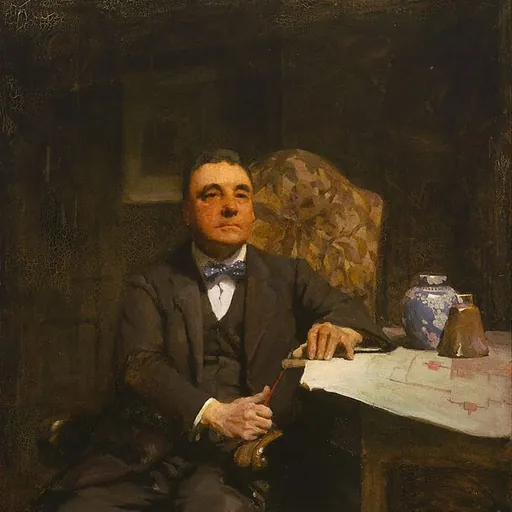
About Harold Desbrowe-Annear
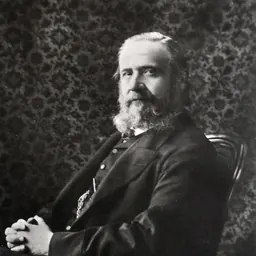
Lived 1865 – 1933 (aged 67). Harold Desbrowe-Annear was an Australian architect.
Harold Desbrowe Annear (16 August 1865 – 22 June 1933) was an influential Australian architect who was at the forefront of the development of the Arts and Crafts movement in the country. During the 1890s he was an instructor in architecture at the Working Men's College (now RMIT University) where he founded the T-Square in 1900. The club acted as a meeting point for Melbourne's architects, artists and craft workers and helped to develop a strong Arts and Crafts culture in the city. Desbrowe Annear was also a supporter of the Victorian Arts and Crafts Society, founded in 1908.
Personal life
Early life and education Born in Happy Valley, Bendigo, in 1865, Desbrowe Annear was the elder son of James Annear, mining contractor, and Eliza Ann (née Hawkins). He had six older stepsisters, two sisters and a brother. After the family moved to Melbourne in 1875 Desbrowe Annear attended Hawthorn Grammar School, matriculating in 1882. On 25 July 1891, he married Florence Susan Chadwick but by the end of World War I, due to irreconcilable differences, they had separated.
Practices In 1883, Desbrowe Annear was articled to Melbourne architect William Salway and during this time his interest and knowledge of architecture grew extensively. In 1889 he chose to pursue a practice of his own having already received recognition for his architectural sketches and papers delivered to the Victorian Institute of Architects. During the 1890s he became an advocate of the Arts and Crafts movement and he established the T-Square Club on an Arts and Crafts agenda of collaborative work and the promotion of the building crafts. He was sympathetic to the theory of a 'democratic architecture' which underpins his most recognised work, the Eaglemont houses (1903) as well as his journal For Every Man his Home (1922) which expressed the idea of domestic Australian architecture suitable for everyone.
Notable projects
Federation Arch, Princes Bridge 1901 The ephemeral triumphal arch erected on Princes Bridge by the City of Melbourne was designed by Desbrowe Annear in 1901 to mark the visit of the Duke and Duchess of York for the Federation celebrations. It was influenced by Beaux-Arts civic design and the 'Arc de Triomphe' in Paris. and 55 Outlook Drive, known as the Officer House. Tintern (1855), 10 Tintern Avenue, Tooraka single-storey mansion built for William Westgarth. The oldest part of the house is a ten-room portable iron dwelling, manufactured by W. and P. McLellan. Springthorpe Memorial, Boroondara Cemetery (1897), High Street, Kew Beleura (s), 42–44 Kalimna Drive, Morningtonbuilt in the 1860s as one of several summer retreats along the Mornington Peninsula; with Desbrowe-Annear designing a formal pool in the early twentieth century Ancestral Hall, See Yup Temple (1901), 76 Raglan Street, South Melbourne Annear House (1903), 36–38 The Eyrie, Heidelbergsubstantially intact, it is one of three houses built on the Eaglemont Estate. and remains in the Myer family, occupied by the Cranlana Center for Ethical Leadership. East View (1903), 16 Martin Street, Heidelberga medium-sized residence built on two levels that utilise the fall of the land. Residence (1903), 55 Outlook Drive, Eaglemontoften referred to as the Officer House. Chadwick House (1904), 32–34 The Eyrie, Heidelbergsubstantially intact, it is one of three houses constructed on the Eaglemont Estate, built for Desbrowe-Annear's father-in-law, James Chadwick. Macgeorge House (1911), 25 Riverside Road, Ivanhoea substantial bungalow, also known as Fairy Hills, is situated at the intersection of the Yarra River and Darebin Creek, and was originally "Ballangeich", the home of prominent artist and critic Norman Macgeorge Donald Shire Offices (1911), 31 McCulloch Street, , designed in conjunction with Gerald Ryan and Harold Ernest Bunnett. Mulberry Hill (1920), 385 Golf Links Road, the home of Sir Daryl (1889–1976) and Joan Lindsay (died 1984) and family. Church Street Bridge (1924), Church Street, in both and and Chapel Street, Longacres (1924), 15 Range Road, a house and gallery, a painting studio, a caretakers residence and several outbuildings arranged in an informal garden on . Westerfield (1924), 72–118 Robinsons Road, Frankston Southa property purchased in 1920 by Russell and Mabel Grimwade as a farm and rural retreat, in an area which became popular in the 1920s for the holiday houses. Delgany (1927), 3809–3819 Point Nepean Road, Portseaa large limestone building with prominent castellated parapets and towers; converted into St Mary's School for the Deaf, a hotel, and subsequently a luxury residential estate. Malwarra (1927), 6 Sherbrooke Road, Katanga (1933), 372 Glenferrie Road, Malvernbuilt for Wesley Ince and his wife, just before Desbrowe-Annear's death.
Other heritage lists The following buildings and structures, designed entirely or in part by Desbrowe-Annear, are listed on other heritage lists or databases: Peroomba House , 80–82 Castle Street, Heidelberga typical, though not as distinguished, example of the Arts and Crafts style. Springdale (1905), 190 Gwyther Siding Road, Souththe former Martin residence; Heidelberg Shire Offices and Library (1908), 60 Beverley Road, Heidelberg Stanhope , 10 Peter Street, Arundel (1911), 10 Chastleton Avenue, Toorak Allanvale (1919), 1334 Western Highway, Great Westernhas significance as a moderately intact example of a 19th-century sheep station. The Gair House , 7 Muriel Street, Miegunyah House , 641 Orrong Road, Toorak, built from the 1850s and remodelled by Desbrowe-Annears during the 1920s House, 234 Rosanna Road , Rosannaof considerable architectural significance and it is externally largely intact. Sallman House (1922), 104 Kooyong Road, Whernside (1929, Serlian screen), 2A Whernside Avenue, Toorak, built in 1876 and remodelled during the 20th century, including by Desbrowe-Annears in 1929. Lear House and Surgery (1933), 572 Plenty Road,
Other major projects, not heritage-listed Triumphal Arch (1901), Princes Bridge, Melbourne
Don’t just read it —
keep it.
Full-length biographies made to live with: read them, listen on the way to work, watch them tonight.
- E-book
- Audio
- Video
Instant download · yours to keep · every purchase keeps this site free
Important facts
People in Harold Desbrowe-Annear's life
Named in this biography and alive at the same time


Related people
Same field, nearest in time



Contemporaries
People whose lives overlapped Harold Desbrowe-Annear's



Frequently asked questions
Who was Harold Desbrowe-Annear?
Australian architect (1865-1933)
When was Harold Desbrowe-Annear born?
Harold Desbrowe-Annear was born on 16 August 1865 in Bendigo, Victoria (Australia).
When did Harold Desbrowe-Annear die?
Harold Desbrowe-Annear died on 22 June 1933.
What was Harold Desbrowe-Annear's occupation?
Harold Desbrowe-Annear was an architect.
What nationality was Harold Desbrowe-Annear?
Harold Desbrowe-Annear was Australian.
Sources & further reading
· Wikipedia: Harold Desbrowe-Annear
· DBpedia: Harold Desbrowe-Annear
Cite this page
APA: Biography.guide. (2026). Harold Desbrowe-Annear. https://biography.guide/harold-desbrowe-annear/
MLA: "Harold Desbrowe-Annear." Biography.guide, https://biography.guide/harold-desbrowe-annear/.
Chicago: "Harold Desbrowe-Annear." Biography.guide. https://biography.guide/harold-desbrowe-annear/.
Data last updated: 2026-09-22 · Spot an error? Report a correction.
Portrait: Wikimedia Commons · author & licence
Page generated 2026-09-27 05:04 UTC