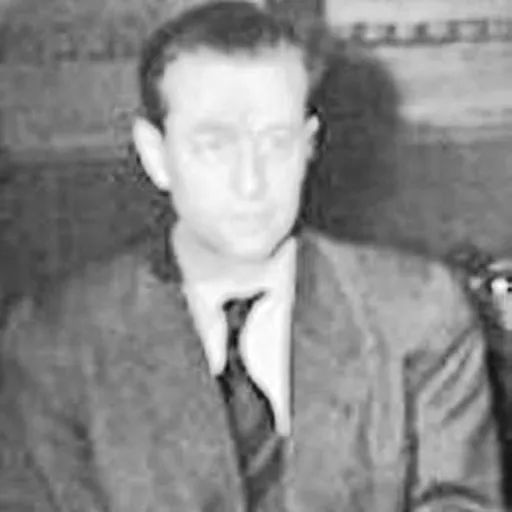
Hans Fritzsche
German Nazi official (1900-1953); International Military Tribunal defendant
About Hans Fritzsche
Lived 1900 – 1953 (aged 53). Hans Fritzsche was a German journalist, politician, radio personality, civil servant, newspaper editor and news director.
August Franz Anton Hans Fritzsche (21 April 1900 – 27 September 1953) was a German journalist and broadcaster who was the at the Reich Ministry of Public Enlightenment and Propaganda of Nazi Germany. He was the preeminent German broadcaster of his time, as part of efforts to present a more popular and entertaining side of the Nazi regime, and his voice was recognised by the majority of Germans. and served in Flanders. After the war, he studied at the universities of Greifswald and Berlin, but did not pass his examinations. In 1923 he joined the conservative German National People's Party headed by Alfred Hugenberg and also became a journalist for the Hugenberg Press, which promoted nationalistic opinions not very different from the Nazis.
Following the Nazi seizure of power, with Fritzsche as its head was incorporated into Joseph Goebbels Propaganda Ministry on 1 May 1933. Fritzsche joined the Nazi Party that same day. In 1938, Fritzsche became head of the Press Division. In November 1942, he became head of the Radio Division. Fritzsche had no involvement in creating policy.
In April 1945 he was present in the Berlin during the last days of Adolf Hitler and Goebbels. After Hitler's suicide on 30 April 1945, Goebbels assumed Hitler's role as chancellor. On 1 May, Goebbels completed his sole official act as chancellor. He dictated a letter to Soviet Army General Vasily Chuikov, requesting a temporary ceasefire and ordered German General Hans Krebs to deliver it. Chuikov commanded the Soviet forces in central Berlin. After this was rejected since the Soviets demanded unconditional capitulation, Goebbels decided that further efforts were futile. Goebbels then launched into a tirade berating the generals, reminding them Hitler forbade them to surrender. Fritzsche left the room to try to take matters into his own hands. He went to his nearby office on Wilhelmplatz and wrote a surrender letter addressed to Soviet Marshall Georgy Zhukov. An angry and drunk General Wilhelm Burgdorf followed Fritzsche to his office. There he asked Fritzsche if he intended to surrender Berlin. Fritzsche replied that he was going to do just that. Burgdorf shouted that Hitler had forbidden surrender and as a civilian he had no authority to do so. Burgdorf then pulled his pistol to shoot Fritzsche, but a radio technician knocked the gun and the bullet misfired, hitting the ceiling. Several men then hustled Burgdorf out of the office and he returned to the bunker. Fritzsche then left his office and went over to the Soviet lines and offered to surrender the city.
Military tribunal
Fritzsche was taken prisoner by Soviet Red Army soldiers. At first he was held prisoner in a basement and then sent to Moscow for interrogation at Lubyanka Prison where, according to his own account, three gold teeth were yanked from his mouth upon arrival. He was confined to a "standing coffin", a cell where it was impossible to sleep, and placed on a bread and hot water diet; he eventually signed a confession. Later, he wrote his account of Soviet prison while on trial at Nuremberg, which was published in Switzerland.
Nuremberg prosecutor Alexander Hardy later said that evidence not available to the prosecution at the time proved Fritzsche not only knew of the extermination of European Jews but also "played an important part in bringing [Nazi crimes] about," and would have resulted in his conviction and execution. Fritzsche was classified as Group I (Major Offenders) by a denazification court, which sentenced him to nine years of hard labor in a labour camp on 31 January 1947. He was released under an amnesty in September 1950. He married his second wife, Hildegard Springer, in 1950.
According to British intelligence, Fritzsche, in the early 1950s, was part of the Naumann Circle, a group of ex-Nazis who aimed to infiltrate the Free Democratic Party and eventually restore the Nazi state.
Publications Account of the Nuremberg trials.
Don’t just read it —
keep it.
Full-length biographies made to live with: read them, listen on the way to work, watch them tonight.
- E-book
- Audio
- Video
Instant download · yours to keep · every purchase keeps this site free
Important facts
People in Hans Fritzsche's life
Named in this biography and alive at the same time

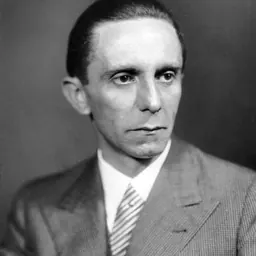

Related people
Same field, nearest in time




Contemporaries
People whose lives overlapped Hans Fritzsche's



Frequently asked questions
Who was Hans Fritzsche?
German Nazi official (1900-1953); International Military Tribunal defendant
When was Hans Fritzsche born?
Hans Fritzsche was born on 21 April 1900 in Bochum.
When did Hans Fritzsche die?
Hans Fritzsche died on 27 September 1953 in Cologne.
What was Hans Fritzsche's occupation?
Hans Fritzsche was a journalist, politician, radio personality, civil servant, newspaper editor and news director.
What nationality was Hans Fritzsche?
Hans Fritzsche was German.
Sources & further reading
Cite this page
APA: Biography.guide. (2026). Hans Fritzsche. https://biography.guide/hans-fritzsche/
MLA: "Hans Fritzsche." Biography.guide, https://biography.guide/hans-fritzsche/.
Chicago: "Hans Fritzsche." Biography.guide. https://biography.guide/hans-fritzsche/.
Data last updated: 2026-09-20 · Spot an error? Report a correction.
Page generated 2026-09-27 05:09 UTC