
Hans Denck
German theologian and Anabaptist leader
About Hans Denck
Lived 1495 – 1527 (aged 31–32). Hans Denck was a German translator, bible translator, theologian and humanist.
Hans Denck ( – November 27, 1527) was a German theologian and Anabaptist leader during the Reformation.
Biography Denck was born in 1495 in the Bavarian town of Habach. He entered the University of Ingolstadt on October 10, 1517, and graduated in 1519. Denck began working as a family tutor in Niederstotzingen.
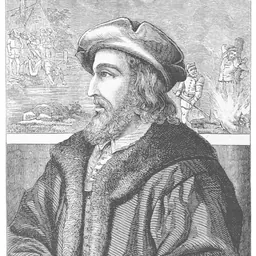
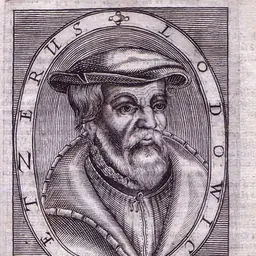
In 1525 he went to Augsburg where he met in April 1526 Balthasar Hubmaier who impressed him very much and who most probably baptized him. In late 1526 he fled from there and arrived in Strasbourg in November 1526 where he stayed with Ludwig Haetzer, a like-minded Anabaptist. He was also expelled from there, and after a long time of wandering in Southern Germany and Switzerland he found refuge with Johannes Oekolampad in Basel. After attending the Martyrs' Synod in Augsburg, he returned to Basel where he died in 1527 of bubonic plague. In his writings he fiercely attacked the reformers; together with Haetzer he translated the Biblical books of the Prophets into German (Worms 1527).
Theology Denck was influenced by the German theologian Johannes Tauler's mysticism. For Denck the living, inner word of God was more important than the letters of the Scripture. This belief was contrary to the Lutheran belief of giving scripture primacy.
It is not clear if Denck was Anti-Trinitarian. His enemies as well as modern Unitarian scholars have presented him as Anti-Trinitarian, despite the lack of evidence of this in Denck's own writings. Clearly though, he was a non-dogmatic Christian.
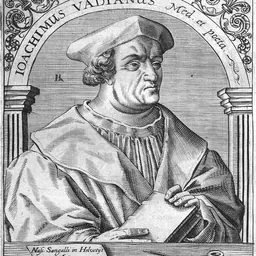
Joachim Vadian and Johann Kessler accused Denck of Universalism, but according to Ludlow, he merely hoped for the salvation of all, and his accusers were mistaken or trying to discredit him. However, Ludlow was unaware of a lesser-known account by sympathetic pastor Sigelsbach of a conversation where Denck said it was "evident that the blasphemy of the damned will stop in the end". Moreover, Urbanus Rhegius wrote how Denck confessed to him, after over a year of denying, "that he believed that no man or devil was eternally damned".
Denck's universalism sprang from his convictions that God is always merciful because He is love, loves His enemies as He teaches us to love ours, uses only corrective albeit sometimes painful and long-lasting ("eternal") punishment, and draws everyone back to unity in Him. Origen's influence probably played a role. Unlike Origen, though, it seems that Denck avoided writing about universalism for fear of the authorities and preached it instead. After Denck's death, universalism was reportedly confessed by an Anabaptist imprisoned for heresy in 1528, and Denck's student Clement Ziegler published two treatises defending it in 1532, though he would keep quiet about it the last 20 years of his life.
Selected works
Von der wahren Liebe. Reprint of the edition Worms 1527. Nördlingen: Uhl 1983. Alle Prophetenn Nach Hebräischer Sprache verdeutscht. Translation: Ludwig Hätzer u. Hans Dengk. Augspurg 1530. Microfiche-edition: The radical Reformation microfiche project [Mikroform]. Section 1, Mennonite and related sources up to 1600. Zug: InterDocumentation Comp., 19XX. Micha der Prophet auss rechter Hebraischen sprach verteutsch und wie den H. D. auf diese letste Zeit verglichen hat. Strassburg.
Don’t just read it —
keep it.
Full-length biographies made to live with: read them, listen on the way to work, watch them tonight.
- E-book
- Audio
- Video
Instant download · yours to keep · every purchase keeps this site free
Important facts
People in Hans Denck's life
Named in this biography and alive at the same time
Related people
Same field, nearest in time

Contemporaries
People whose lives overlapped Hans Denck's

Frequently asked questions
Who was Hans Denck?
German theologian and Anabaptist leader (1495-1527)
When was Hans Denck born?
Hans Denck was born in 1495 in Habach.
When did Hans Denck die?
Hans Denck died in 1527 in Basel.
What was Hans Denck's occupation?
Hans Denck was a translator, bible translator, theologian and humanist.
What nationality was Hans Denck?
Hans Denck was German.
Sources & further reading
Cite this page
APA: Biography.guide. (2026). Hans Denck. https://biography.guide/hans-denck/
MLA: "Hans Denck." Biography.guide, https://biography.guide/hans-denck/.
Chicago: "Hans Denck." Biography.guide. https://biography.guide/hans-denck/.
Data last updated: 2026-09-20 · Spot an error? Report a correction.
Page generated 2026-09-27 05:09 UTC