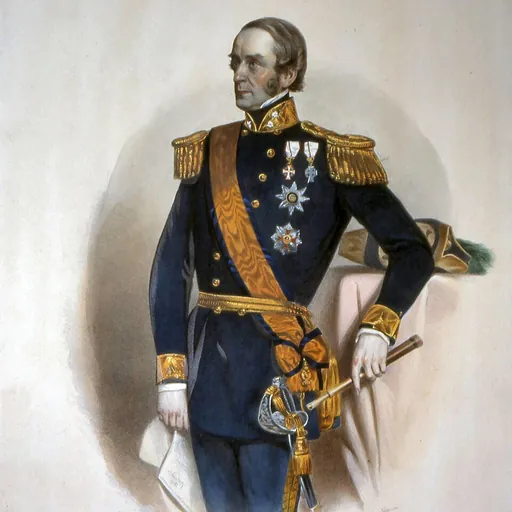
About Hans Dahlerup
Lived 1790 – 1872 (aged 82). Hans Dahlerup was a Danish naval officer, admiral, sailor, military officer and writer.
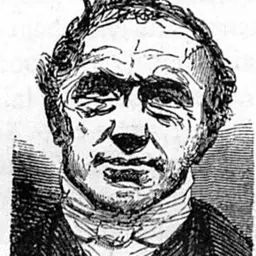
Vice-Admiral Hans Birch Dahlerup (25 August 1790 – 26 September 1872) was a Danish naval officer. He was among Denmark's most important naval strategists in the 19th century. Dahlerup rose through the ranks to become a counter admiral in the Royal Danish Navy. He also served as vice admiral and commander-in-chief of the Imperial Austrian Navy after the Revolution of 1848. Dahlerup rebuilt the Austrian navy and led the blockade and recapture of Venice in 1849. For these efforts, he was knighted by Franz Joseph I of Austria. Dahlerup had a broad interest in culture and science. He was fluent in German, English, French and Italian as foreign languages. He wrote his memoirs, published in four volumes after his death.
Early life Dahlerup grew up in a family of civil servants in Hillerød on Zealand. His father, Hans Jensen Dahlerup, came from a simple background in East Jutland, but as a young man he was employed by an official in Hillerød, and once sailed as a cabin clerk on a merchant ship to Tranquebar in India. Hans knew little else about his father's family and upbringing. When Hans was growing up, his father was the Amtmann in Frederiksborg County. He was also a civil magistrate and auctioneer. Later, he became a road tax collector, hospital superintendent, and postmaster. His mother, Sophie Marie Birch, was the daughter of a goldsmith. When she died in 1799 of tuberculosis, his father then married her sister, Vilhelmine.
The home was not particularly wealthy, but rich in talent. Hans read avidly from his father's book collection. Hans' brothers and half-brothers became lawyers, priests, and officers. His half-brother Edvard became King Christian VIII's personal physician. His sisters married officials.
Young naval officer during the Napoleonic Wars Dahlerup was first captured during the Battle of Zealand Point, where his brother Jens lost his life.
When the Gunboat War broke out between Denmark-Norway and Britain in 1807, he was a second lieutenant. He served on the ship of the line HDMS Prinds Christian Frederik, which had been sent to Norway and thus avoided the Battle of Copenhagen. He was seriously ill on the lower deck when the ship entered combat during the Battle of Zealand Point, where was captured by the British. As an officer, he was treated well, and the following year he was released.
Dahlerup then came to Silda as commander of two gun schooners and a gun dinghy, crewed by local fishermen, farmers and craftsmen. In 1810 they were attacked by a superior British force and he surrendered the schooner without loss of life. He was again captured and sent to Reading in England, but exchanged in 1811. Back in Bergen he was court-martialed for the surrender but was acquitted.
In the summer of 1813, he became commander of a gun sloop in the Sound, where his mission was to hinder British and Swedish convoys. In October he was reconnoitring in the Great Belt, but came across a British convoy and ended up being captured for the third time. He was imprisoned until the conclusion of peace in 1814.
His stays in the Danish West Indies lasted for months, and Dahlerup became acquainted with many officials and plantation owners, but he particularly valued his friendship with Governor-General Adrian Benjamin Bentzon. In 1818, Dahlerup and Sneedorff bought their own brig and sailed to England, but were unable to make the venture profitable. They sold the ship and returned to the navy. After completing his service in the merchant navy, Dahlerup taught English and naval artillery at the naval academy. He was also chairman of the :da:Søe-Lieutenant-Selskabet and editor of the journal Archiv for Søvæsen. The journal addressed many current political issues, such as slavery in the Danish West Indies.
Dahlerup praised Governor-General Peter von Scholten's efforts to improve the living conditions of slaves in the Danish West Indies, including better education, the right to free their slaves, the right to change their own slave owners, and protection from arbitrary punishment. Dahlerup saw this as a first step towards "the threshold of complete civil freedom",
In 1838 he took the frigate Rota to the Mediterranean, partly as a training exercise for the crew, and partly to bring the sculptor Bertel Thorvaldsen and his works home from Rome. Thorvaldsen was received as a hero in Copenhagen.
At the same time, a new Danish Ministry of the Navy was established under :da: Christian Christopher Zahrtmann, an old friend of Dahlerup’s, who asked him to take on the task of getting the navy combat-ready. Dahlerup was in poor health and said he was too busy with other tasks. After the armistice in August 1848, Dahlerup published a paper criticizing Zahrtmann's naval strategy. The government disliked his outspokenness but thought it best not to intervene. This incident made Dahlerup and Zahrtmann become enemies.
In February 1849, Zahrtmann was asked by an Austrian envoy to allow an experienced Danish naval officer to take command of the shattered and demoralized Austrian navy. The Danish government saw this as an opportunity to split Austria and Prussia, who were competing for leadership of the German Confederation, while both were also confronting the Danes in Schleswig and Holstein. Zahrtmann invited Dahlerup to take up the offer. Dahlerup was reluctant but was eventually persuaded that it was important to “the Danish cause". However, after its defeat at the battle of Custoza, the Kingdom of Sardinia was obliged to abandon its support for Venice and withdraw its fleet. Dahlerup then led a reorganized Austrian squadron to Venice and blockaded it. In May 1849 Dahlerup also blockaded and bombarded the Ancona, which surrendered to the Austrians on 19 June.
Venice itself surrendered on 22 August, after which there was a huge celebration. "It was a triumph that surpassed in pomp anything I had ever experienced," recalled Dahlerup. He and Field Marshal Radetzky sailed down the Grand Canal, to salutes and flag-raising. At St. Mark's Square, they were presented with the keys to the city by the city's officials and clergy and mass of thanksgiving was then held in St. Mark's Basilica. Dahlerup recommended acquiring new ships and new naval artillery. Although new steamships were commissioned, he mostly continued to rely on sailing ships as the backbone of the navy. Nevertheless, he was accused by German nationalists of “danifying" the navy. He tried to put an end to officers being promoted at their own request, or because they were of noble lineage. While rebuilding the Austrian navy, Dahlerup also wanted to undermine Austrian ambitions within the German Confederation which might lead to the navy coming under some kind of unified German command structure.
Dahlerup found the many intrigues in the Austrian military very wearing. He began to sense that he no longer had the emperor's full confidence, and rumours began to circulate of his resignation. In July 1851, Dahlerup was formally dismissed by the emperor's adjutant general Karl Ludwig von Grünne. He was offered a position as naval inspector but decided to go home.
Dahlerup was deeply offended and believed that the king and government had broken their promises.
Family life
In 1829 Dahlerup married Louise Margrethe van Dockum (1799–1840), daughter of Admiral Jost van Dockum and sister of the later Admiral and Minister of the Navy Carl Edvard van Dockum. But as long as her father-in-law was alive, she was "almost happy," she wrote in her memoirs.
Honours
Grand Cross of the Order of St. Gregory the Great (Holy See)
Don’t just read it —
keep it.
Full-length biographies made to live with: read them, listen on the way to work, watch them tonight.
- E-book
- Audio
- Video
Instant download · yours to keep · every purchase keeps this site free
Important facts
People in Hans Dahlerup's life
Named in this biography and alive at the same time



Related people
Same field, nearest in time





Contemporaries
People whose lives overlapped Hans Dahlerup's




Frequently asked questions
Who was Hans Dahlerup?
Danish naval officer (1790–1872)
When was Hans Dahlerup born?
Hans Dahlerup was born on 25 August 1790 in Hillerød.
When did Hans Dahlerup die?
Hans Dahlerup died on 26 September 1872 in Frederiksberg, Copenhagen.
What was Hans Dahlerup's occupation?
Hans Dahlerup was a naval officer, admiral, sailor, military officer and writer.
What nationality was Hans Dahlerup?
Hans Dahlerup was Danish.
Sources & further reading
· DBpedia: Hans Birch Dahlerup
Cite this page
APA: Biography.guide. (2026). Hans Dahlerup. https://biography.guide/hans-dahlerup/
MLA: "Hans Dahlerup." Biography.guide, https://biography.guide/hans-dahlerup/.
Chicago: "Hans Dahlerup." Biography.guide. https://biography.guide/hans-dahlerup/.
Data last updated: 2026-09-22 · Spot an error? Report a correction.
Portrait: Wikimedia Commons · author & licence
Page generated 2026-09-27 05:02 UTC