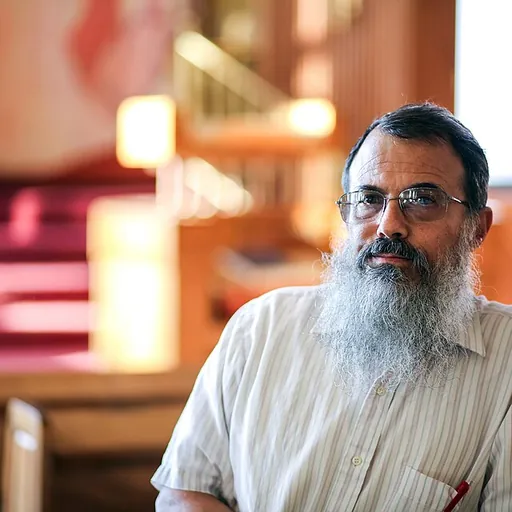
Hanan Schlesinger
Rabbi
About Hanan Schlesinger
Rabbi Hanan Schlesinger is an Israeli Orthodox rabbi and activist. Along with Ali Abu Awwad and Shaul Judelman, Schlesinger cofounded Roots – Judur – Shorashim, a joint Palestinian-Israeli grassroots peacemaking initiative dedicated to understanding nonviolence and transformation, where he currently remains director of international relations. He also serves as the Executive Director and Community Rabbinic Scholar for the Jewish Studies Initiative of North Texas and as coordinator for Faiths in Conversation, a framework for Muslim-Jewish-Christian interfaith dialogue which he found in 2012.
A biography regarding his speaking engagements writes, “In these two capacities, he (Schlesinger) teaches adult education classes on Judaism and spearheads interfaith projects throughout the greater Dallas area. He is also a member of the Rabbinical Council of America and the International Rabbinic Fellowship, as well as Beit Hillel (an Israeli rabbinical association dedicated to influencing a more inclusive, Halakha-observant Judaism). He is a Rabbis Without Borders Fellow, and was honored in 2013 and again in 2014 as the Memnosyne Institute Interfaith Scholar.
Early life
After growing up in New York, Schlesinger moved to Israel at the age of 20, served in the Israeli Defense Forces, and completed a BA through Empire State College, the open university of New York State. He has invested a great deal in strengthening his Jewish education, having studied over ten years in Israeli Yeshivot, primarily at Yeshivat Har Etzion, and in an M.A. program of Jewish Philosophy at Hebrew University.
The first part of his professional career was dedicated to teaching Jewish studies in various colleges and seminaries in the Jerusalem area, as well as in different frameworks in Florida and Texas. Schlesinger's website details his various engagements in Jewish education over the years: “From 1998 to 2000 he served as a fellow in the Judaic Fellows Program of Boca Raton, Florida. In 2005 Rabbi Schlesinger came to Dallas, Texas to serve as the head of the Community Kollel, and he spent eight years serving the Dallas Jewish community. When the Community Kollel folded in 2010, he founded the Jewish Studies Initiative of North Texas to continue the educational work he had been doing in the larger Jewish community of Dallas."
He has four grown children and twelve grandchildren.
Interfaith work Ten years ago in Dallas, Schlesinger began his work in cultivating interfaith dialogue and connections across faith and cultural backgrounds. He served as a speaker for a local organization called Connecting our Faiths and later spearheaded the founding of Faiths in Conversation, a framework for Jewish-Christian-Muslim theological dialogue. His website notes, “The experience of these trialogues inspired him to attempt to meet Muslims and Christians back in the Holy Land."
Personal transformation Schlesinger, an Orthodox rabbi and teacher, is also a self-described “passionate Zionist settler." He moved to the West Bank in 1983 “out a deep sense of the fact that Jewish destiny has come to a deep consummation, and I wanted to be part of the Jewish destiny…In front of my eyes, I saw the fulfillment of 2,000 years of Jewish dreams and hopes, and the resilience of a people, after so much destruction. I saw the triumph of the spirit, the fulfillment and consummation of our people, and I saw tremendous justice in it. I saw the triumph of the human spirit. I saw justice all around me". His website notes that he had never “met a Palestinian as an equal until he returned to Gush Etzion from Dallas” a few years ago."
In another article, he mentions, “I have never been the same since that fateful day when I met the Palestinians who are today my friends, partners and life guides.”
Roots developed out of experiences of personal transformation like Schlesinger's: “We created Roots as a framework to bring these two sides together, to listen very deeply to each other, and to find a way to absorb some of the Other’s truth and fear and narrative and identity into our own identities” Schlesinger said.”
Commenting on the nature of the conflict, Schlesinger is quoted as saying, “There are absolutely religious elements to the (Israeli-Arab) conflict. Those elements are often ignored by secular politicians who want to sweep them under a rock and think that if we ignore them, we could make peace between secular Jews and secular Palestinians. But we believe that religion is playing a role in the conflict and we believe it has to play a role and can play a role in the solution.”
His own religiosity opened up the conversation with the Palestinian experience he once unwittingly ignored: “I had been blind to the story of Palestinians, so I began to develop the religious ideology that is based in the mysticism that sees God as the infinite collection of partial truths. And then, six months after we first met, we see that we have created something.”
The same article touches upon the anti-normalization movement in the West Bank, which sees any contact with Israelis as unacceptable, and how it remains an obstacle to Roots’ efforts. Schlesinger makes a rejoinder to the movement: “Instead of encouraging contact that would allow each side to humanize the other, efforts to build barriers between our two peoples encourage us all to remain stuck in an ‘us’ and ‘them’ zero-sum game.”
He goes on, “We need the Palestinians to allow us to get to know them. For far too many Israelis, the words “Palestinian" and "terrorist" are interchangeable, and “relations" with Palestinians have been limited to construction sites and menial labor. They are little more than blood-thirsty bus-bombers, barely alive as real human characters in the story of our joint Holy Land. Palestinians must show us their human face. They must allow themselves to engage in dialogue and human reconciliation so that we break out of stereotypes and ignorant misconceptions. Ironically, we need the Palestinians to rescue us from this mess. Only with their help can we get out of this quagmire and return to our true selves."
His work at Roots reflects a belief that human contact and dialogue will prepare the ground from which justice and freedom, peace and security, can take root.
Don’t just read it —
keep it.
Full-length biographies made to live with: read them, listen on the way to work, watch them tonight.
- E-book
- Audio
- Video
Instant download · yours to keep · every purchase keeps this site free
Important facts
Frequently asked questions
Who was Hanan Schlesinger?
rabbi
When was Hanan Schlesinger born?
Hanan Schlesinger was born in Brooklyn.
Sources & further reading
· Wikipedia: Hanan Schlesinger
Cite this page
APA: Biography.guide. (2026). Hanan Schlesinger. https://biography.guide/hanan-schlesinger/
MLA: "Hanan Schlesinger." Biography.guide, https://biography.guide/hanan-schlesinger/.
Chicago: "Hanan Schlesinger." Biography.guide. https://biography.guide/hanan-schlesinger/.
Data last updated: 2026-09-22 · Spot an error? Report a correction.
Page generated 2026-09-27 05:10 UTC