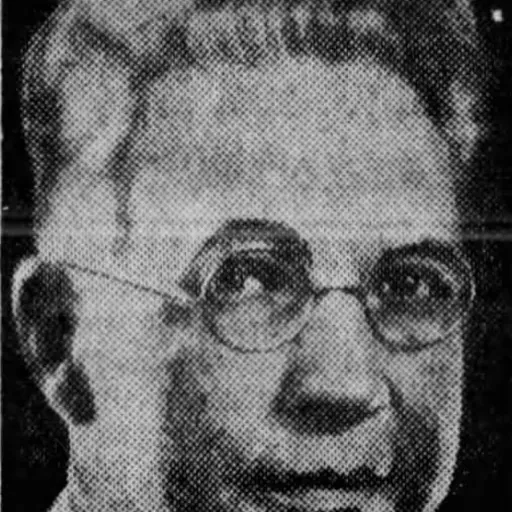
About Halsted L. Ritter
Lived 1868 – 1951 (aged 83). Halsted L. Ritter was an American lawyer, judge and writer.
Halsted Lockwood Ritter (July 14, 1868 – October 15, 1951) was a United States district judge of the United States District Court for the Southern District of Florida. He was the thirteenth individual to be impeached by the United States House of Representatives and the fourth individual to be convicted and removed from office in an impeachment trial before the United States Senate. He was also the last federal official to be impeached by the House of Representatives until Harry E. Claiborne (not counting Richard Nixon, who resigned before he was impeached), when he was impeached in 1936 and removed from office by the Senate on a general charge of misbehavior, after being acquitted on all six specific articles, including two counts of tax evasion.
Education and career
Born on July 14, 1868, in Indianapolis, Indiana, Ritter received a Bachelor of Philosophy degree in 1891, a Bachelor of Laws in 1892, and an Artium Magister degree in 1893, all from DePauw University.
In 1919, as a member of the Denver Lions Club, he attended the association's 3rd international convention in Chicago, where he proposed what would become the association's slogan - "liberty, intelligence, and our nation's safety", a backronym for the Lions name.
In 1925, he moved to West Palm Beach, Florida for his wife's health and continued in private practice until 1929. Ritter was the author of 1931's Washington as a Business Man, a work that explored George Washington's career as an entrepreneur and land speculator.
Federal judicial service
Ritter was nominated by President Calvin Coolidge on January 23, 1929, to a seat on the United States District Court for the Southern District of Florida vacated by Judge Rhydon Mays Call.
On March 2, 1936, the United States House of Representatives voted to impeach Ritter by 181 votes to 146 (with 7 present and 96 not voting).
Ritter then asked the Supreme Court to hear the case. The Court declined. In his petition, he argued he had not been convicted on an impeachable charge, and said the Senate's action amounted to an attempt to "amend the Constitution without popular consent." Impeachment Is Appealed; Former Judge-Ritter Asks Supreme Court Review of Ouster, New York Times, Jan. 19, 1937
During the trial itself, the defense had asked the Senate to throw out Article VII, the general charge, entirely. The Senate refused. The New York Times reported that the defense had described the article as "a catch-all of all charges." "Judge Ritter Denies All House Charges", New York Times, April 4, 1936
Subsequent legal assessment
Ritter's conviction on a single general article, after acquittal on six specific ones, drew renewed legal and journalistic attention in the decades that followed.
Within days of the verdict, New York Times columnist Arthur Krock came to its defense. He reasoned that because federal judges hold office only so long as they exhibit "good behavior," the Senate was not required to establish a specific crime — only that a judge's conduct had compromised public confidence in the court. Krock also pointed to the Senate's unanimous vote against barring Ritter from future office. He read that vote as evidence the Senate did not view Ritter as having committed a specific crime, though the vote does not specify the senators' reasoning. In the Nation; Issues of Judicial Conduct Posed in Ritter Case, New York Times, April 22, 1936
Nearly four decades later, Ritter's case resurfaced amid the debate over whether to impeach President Nixon, as lawmakers grappled with whether impeachment demands proof of an actual crime. The New York Times observed that Ritter remained the only individual the Senate had convicted after acquitting him on every specific charge brought against him, having removed him instead on a general accusation. The article also noted that Nixon's defense team invoked Ritter's case to argue it set no precedent applicable to a president, since judges — unlike presidents — hold office only during "good behavior." Issue and Debate, New York Times, July 24, 1974
That same year, Yale law professor Charles L. Black Jr. published an influential study of impeachment, arguing that the further a case strays from clearly criminal conduct, the more difficult it becomes to determine with confidence whether the underlying behavior is genuinely impeachable. Charles L. Black Jr., Impeachment: A Handbook (Yale University Press, 1974)
Reporting on the same proceedings, a separate Times article noted that Nixon's case marked the first occasion since Ritter's removal in 1936 that a federal official had faced this kind of congressional reckoning. A Historic Charge, New York Times, July 28, 1974
A 2019 Congressional Research Service report on the constitutional basis for impeachment also discussed Ritter's case directly. It noted that his was the first impeachment ever challenged in court, and that he had argued the Senate improperly convicted him on a single general article after acquitting him on each of the six specific charges against him. Impeachment and the Constitution, Congressional Research Service, R46013 (Nov. 20, 2019; updated Dec. 6, 2023)
Later career and death
After his removal from office, Ritter continued to practice law in Miami, Florida. He became ill while flying to the West Coast, and stopped in New Orleans, Louisiana. He subsequently traveled to Laurel, Mississippi, to recover while staying with friends. He died there on October 15, 1951.
Personal
Ritter's sister was Mary Ritter Beard, the wife of Charles A. Beard; both were noted historians.
Don’t just read it —
keep it.
Full-length biographies made to live with: read them, listen on the way to work, watch them tonight.
- E-book
- Audio
- Video
Instant download · yours to keep · every purchase keeps this site free
Important facts
People in Halsted L. Ritter's life
Named in this biography and alive at the same time




Related people
Same field, nearest in time
Contemporaries
People whose lives overlapped Halsted L. Ritter's



Frequently asked questions
Who was Halsted L. Ritter?
American judge (1868–1951)
When was Halsted L. Ritter born?
Halsted L. Ritter was born on 14 July 1868 in Indianapolis.
When did Halsted L. Ritter die?
Halsted L. Ritter died on 15 October 1951 in Laurel.
What was Halsted L. Ritter's occupation?
Halsted L. Ritter was a lawyer, judge and writer.
What nationality was Halsted L. Ritter?
Halsted L. Ritter was American.
Sources & further reading
· Wikipedia: Halsted L. Ritter
Cite this page
APA: Biography.guide. (2026). Halsted L. Ritter. https://biography.guide/halsted-l-ritter/
MLA: "Halsted L. Ritter." Biography.guide, https://biography.guide/halsted-l-ritter/.
Chicago: "Halsted L. Ritter." Biography.guide. https://biography.guide/halsted-l-ritter/.
Data last updated: 2026-09-23 · Spot an error? Report a correction.
Portrait: Wikimedia Commons · author & licence
Page generated 2026-09-27 05:07 UTC