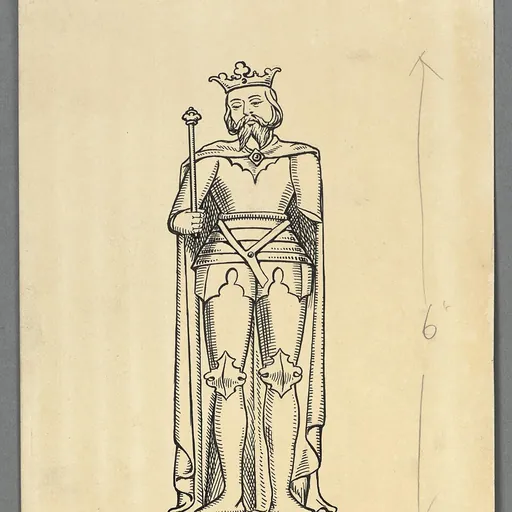
About Gwynllyw
Lived 500 – 520. Gwynllyw was a Welsh sovereign.
Gwynllyw Filwr or Gwynllyw Farfog , known in English in a corrupted form as Woolos the Warrior or Woolos the Bearded (; 450 – 500 A.D.) was a Welsh king and religious figure.
He was King of Gwynllŵg in South Wales and is the legendary founder and patron saint of the City of Newport, living in the 5th century. According to medieval tradition, he was a feared warlord and livestock raider who was acquainted with the mythical King Arthur, but later encountered religion and became a hermit, founding St Woolos Cathedral in Newport. He was the father of one of the most revered of Welsh saints, Saint Cadoc the Wise.
Traditional history The medieval lives of Saint Cadoc (c. 1100) by Lifris and of Saint Gwynllyw (c. 1120) preserve fabled details of Gwynllyw, though specifics frequently differ. He is also noted in Welsh king lists. The aforementioned descriptions of Gwynllyw note that his deeds were celebrated by Welsh bards, indicating he had a widespread popular following. Although saints' lives frequently exaggerate, it does seem likely that a monarch of this name existed. A core element in such narratives may contain some elements that are historically accurate.
Gwynllyw was the son of King Glywys, whose powerful kingdom of Glywysing was centred on Glamorgan. It is debatable where the north-west border was, but the prevailing conclusion among historical accounts and historians is the course of the River Loughor from Black Mountain (near Talgarth), i.e. the current border between Carmarthenshire and Swansea. Gwynllyw was a descendant of Macsen Wledig according to some accounts, while his mother Guaul was equally distinguished, being the granddaughter of Cunedda. The kingdom was split on Glywys' death amongst his sons, of whom Gwynllyw was the eldest and most powerful, and he was overlord over the others. The centre of his domain was the cantref of Gwynllwg; named after him, and to be later known in English as Wentloog hundred. One of Gwynllyw's brothers was Saint Petroc, an important Cornish, and Breton saint, and patron saint of Devon.
Narratives of Gwynllyw portray him as an active and merciless warrior who attacked and raided nearby kingdoms. The Life of Saint Cadoc describes him as "very partial to thieves, and used to instigate them somewhat often to robberies" but the Life of Saint Gwynllyw insists he was a just and fair ruler. These raids included attacking his northern neighbour Brycheiniog.
Marriage In one such raid, described in Life of Saint Cadoc, Gwynllyw led some 300 men to abduct King Brychan of Brycheiniog's beautiful daughter Gwladys (Gladys), as Brychan had refused to let him marry her. She was one of Brychan's famous twenty-four children. A pitched battle ensued, arrested only by the intervention of Cai and Bedwyr, supporting Gwynllyw and his warriors, and assisted allegedly by the fabled King Arthur. This tale of abduction resembles elements in the tale Culhwch and Olwen and other Arthurian stories, suggesting it originated in bardic stories. Among the various hagiographies, this, the Life of Saint Cadoc, is the earliest reference to the legendary Arthur. According to the Life of Saint Gwynllyw this battle seems never to have occurred; the marriage contracted amicably.
Gwladys soon had a son, the celebrated Saint Cadoc. To mark his son's birth Gwynllyw went on another raid, stealing cattle from Caerwent. When Saint Tathyw approached courageously, to demand the return of a cow, the king was so impressed he decided in response to send his son to Tathyw to be educated at Caerwent. Gwynllyw reputedly had other children, also saints: Cynidr, Bugi and Egwine. Bugi was married to Peren, daughter of King Lleuddun Llyddog of Lothian. One, Maches (Latin: Machuta), the sister of Cadoc according to tradition, was killed by robbers stealing her finest ram. Tathan, to whom the murderers confessed their crime, built a church on the spot.
Hermit Once grown, Cadoc was deeply religious. According to some sources, it was his example and preaching that persuaded Gwynllyw to abandon his life of violence and to seek forgiveness for his sins. King Gwynllyw is said to have had a dream in which an angel spoke to him, and he saw a vision of a white ox with a black spot high on its forehead. The story goes that Gwynllyw set out, and when he saw the ox of his dream he founded a hermitage there, on what is now Stow Hill in Newport, South Wales, which he built out of wood. Of this spot Gwynllyw said "There is no retreat in the world such as in this space which I am destined now to inhabit. Happy therefore is the place, happier then is he who inhabits it." Similarly, a man's having been supernaturally driven mad after stealing from Gwynllyw's church is mere fancy. continued to enlarge the church – a process that has continued up to the present day.
Post-medieval folklore
Stories of Gwynllyw's dark past later included tales of piracy and claims that his ships, based in the Uskside parish of Pillgwenlly that bears his name, caused terror across the Bristol Channel. One tradition asserts that this background meant Gwynllyw was the patron saint of choice for Welsh pirates and smugglers including Sir Henry Morgan. Certainly the many sailors based in Newport would have known of him. Another local story claims that Gwynllyw forcibly baptised the population of Gwynllwg by the sword.
Legacy In 1949 St Woolos Church became a full cathedral and, besides churches, the saint is remembered today through St Woolos Hospital, St Woolos Primary School and in 1988 a Welsh language school, Ysgol Gyfun Gwynllyw, was set up in Pontypool.
The vision of an ox inspired the sculpture by Sebastien Boyesen called The Vision of Saint Gwynllyw or The Bell Carrier, finished in 1996 and found in central Newport today.
Don’t just read it —
keep it.
Full-length biographies made to live with: read them, listen on the way to work, watch them tonight.
- E-book
- Audio
- Video
Instant download · yours to keep · every purchase keeps this site free
Important facts
People in Gwynllyw's life
Named in this biography and alive at the same time

Related people
Same field, nearest in time


Contemporaries
People whose lives overlapped Gwynllyw's



Frequently asked questions
Who was Gwynllyw?
Welsh sovereign (c. 450-500)
When was Gwynllyw born?
Gwynllyw was born in 500 in Gwynllwg.
When did Gwynllyw die?
Gwynllyw died in 520.
What was Gwynllyw's occupation?
Gwynllyw was a sovereign.
What nationality was Gwynllyw?
Gwynllyw was Welsh.
Sources & further reading
Cite this page
APA: Biography.guide. (2026). Gwynllyw. https://biography.guide/gwynllyw/
MLA: "Gwynllyw." Biography.guide, https://biography.guide/gwynllyw/.
Chicago: "Gwynllyw." Biography.guide. https://biography.guide/gwynllyw/.
Data last updated: 2026-09-21 · Spot an error? Report a correction.
Portrait: Wikimedia Commons · author & licence
Page generated 2026-09-27 05:00 UTC