
About Guy de Chauliac
Lived 1290 – 1368 (aged 77–78). Guy de Chauliac was a French physician, surgeon and canon.
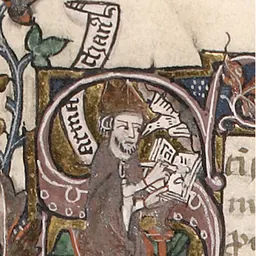
Guy de Chauliac , also called Guido or Guigo de Cauliaco ( – 25 July 1368), was a French physician and surgeon who wrote a lengthy and influential treatise on surgery in Latin, titled Chirurgia Magna. It was translated into many other languages (including Middle English) and widely read by physicians in late medieval Europe.
Life Guy de Chauliac was born in Chaulhac, Lozère, France, into a family of modest means. He began his study of medicine in Toulouse before going to study in Montpellier, the center for medical knowledge in the 14th century of France. He was in Paris between 1315 and 1320, and around 1325, he became a Master of Medicine and Surgery. After receiving his degree, he went to Bologna to study anatomy under Nicola Bertuccio, from whom he may have learned surgical techniques. It is unknown whether de Chauliac applied his surgical studies and knowledge. Charles H. Talbot writes, It was seemingly from books that [Chauliac] learned his surgery.... He may have used the knife when embalming the bodies of dead popes, but he was careful to avoid it on living patients. Others, including Thevenet, claim that Chauliac moved to Mende and then Lyons to practice medicine after learning the art of surgery from Bertuccio. The great death toll began in our case in the month of January , and lasted for the space of seven months. It was of two kinds: the first lasted two months; with continuous fever and spitting of blood; and death occurred within three days. The second lasted for the whole of the remainder of the time, also with continuous fever, and with ulcers and boils in the extremities, principally under the arm-pits and in the groin; and death took place within five days. And [it] was of so great a contagion (especially when there was spitting of blood) that not only through living in the same house but merely through looking, one person caught it from the other.The plague was recognized as being contagious although the agent of contagion was unknown; as treatment, Chauliac recommended air be purified, venesection (bleeding), and healthy diet. The outbreak of plague and widespread death was blamed on Jews, who in some areas were believed to have poisoned wells; Chauliac fought against this idea, using science to declare the theory untrue.
Works
Chirurgia magna
Chauliac's seminal work on surgery, Chirurgia magna, was finished in 1363 in Avignon, France, just after the bubonic plague. In seven volumes, the treatise covers anatomy, bloodletting, cauterization, drugs, anesthetics, wounds, fractures, ulcers, special diseases, and antidotes. He describes surgical techniques such as intubation, tracheotomy, and suturing,
Chauliac quoted frequently from other medical works, written by contemporaries or those written by earlier physicians and anatomists, as he sought to describe the history of medicine. He claimed that surgery began with Hippocrates and Galen, and was developed in the Islamic world by Haly Abbas, Albucasis, and Al-Razi. Through his position as papal physician, Chauliac had access to Galen's texts, recently translated by Niccolò da Reggio from original Greek versions, which were more accurate than the Latin translations.
As well as owing a debt to Galen, Chirurgia magna was greatly influenced by Islamic scientists, and de Chauliac references Avicenna often in the work. The work became popular and was translated into English, French, Dutch, Italian, and Provençal. It was translated into Irish by Cormac Mac Duinnshléibhe. It was reworked multiple times, including to remove references to Islamic scientists, to the point that the work was no longer recognizable as Chauliac's own.
De Chauliac recognized the importance of Montpellier with respect to surgical study.
Emphasis on anatomy Galen's influence on Chauliac can clearly be seen in the latter's belief that surgeons should have a thorough understanding of anatomy. He wrote, "A surgeon who does not know his anatomy is like a blind man carving a log". He also describes the dissection of a corpse in accordance with Galen's beliefs about the human body. De Chauliac's (and his contemporaries) unwillingness to look outside of textbook knowledge was one of the reasons that Chauliac's anatomical descriptions are not always correct.
Other works Three other works were written by Chauliac: Practica astrolabii (De astronomia), an essay on astrology; De ruptura, which describes different types of hernias; and De subtilianti diaeta, describing treatments for cataracts.
Don’t just read it —
keep it.
Full-length biographies made to live with: read them, listen on the way to work, watch them tonight.
- E-book
- Audio
- Video
Instant download · yours to keep · every purchase keeps this site free
Important facts
Related people
Same field, nearest in time



Contemporaries
People whose lives overlapped Guy de Chauliac's
Frequently asked questions
Who was Guy de Chauliac?
French surgeon (ca. 1300-1368)
When was Guy de Chauliac born?
Guy de Chauliac was born in 1290 in Chaulhac.
When did Guy de Chauliac die?
Guy de Chauliac died on 25 July 1368 in Avignon.
What was Guy de Chauliac's occupation?
Guy de Chauliac was a physician, surgeon and canon.
What nationality was Guy de Chauliac?
Guy de Chauliac was French.
Sources & further reading
Cite this page
APA: Biography.guide. (2026). Guy de Chauliac. https://biography.guide/guy-de-chauliac/
MLA: "Guy de Chauliac." Biography.guide, https://biography.guide/guy-de-chauliac/.
Chicago: "Guy de Chauliac." Biography.guide. https://biography.guide/guy-de-chauliac/.
Data last updated: 2026-09-20 · Spot an error? Report a correction.
Page generated 2026-09-27 05:18 UTC