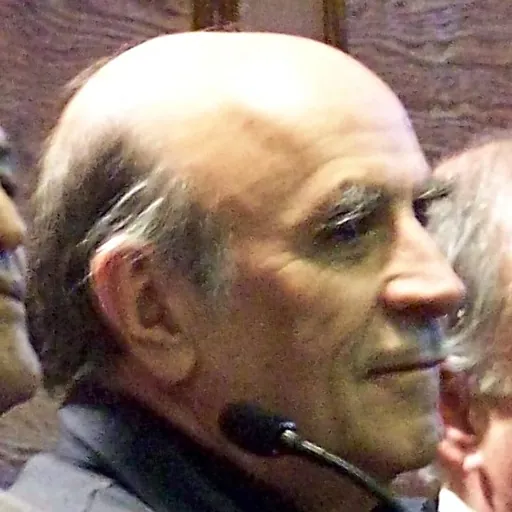
About Gustavo Esteva
Lived 1936 – 2022 (aged 85). Gustavo Esteva was a Mexican author and activist.
Gustavo Esteva (20 August 1936 – 17 March 2022) was a Mexican activist, "deprofessionalized intellectual" and founder of the Centro de Encuentros y Diálogos Interculturales and the Universidad de la Tierra in the Mexican city of Oaxaca. He was one of the best-known advocates of post-development.
Life and career
Esteva was born in Mexico City on 20 August 1936, as the third child of Elodia Figueroa and Guillermo A. Esteva, a politician, writer and professor. Esteva's father died early.
Esteva worked for different companies. "Despite the personal discomfort brought about by an increasing awareness of the fraud of the original promise of my profession, I advanced rapidly in my career."
From 1970 to 1976 he was a high-ranking official in the government of President Echeverría.
When he gave up this job, he was totally disillusioned about statist development practices.
A long session with [the next president][...]López Portillo and his top advisors two weeks before he took office removed any doubts for me as to the path I should take. In that session the President announced unequivocally that his policies would be adverse to the peasants. Five days after this session I initiated the first of two non profit organizations, entering thus the world of civil society in which I have been working since then.
Esteva was an advisor with the Zapatista Army for National Liberation in Chiapas for the negotiations with the government. He worked at the Centre for Intercultural Dialogues and Exchanges (CEDI) in the city of Oaxaca, published regularly in different journals, and worked with Indian groups and NGOs. In 2019 he co-created the Global Tapestry of Alternatives process.
Esteva died in Oaxaca on 17 March 2022 aged 85.
Thinking Esteva had a Catholic upbringing. During his studies at the Universidad IberoAmericana, Gustavo approached a jesuit philosopher and asked him if it was possible to rationally prove the existence of god. After many readings and meetings with the philosopher, he arrived at the conclusion that it was not possible. When he lost his faith in God he replaced it with a faith in reason. Through his studies he became familiar with instrumental rationality; dissatisfied he turned, after some soul searching, to Marxism. During the 70s Esteva
[...] took part in a very intense debate regarding the peasants. The debate took place throughout Latin America and especially in Mexico, which partially were resonating to a world debate. The topic of this debate allowed me to advance a radical critique of Marxism's well-known position on the peasants. I was classified as a 'campesinista' in contrast to various other intellectual positions, in a debate basically celebrated within the Marxist framework. Even though I continued, for a long time, to consider myself a Marxist, little by little I abandoned Marxism as a doctrine and as a political and ideological orientation. [...] In that process, through which I came closer and closer in contact with the concrete activities of peasants, I was able to question the categories of all the disciplines in which I had been educated or which I had learned on my own. I began to formulate a radical critique of development. This change in my thinking could be clearly seen in the name of an umbrella organization, Analysis, Development and Gestión, created in 1979 to coordinate the actions of many other NGOs we had constituted in that period.
[...]
I suspect that the most important rupture in my life occurred when I began to remember my experiences with my grandmother as a child. She could not come to our house in Mexico City through the front door because she was an Indian. She was not allowed by my mother to talk to us in Zapotec or tell us stories about her community. My mother assumed that the best she could do for her children was to radically uproot them from their Indian ancestry. But I adored my grandmother and during holidays asked to be sent with her, to Oaxaca. Remembering my grandmother, remembering what she taught me in spite of the restrictions imposed by my mother –something I had in the back of my mind through my previous journey-, re-membered me with the people at the grassroots. I described this experience in a text written in 1986 and which I still consider an important guiding text, "Regenerating People's Space." In this text I alluded to the new questions that I began to ask myself in that time, and also some of the ways in which I began to confront them. My theoretical work on people of the margins, which was abundant in those years, very clearly shows a new path which was consolidated and affirmed when I met Ivan Illich in 1983.
The rupture with previous ways of thinking and acting is clearly evident in the 80s. What I did and what I wrote clearly illustrates it. I still, however, found myself, especially in the sphere of ideas, rooted in the Western horizon of intelligibility. Only after moving to live in the Zapotec village of San Pablo Etla, in Oaxaca, in 1989, and after my involvement with the Zapatistas starting in 1994, was I able to abandon that horizon and seriously entertain the possibility that a new horizon had appeared for me, even though I was still not able to fully articulate it.
Discussing the national identity Esteva refers to Guillermo Bonfil' distinction between a profound (México profundo) and an imaginary Mexico (México imaginario). He questions the modern obsession with planning the future and "projects" of all kinds:
The contrasting attitude of the indigenous peoples, according to Esteva, is not to reject change, but
Traditionally the indigenous people did not oppose their own project to the dominant project—but times have changed:
Selected works Books David Barkin, Gustavo Esteva: Inflación y Democracia : El Caso de México, México : Siglo XXI, 1979 Gustavo Esteva: Economía y enajenación [Economy and alienation], México, D.F. : Biblioteca Universidad Veracruzana, 1980 Gustavo Esteva: La batalla en el México rural, México : Siglo XXI, 1982. James E. Austin and Gustavo Esteva (ed.):Food policy en Mexico : the search for selfsufficiency, Ithaca; London : Cornell Univ. Pr., 1987 Gustavo Esteva: Fiesta - jenseits von Entwicklung, Hilfe und Politik, Frankfurt a. M. : Brandes & Apsel, 1992 -German translation of a selection of essays, enlarged second edition in 1995 Gustavo Esteva: Crónica del fin de una era : el secreto del EZLN, México : Ed. Posada, 1994 Gustavo Esteva Figueroa and Madhu Suri Prakash: Hope at the margins : beyond human rights and development, New York : St. Martin's Press, 1997 Madhu Suri Prakash and Gustavo Esteva: Escaping education : living as learning within grassroots cultures, New York [etc.]: Peter Lang, 1998 Gustavo Esteva and Madhu Suri Prakash: Grassroots post-modernism : remaking the soil of cultures, London & New Jersey: Zed Books, 1998 Gustavo Esteva, and Catherine Marielle (eds.):Sin maíz no hay país: páginas de una exposición, México : Consejo Nacional para la Cultura y las Artes, Dirección General de Culturas Populares e Indígenas, 2003 Gustavo Esteva, Salvatore Babones, and Philipp Babcicky: The future of development : a radical manifesto, Bristol: Policy Press, 2013 Gustavo Esteva, a cura di, Ripensare il mondo con Ivan Illich, Riola (Bo), Mutus Liber, 2014 Gustavo Esteva, Nuovi ambiti di comunità Per una riflessione sui 'beni comuni, Collana Voci da Abya Yala, Documenti dall'America latina, a cura del gruppo Camminardomandando, Edizioni Mutus Liber, 2016 Gustavo Esteva, Gustavo Esteva: A Critique of Development and Other Essays, Routledge, 2022Book Chapters'''
Esteva, Gustavo. (1971). "El Mito de La Planeación Económica Mexicana." [The Myth of Mexican Economic Planning] In Cuestiones Económicas Nacionales, ed. Banco Nacional de Comercio Exterior. México: Banco Nacional de Comercio Exterior. Esteva, Gustavo. (1974). "Autosuficiencia y Reorganización de La Producción, Claves de La Estrategia Agropecuaria Tomo I." [Self-sufficiency and Reorganization of Production, Keys to Agropecuary Strategy Tome I] In Memoria Del Primer Congreso Nacional de Economistas, ed. Colegio Nacional de Economistas. México: Colegio Nacional de Economistas. Esteva, Gustavo. (1980). "La economía campesina actual como opción de desarrollo, una noción, un proyecto de investigación y un programa de acción de desarrollo" [Current Peasant Economy as a Development Option, A Notion, a Research Project and a Development Action Plan], México: Ensayos COPIDER. Esteva, Gustavo. (1984). "Capacitación para el desarrollo vernáculo y ciudadanía" [Training for Vernacular Development and Citizens], In Centro de Investigación para el Desarrollo Rural Integral (Ed.), La capacitación en el medio rural, México: CIDERI. Esteva, Gustavo. (1986). "En la hora del encuentro" [The Hour of the Encounter], en: Adolfo Aguilar Zinzer, Cesáreo Morales y Rodolfo Peña (Eds.), Aún tiembla. Sociedad política y cambio social: el terremoto del 19 septiembre de 1985. México, Grijalbo. Esteva, Gustavo. (1987). "Development as a threat: the struggle for rural Mexico,"In Teodor Shanin (Ed.), Peasants and peasant societies. Oxford: Basil Blackwell. Esteva, Gustavo. (1987). "Regenerating people´s space", In Saúl H. Mendlovitz (Ed.), Towards a just world peace. Londres: Butterworths. Esteva, Gustavo. (1989)."Alternatives to Economics", In Macroeconomics 89´90. Connecticut: The Dushkin Publishing Group. Esteva, Gustavo: "Development" in The Development Dictionary. A Guide to Knowledge as Power, London & New Jersey: Zed Books, 1992, pp. 6–25 Esteva, Gustavo. (1993). "On Behalf of People's Dignity: An Argument for Resisting the Idea of Being Developed", In Camilla Nielsen, Oliver Rathcolb (Eds.), From Cancún to Vienna. International Development in a New World. Viena: The Bruno Kreisky Forum for International Dialogue. Esteva, Gustavo. (1996). "Hosting the otherness of the other", S. Marglin and Frederique Apfel-Marglin, (Eds.), Decolonizing Knowledge: From Development to Dialogue. Clarendon: Oxford University Press. Esteva, Gustavo. (1997). "From Global Thinking to Local Thinking" (with Madhu S. Prakash) and "Basta! Mexican Indians Say 'Enough'", Majid Rahnema, with Victoria Bawtree, The Post-Development Reader. London: Zed Books. Esteva, Gustavo. (2009). "Volver a la mesa" [Returning to the Table], In Pratec, Soberanía alimentaria y cultura de la comida en la América profunda, Lima: Pratec Esteva, Gustavo. (1998). "The Revolution of the New Commons" C. Cook and J.D.Lindau (Eds.), Aboriginal Rights and Self.Government. Montreal: McGill-Queen's University Press. Esteva, Gustavo. (2001). "Mexico: Creating Your Own Path at the Grassroots", In V. Benntholdt-Thomsen, N. Faraclas and C. Von Werlhof (Eds.), There Is an Alternative: Subsistence and Worldwide Resistance to Corporate Globalization. Victoria: Spinifiex Press/Londres y Nueva York: Zed Books. Esteva, Gustavo; Stuchul, D.; Prakash, M.K; Shiksha; V. (2002). "From a Pedagogy for Liberation to Liberation from Pedagogy." In Unfolding Learning Societies: Experiencing the Possibilities. Udaipur, Rajasthan, India: Shikshantar, The Peoples' Institute for Rethinking Education and Development. Esteva, Gustavo.(2004). "Un mundo de muchos mundos" [A World of Many Worlds], with Martina Kaller. "Eine dialogische Perspektive auf die mexikanische Agrargeschichte." In Wolfgang Dietrich/Stefanie Reinberg (Hrs.), Lateinamerika und Europa: Auf dem Weg zu einem gemeinsamen Bildungs . und Kulturraum? Frankfurt: Brandes and Apsel/Sudwind. Esteva, Gustavo. (2005). "Universidad de la Tierra: The freedom to learn", "Development – Walking Beyond: From promotion to Co-motion", "Learning from Literacy Campaigns: An Intercultural approach to Orality", "Cultural regeneration, instead of Education" and "Time for celebration." In S. Pimparé and C. Salzano (Eds.), Emerging and re-emerging leaning communities: Old wisdoms and new initiatives from around the world. Paris: UNESCO. Esteva, Gustavo. (2008). "The Other Campaign, APPO and the Left." In Diana Denham & C.A.S.A. Collective, Teaching Rebellion: Stories from the Grassroots Mobilization in Oaxaca. Oakland: PM Press. Esteva, Gustavo. (2010). "Beyond education", Lois Meyer & Benjamín Maldonado Alvarado (Eds.), New World of Indigenous Resistance: Noam Chomsky and Voices from North, South and Central America. San Francisco: City Lights Books. Esteva, Gustavo. (2018). "Friendship, Hope and Surprise." In V. Brunetta and K. O'Shea (Eds.), Durty Words, Limmerick, Ireland: Durty Words Publishing House. Esteva, Gustavo. (2019). "El camino hacia el diálogo de vivires." [The Path Towards the Dialogue of Vivires] In Stefano Sartorello (Coord.), Diálogo y conflict interepistèmicos en la construcción de una casa común, Mexico: Universidad Iberoamericana. Esteva, Gustavo. (2019). "Caminos de autonomía bajo la tormenta" [Pathways to Autonomy through the Storm], In G. Makaran, P. López and J. Wahren (Coords.), Vuelta a la autonomía, Mexico: Bajo Tierra Ediciones/Editorial El Colectivo/UNAM/CEALC. Esteva, Gustavo. (2019)."Postdevelopment @25: on being 'stuck' and moving forward. Sideways, backward and otherwise." In E. Klein and C.E. Morreo, Postdevelopment in Practice: Alternatives, Economies, Ontologies, London & New York: Routledge. Esteva, Gustavo. (2020). "Repensar El Carácter Del Régimen Dominante" [Rethinking the Character of the Dominant Regime]. In Raúl Ornelas and Daniel Inclán (eds.), Cuál Es El Futuro Del Capitalismo, Ciudad de México: UNAM, 69–104. Esteva, Gustavo. (2020). "El día después" [The Day After]. In Segato, R.S; Krenak, A.; Escobar, A.; Esteva, G.; Hackeo Cultural; Toro Pérez, C.; Leff, E.; De Sousa Santos, B.; Zibechi, R.; Claivjo Gallego, T.; Mignolo, W.; Torrez, Y.F.; Reichmann, J.; Adrían Almazán and 300 more; Angulo Jara, C.; Cisneros Ordoñez, W.A.; Dagua Mosquera, A.L.; Hernández Romero, R.; Niebles Guitiérrez, G.A.; Yarza de los Ríos, V.A.; Albán Achinte, A. Prometeo, Pandemia al Sur. Prometeo. Articles Esteva, Gustavo. (1991). Development: the modernization of poverty. Panoscope, 27, November, 28. Esteva, Gustavo: "Tepito: No Thanks, First World", in: In Context, num. 30, Fall/Winter 1991 Esteva, Gustavo; Prakash, M.S. (1992). Grassroots Resistance to Sustainable Development: Lessons from the Banks of the Narmada, The Ecologist, Vol. 22, No. 2, March/April, pp. 45–51. See also Lokayan Bulletin, Summer 1992. Esteva, Gustavo: "Re-embedding Food in Agriculture", in: Culture and Agriculture [Virginia, USA], 48, Winter 1994 Esteva, Gustavo: "From 'Global Thinking' to 'Local Thinking': Reasons to Go beyond Globalization towards Localization", with M.S.Prakash, in: Osterreichische Zeitschirift für Politikwissenschatft, 2, 1995 Esteva, Gustavo:"Hosting the Otherness of the Green Revolution" in: Frédérique Apffel-Marglin and Stephen A. Marglin, eds.: Decolonizing Knowledge: From Development to Dialogue. Oxford: Clarendon Press, 1996, pp. 249–278 Esteva, Gustavo: "Beyond Development, What?", with M.S. Prakash, in: Development in Practice, Vol. 8, No.3, August 1998. Esteva, Gustavo: "The Zapatistas and People's Power", in Capital & Class, 68, Summer 1999. Esteva, Gustavo: "The meaning and scope of the struggle for autonomy" in: Lat. Am. Perspect., 28:2, March 2001, pp. 120–148 Esteva, Gustavo(2004a): "Back from the future" -Notes for the presentation in "Schooling and Education: A Symposium with Friends of Ivan Illich" organized by TALC New Vision, Milwaukee, October 9, 2004. online Esteva, Gustavo(2004b):"Rupturas:" Turning Points online Esteva, Gustavo. (2007). The Asamblea Popular de los Pueblos de Oaxaca: A Chronicle of Radical Democracy. Latin American Perspectives, Issue 152, January 2007. Esteva, Gustavo. (2007). Oaxaca: The Path to Radical Democracy. Socialism and Democracy, Vol.21, July 2007, pp. 74–96. Esteva, Gustavo: The Oaxaca commune and Mexico's autonomous movement's, Oaxaca de Juárez, Oaxaca, México : Ed. ¡Basta!, 2008, 22 p. Esteva, Gustavo. (2012). Pensar todo de nuevo: anticapitalismos sin socialismo. Una conversación con Teodor Shanin. Bajo el volcán, 11, 18, marzo-agosto. Esteva, Gustavo. (2015). Pensar desde el abismo. La Voz de la Tribu, No. 2: 23-29. Esteva, Gustavo. (2015). The Hour of Autonomy. Latin American and Caribbean Ethnic Studies, Vol. 10, No. 1: 134-145.
Don’t just read it —
keep it.
Full-length biographies made to live with: read them, listen on the way to work, watch them tonight.
- E-book
- Audio
- Video
Instant download · yours to keep · every purchase keeps this site free
Important facts
People in Gustavo Esteva's life
Named in this biography and alive at the same time







Related people
Same field, nearest in time




Contemporaries
People whose lives overlapped Gustavo Esteva's





Frequently asked questions
Who was Gustavo Esteva?
Mexican activist
When was Gustavo Esteva born?
Gustavo Esteva was born on 20 August 1936 in Mexico City.
When did Gustavo Esteva die?
Gustavo Esteva died on 17 March 2022 in Oaxaca.
What was Gustavo Esteva's occupation?
Gustavo Esteva was an author and activist.
What nationality was Gustavo Esteva?
Gustavo Esteva was Mexican.
Sources & further reading
Cite this page
APA: Biography.guide. (2026). Gustavo Esteva. https://biography.guide/gustavo-esteva/
MLA: "Gustavo Esteva." Biography.guide, https://biography.guide/gustavo-esteva/.
Chicago: "Gustavo Esteva." Biography.guide. https://biography.guide/gustavo-esteva/.
Data last updated: 2026-09-24 · Spot an error? Report a correction.
Portrait: Wikimedia Commons · author & licence
Page generated 2026-09-27 05:08 UTC