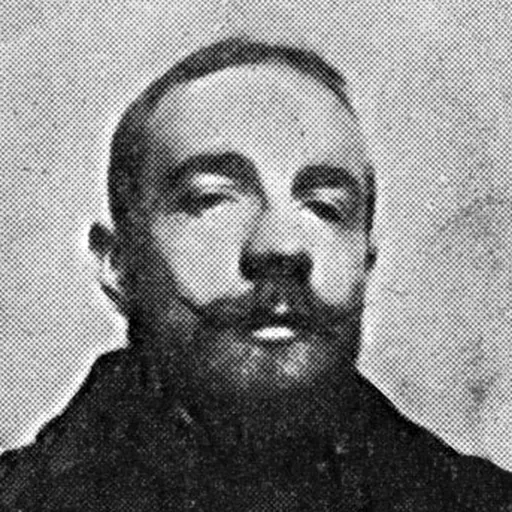
About Gustave Verbeek
Lived 1867 – 1937 (aged 70). Gustave Verbeek was a Dutch writer, sculptor, illustrator, painter and comics artist.
Gustave Verbeek (; born Gustave Verbeck ; August 29, 1867 – December 5, 1937) was a Japanese-born American illustrator and cartoonist of Dutch ancestry, best known for his newspaper cartoons in the early 1900s featuring an inventive use of word play and visual storytelling tricks.
He was ill for two years, and died on December 5, 1937, at the Home for Incurables, on Third Avenue and 183rd Street in the Bronx, New York. He had been a patient there for two months.
Comics Verbeek's first strip was Easy Papa, a fairly conventional strip about two mischievous kids and their father, similar to the highly popular contemporary strip The Katzenjammer Kids, which ran in a competing newspaper. Easy Papa appeared in The New York Herald from May 25, 1902, through February 1, 1903.
Verbeek is most noted for The Upside Downs of Little Lady Lovekins and Old Man Muffaroo, a weekly 6-panel comic strip in which the first half of the story was illustrated and captioned right-side-up, then the reader would turn the page up-side-down, and the inverted illustrations with additional captions describing the scenes told the second half of the story, for a total of 12 panels. His signature usually appeared at the top of the first/last panel, upside down. The two main characters were designed such that each would be perceived as the other character when inverted. For example, in one often-reproduced panel, Muffaroo appears in a canoe next to a tree-covered island, and is being attacked by a large fish. When inverted, the image shows a later scene of Lovekins in the beak of a giant roc: Muffaroo's canoe has become the bird's beak, the fish has turned into the bird's head, the island has become its body and the trees its legs, and Muffaroo has turned into Lovekins. Verbeek created a total of 64 of these strips for The New York Herald, from October 11, 1903, to January 15, 1905. A pilot strip was published on October 4, 1903. The format of the strip put extreme restrictions on the use of word balloons (even with the use of ambigrams only three strips used word-balloons, all in March 1904). Although the July 10, 1904, strip implies that the stories are set in America, Verbeek filled his milieu with African animals and peoples, fabulous monsters, fairy castles, etc.
Verbeek's longest-running strip was The Terrors of the Tiny Tads, published by the Herald from May 28, 1905, to October 28, 1914. This strip features a group of four unnamed and interchangeable boys, who encounter a variety of strange creatures based on inventive word combinations. For example, they find a "hippopautomobile" (a hippopotamus with a steering wheel and seating in its back as in an automobile), a "pelicanoe" (a pelican in which a rider could sit and paddle like a canoe), and a "samovarmint" (a samovar for serving tea with the head and claws of a wild animal). As with The Upside Downs, the strip's text consisted of captions below the illustrations; there were no speech balloons. Dan Nadel describes the strip as "quiet, subdued, and somnambulant" in character, partly because Verbeek eschewed "speed lines, stars of pain", and other such cartoon conventions. The Incredible Upside-Downs of Little Lady Lovekins and Old Man Muffaroo, G.W. Dillingham Company (New York) in 1905. The Incredible Upside-Downs of Gustave Verbeek, The Rajah Press ( Summit, NJ) in 1963. The Incredible Upside-Downs (of Gustave Verbeek), Real Free Press International (Amsterdam;) in 1973. The Incredible Upside-Downs of Gustave Verbeek, Nostalgia Press, Incorporated (New York) in 1976. . Niet Te Geloven Ondersteboven!, Erven Thomas Rap (Amsterdam) in 1976. . Dessus-Dessous, Pierre Horay (Paris) in 1978. . Four Confusing Tales, Each Illustrated by Six Up-Turnable Pictures, from the Incredible Topsy-Turvy World of Gustave Verbeek, Tobar Limited (Harleston, Norfolk), 1990's. . Unten ist Oben, Comic Companie ( Frankfurt/Main 1; Germany) in 1985. . 少女ラブキンズとマファルー老人の冒険 (The Incredible Upside-Downs of Gustave Verbeek), TBS Publications, Tokyo in 1987. . Edited by 坂根厳夫 (Itsuo Sakane). The Upside-Down World of Gustave Verbeek, Sunday Press Books (Palo Alto, CA) in 2009. .
The 2009 reprint contains the complete The Upside-Downs of Little Lady Lovekins and Old Man Muffaroo and the complete Loony Lyrics of Lulu together with other selected samples from Verbeek's comics career.
Remakes In 2012, a remake of Verbeek's Upside-downs was published by Swedish publisher Epix. The book 'In Uppåner med Lilla Lisen & Gamle Muppen' by Marcus Ivarsson shows 24 of Verbeek's comics redrawn in the style of the author. No other attempts were made to replicate the 'upside-down' comic style.
Don’t just read it —
keep it.
Full-length biographies made to live with: read them, listen on the way to work, watch them tonight.
- E-book
- Audio
- Video
Instant download · yours to keep · every purchase keeps this site free
Important facts
Related people
Same field, nearest in time


Contemporaries
People whose lives overlapped Gustave Verbeek's



Frequently asked questions
Who was Gustave Verbeek?
Dutch-American illustrator and cartoonist (1867-1937)
When was Gustave Verbeek born?
Gustave Verbeek was born on 29 August 1867 in Nagasaki.
When did Gustave Verbeek die?
Gustave Verbeek died on 5 December 1937 in The Bronx.
What was Gustave Verbeek's occupation?
Gustave Verbeek was a writer, sculptor, illustrator, painter and comics artist.
What nationality was Gustave Verbeek?
Gustave Verbeek was Dutch.
Sources & further reading
Cite this page
APA: Biography.guide. (2026). Gustave Verbeek. https://biography.guide/gustave-verbeek/
MLA: "Gustave Verbeek." Biography.guide, https://biography.guide/gustave-verbeek/.
Chicago: "Gustave Verbeek." Biography.guide. https://biography.guide/gustave-verbeek/.
Data last updated: 2026-09-23 · Spot an error? Report a correction.
Portrait: Wikimedia Commons · author & licence
Page generated 2026-09-27 05:08 UTC