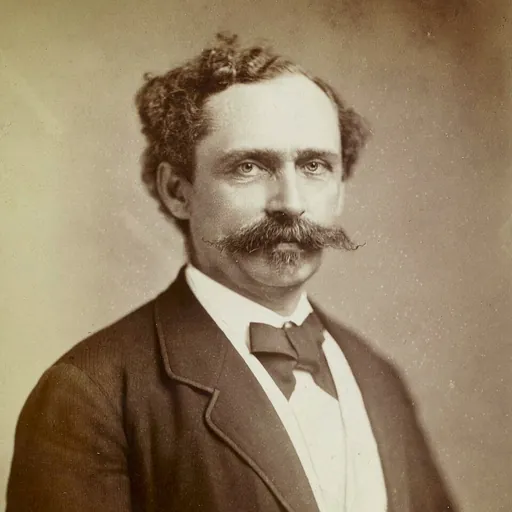
Gustav Hermann Nachtigal
German physician, consul-general and explorer of Central and West Africa
About Gustav Hermann Nachtigal
Lived 1834 – 1885 (aged 51). Gustav Hermann Nachtigal was a German explorer, writer, botanical collector, botanist, africanist and diplomat.
Gustav Nachtigal (; born 23 February 1834 – 20 April 1885) was a German military surgeon and explorer of Central and West Africa. He is also known as the German Empire's consul-general for Tunisia and Commissioner for West Africa. His mission as commissioner resulted in Togoland and Kamerun becoming the first colonies of a German colonial empire.
Early life and education Gustav Nachtigal, the son of a Lutheran pastor and his wife, was born on 23 February 1834 at Eichstedt in the Prussian province of Saxony-Anhalt. His father died of Phthisis pulmonum (pulmonary tuberculosis) in 1839, when the boy was five.
After early education, Nachtigal studied medicine at the universities of Halle, Würzburg, and Greifswald. In 1882, he was awarded the Royal Geographical Society's Founder's Medal.
After the establishment of a French protectorate over Tunisia, Nachtigal was sent as consul-general for the German Empire and served there until 1884. Thereafter, he was appointed by Chancellor Otto von Bismarck as special commissioner for West Africa. in front of the Kamerun colonial government building.
Legacy
Along with Heinrich Barth, Nachtigal has been regarded as the other important German explorer of Africa.
He had witnessed slave hunts performed by African rulers and the cruelties inflicted by them upon other Africans. The horror that he felt about these atrocities made him enter colonial endeavours, because he believed that European domination of the African continent might stop slave-hunting and slave ownership.
In 2022, "Nachtigalplatz" (Nachtigal Square) in Berlin was renamed "Manga-Bell-Platz", in honor of Duala king and resistance leader Rudolf Duala Manga Bell.
Works Original Publication Saharâ und Sûdân. 2 volumes, Berlin 1879-81, volume 3 published by E. Groddeck, Leipzig 1889.
English Translation Sahara and Sudan. volume I: Fezzan and Tibesti; volume II: Kawar, Bornu, Kanem, Borku, Ennedi; volume III: The Chad Basin and Bagirmi; volume IV: Wadai and Darfur. Translated from the original German with an Introduction and Notes by Allan G. B. Fisher and H. J. Fisher. London — New York — Berkeley - 1971–1987.
Don’t just read it —
keep it.
Full-length biographies made to live with: read them, listen on the way to work, watch them tonight.
- E-book
- Audio
- Video
Instant download · yours to keep · every purchase keeps this site free
Important facts
more
Gustav Nachtigal, G. H. Nachtigall, G. Nachtigal, Gustav H. Nachtigal, Gustav H. NachtigallPeople in Gustav Hermann Nachtigal's life
Named in this biography and alive at the same time

Related people
Same field, nearest in time


Contemporaries
People whose lives overlapped Gustav Hermann Nachtigal's



Frequently asked questions
Who was Gustav Hermann Nachtigal?
German physician, consul-general and explorer of Central and West Africa (1834–1885)
When was Gustav Hermann Nachtigal born?
Gustav Hermann Nachtigal was born on 23 February 1834 in Eichstedt.
When did Gustav Hermann Nachtigal die?
Gustav Hermann Nachtigal died on 20 April 1885 in Cape Palmas.
What was Gustav Hermann Nachtigal's occupation?
Gustav Hermann Nachtigal was an explorer, writer, botanical collector, botanist, africanist and diplomat.
What nationality was Gustav Hermann Nachtigal?
Gustav Hermann Nachtigal was German.
Sources & further reading
· Wikipedia: Gustav Hermann Nachtigal
Cite this page
APA: Biography.guide. (2026). Gustav Hermann Nachtigal. https://biography.guide/gustav-hermann-nachtigal/
MLA: "Gustav Hermann Nachtigal." Biography.guide, https://biography.guide/gustav-hermann-nachtigal/.
Chicago: "Gustav Hermann Nachtigal." Biography.guide. https://biography.guide/gustav-hermann-nachtigal/.
Data last updated: 2026-09-21 · Spot an error? Report a correction.
Portrait: Wikimedia Commons · author & licence
Page generated 2026-09-27 04:59 UTC