
About Günther Simon
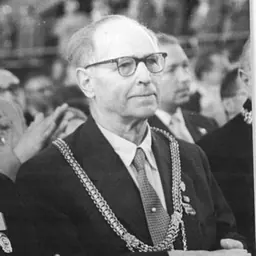
Lived 1925 – 1972 (aged 47). Günther Simon was a German actor, voice actor, stage actor, film actor and television actor.
Günther Simon (11 May 1925 – 25 June 1972) was an East German actor.
Biography
Early life A bank clerk's son, Simon attended an acting school already in Gymnasium. At the age of 16, he was sent to a premilitary training camp of the Hitler Youth and then drafted to the Reich Labour Service. He volunteered to join the paratroopers in August 1943. He was captured by American troops near Normandy and shipped to a POW camp in Colorado, where he acted in the camp's makeshift theater.
Breakthrough After returning home in 1947, Simon took private acting lessons with Karl Meixner in the Hebbel Theater in Berlin. He made his debut on stage in the Municipal Theater of Köthen in 1948, in a production of Dmitry Scheglov's The Storm. He then moved to the Schwerin Theater, in which he remained until 1950; there, he met his wife Margarita, who was employed as a dancer. Afterwards, Simon joined the cast of the Dresden Theater. In late 1951, he left it in favour of the Leipzig Theater, where he remained for only a short period.
Summit Simon was cast for one of the leading roles in the 1952 film The Condemned Village, and since then was active mainly in cinema. At the same year, in spite of his inexperience, he was chosen to portray Ernst Thälmann in Kurt Maetzig's two-part propaganda epic about the communist leader's life. The picture was watched by millions and entered the East German schools' curriculum. Simon received the National Prize first class for his work on the first part, and the Best Actor Award in the 1956 Karlovy Vary International Film Festival for his appearance in the second. He joined the country's Socialist Unity Party of Germany (SED / Sozialistische Einheitspartei Deutschlands) in 1954 and became a member of the DEFA Studio's management.
Simon appeared in some 30 pictures throughout the years. In 1956, he was awarded the Heinrich Greif Prize second class. He won the National Prize once more, in 1968, for his portrayal of Krause in the television miniseries Krause and Krupp, and received the Art Prize of the Free German Trade Union Federation thrice, in 1967, 1968, and 1971. He had three sons and one daughter, and is buried in the Dorotheenstadt cemetery.
Partial filmography
Das verurteilte Dorf (1952) – Heinz Weimann Anna Susanna (1953) – Orje Swings Or Roundabouts (1953) – Ernst Ernst Thälmann (1954–1955, part 1, 2) – Ernst Thälmann Drei Mädchen im Endspiel (1956) Das Traumschiff (1956) – Kapitän Franz Müller Treffpunkt Aimée (1956) – Wendt Damals in Paris (1956) – Georges Tinko (1957) – Ernst Kraske Don't Forget My Little Traudel (1957) – The Peoples'-Police Commissar Sheriff Teddy (1957) – Lehrer Freitag My Wife Makes Music (1958) – Gustl Wagner Cerný prapor (1958) – Gerhardt Der Lotterieschwede (1958) – Arzt The Sailor's Song (1958) – Erich Steigert Geschwader Fledermaus (1958) – Tex Stankowsky Sun Seekers (1958) – Franz Beier Der kleine Kuno (1959) – Verkehrspolizist Senta auf Abwegen (1959) – Max Matuschek Eine alte Liebe (1959) – 1. Sekretär der SED-Kreiparteileitung First Spaceship on Venus (1960) – Deutscher Pilot / Robert / Raimund Brinkmann Einer von uns (1960) – Richard Bertram Die heute über 40 sind (1960) – Vertreter des NKFD Kein Ärger mit Cleopatra (1960) – LPG-Vorsitzender Der Moorhund (1960) – Oberleutnant Suter Die Liebe und der Co-Pilot (1961) – Richard Wagner Der Fremde (1961) – Reichert Der Traum des Hauptmann Loy (1961) – First Lt. Phil A. Rodney Der Tod hat ein Gesicht (1961) – Dr. Cramm Eine Handvoll Noten (1961) – Paul Steinmetz The Dress (1961) – Fleischer Ärzte (1961) – Dr. Brehm Mord ohne Sühne (1962) – Heinz Lippert An französischen Kaminen (1962) – General Rucker Nebel (1963) – Verteidiger At A French Fireside (1963) – SS-Gruppenführer Upitz Schwarzer Samt (1964) – Manfred Sibelka Preludio 11 (1964) – Palomino Das Lied vom Trompeter (1964) – Ernst Thälmann Der Reserveheld (1965) – Genosse Oberst Lots Weib (1965) – Richard Lot Der Frühling braucht Zeit (1965) – Erhard Faber Alfons Zitterbacke (1966) – Vater Zitterbacke Reise ins Ehebett (1966) – Kapitän Bread and Roses (1967) – Georg Landau Heroin (1968) – Zollkommissar Zinn Verdacht auf einen Toten (1969) – Major Klausnitzer Weil ich dich liebe (1970) – Paul Wienecke KLK Calling PTZ – The Red Orchestra (1971) – John Sieg Nakovalnya ili chuk (1972) – Pfarrer Ripe Cherry (1973) – Helmut Kamp Wenn du groß bist, lieber Adam (1990) – Minister (final film role)
Don’t just read it —
keep it.
Full-length biographies made to live with: read them, listen on the way to work, watch them tonight.
- E-book
- Audio
- Video
Instant download · yours to keep · every purchase keeps this site free
Important facts
People in Günther Simon's life
Named in this biography and alive at the same time







Related people
Same field, nearest in time




Contemporaries
People whose lives overlapped Günther Simon's




Frequently asked questions
Who was Günther Simon?
German actor (1925–1972)
When was Günther Simon born?
Günther Simon was born on 11 May 1925 in Berlin.
When did Günther Simon die?
Günther Simon died on 25 June 1972 in East Berlin.
What was Günther Simon's occupation?
Günther Simon was an actor, voice actor, stage actor, film actor and television actor.
What nationality was Günther Simon?
Günther Simon was German.
Sources & further reading
Cite this page
APA: Biography.guide. (2026). Günther Simon. https://biography.guide/gunther-simon/
MLA: "Günther Simon." Biography.guide, https://biography.guide/gunther-simon/.
Chicago: "Günther Simon." Biography.guide. https://biography.guide/gunther-simon/.
Data last updated: 2026-09-22 · Spot an error? Report a correction.
Page generated 2026-09-27 05:21 UTC