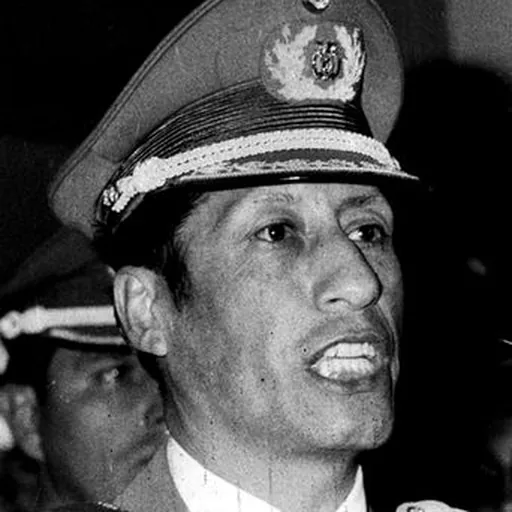
About Guido Vildoso
Born 1937. Guido Vildoso is a Bolivian politician.
General Guido Hernán Vildoso Calderón (born 5 April 1937) is a Bolivian retired military officer who served as the 59th president of Bolivia from July to October 1982. He was the last president installed by the military.
Biography Born in La Paz on 5 April 1937, Vildoso joined the Bolivian armed forces and took specialized courses in Brazil, Panama, and the United States. In the 1970s he served in the cabinet of military dictator Hugo Banzer. Vildoso was second in command in the Bolivian Army when, in July 1982, he was entrusted by his peers with the task of extricating the military from power and returning the country to constitutional, democratic rule after a period of several dictatorships. His appointment followed the highly unpopular 1980–82 dictatorships of Luis García Meza and Celso Torrelio.
Presidency (1982)
Vildoso became president of Bolivia on 21 July 1982. Faced with a grave social, economic and fiscal crisis, Vildoso accelerated the re-democratization process. He and his fellow commanders essentially had two options: call new elections, or to reconvene the 1980 Congress and respect the results of that year's presidential contest. When it became apparent that the country would crumble into civil war before new elections could be held, Vildoso's junta recalled the 1980 Congress and promised to accept its choice of president. Congress reconvened on 23 September, and its virtual first act was to reconfirm the 1980 election results, which showed former president Hernán Siles Zuazo well ahead, though short of a majority. On 5 October, Congress overwhelmingly elected Siles as president.
Vildoso returned the presidential emblems to Congress on October 10, 1982, thus closing the door on military control of Bolivia. This gesture allowed Siles to formally take office later that day. Nonetheless, Vildoso and his cabinet were loudly booed by the population present at the transfer of power to Siles. The Bolivian Congress did later acknowledge Vildoso for his two main accomplishments: restoring democracy to Bolivia with no bloodshed and developing the fundamentals of the economic plan, 21060, that was later used by President Víctor Paz Estenssoro to restore sound macroeconomic variables to the nation.
Post-presidency (1982–present) After the handover of authority, Vildoso retired from the military and currently lives in Cochabamba. To date, he is the last non-constitutional ruler of the country.
Don’t just read it —
keep it.
Full-length biographies made to live with: read them, listen on the way to work, watch them tonight.
- E-book
- Audio
- Video
Instant download · yours to keep · every purchase keeps this site free
Important facts
People in Guido Vildoso's life
Named in this biography and alive at the same time



Related people
Same field, nearest in time




Contemporaries
People whose lives overlapped Guido Vildoso's


Frequently asked questions
Who is Guido Vildoso?
President of Bolivia
When was Guido Vildoso born?
Guido Vildoso was born on 5 April 1937 in Cochabamba Department.
What is Guido Vildoso's occupation?
Guido Vildoso is a politician.
What nationality is Guido Vildoso?
Guido Vildoso is Bolivian.
Sources & further reading
Cite this page
APA: Biography.guide. (2026). Guido Vildoso. https://biography.guide/guido-vildoso/
MLA: "Guido Vildoso." Biography.guide, https://biography.guide/guido-vildoso/.
Chicago: "Guido Vildoso." Biography.guide. https://biography.guide/guido-vildoso/.
Data last updated: 2026-09-20 · Spot an error? Report a correction.
Page generated 2026-09-27 05:09 UTC