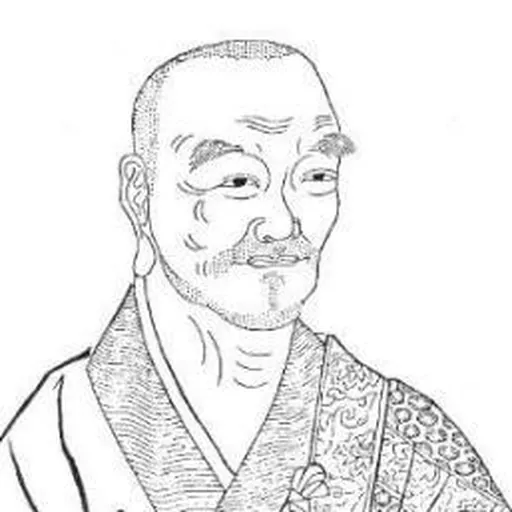
About Guanding
Lived 561 – 632 (aged 70–71). Guanding was a Chinese buddhist monk.
Guanding (, 561–632 CE), also known as Shi Guanding , was a Chinese Buddhist monk and exegete during the Sui dynasty (581–618). Guanding is traditionally recognized as the principal disciple and successor of Zhiyi (538–597), the eminent founder of the Tiantai school. He is also traditionally regarded as the fourth patriarch of the Tiantai tradition. Guanding played a decisive role in the preservation, organization, and transmission of Zhiyi's teachings, notably by ensuring that many of his master's oral discourses were systematically recorded and edited into written form. His efforts were instrumental in shaping the doctrinal and institutional legacy of Tiantai Buddhism.
Guanding was sometimes referred to by the name of his birthplace, Zhang'an (章安), and is thus often called the Master of Zhang'an or Zhang'an Guanding in historical records. Following Zhiyi's death, Guanding assumed responsibility for compiling his master's teachings, especially by writing down the "Three Great Works of Tiantai" (天台三大部), which is considered his major contribution to the establishment of Tiantai doctrine.
Life As a direct disciple of Zhiyi, the founder of the Tiantai tradition, Guanding played a critical role in systematizing and transmitting Tiantai doctrines after Zhiyi's death.
Guanding's (灌頂) secular surname was Wu, his courtesy name was Fǎyún (法雲).
Original works In addition to his editorial work, Guanding himself authored eight distinct compositions, totaling forty-nine fascicles. Among his own writings are: It provides information on early Tiantai monastic practices and the development of Guoqing Monastery as the school's central site. Zhizhe dashi biechuan (智者大師別傳, "The Supplementary Biography of Great Master Zhizhe")
Interpretation of the Great Nirvana Sutra A scene from the Nirvana Sutra, Shakyamuni's vajra body arising from his golden tomb, 11th century Heian period Hanging scroll, Kyoto National Museum. According to Guo Chaoshun, the commentaries on the Great Nirvāṇa Sūtra (Mahāyāna Mahāparinirvāṇa Sūtra), written towards the end of his life, are the "only works in which Guanding possibly expresses his independent Buddhist thinking", though he always presents his work as being "a narrow glimpse into the Master’s [Zhiyi's] intention".
The meaning of Great Nirvāṇa
Guanding sees the term Mahāparinirvāṇa (大般涅槃 Dàbōnièpán) as containing multiple layers of meaning which communicate the highest and ultimate state of the Buddha's Nirvāṇa. Glosses include “extinction,” “tranquility,” “cessation,” “release,” “liberation,” “no rebirth,” “nonexistence,” “non-self,” “elimination of suffering,” etc. Guanding also critiques the rendering of the term as “great extinction” indicating non-being or elimination, since it would entail a distortion of the intent of the Mahāparinirvāṇa Sūtra, which argues that the Buddha's Nirvana was not ultimately an actual moment of extinction (as the provisional teachings state). As a non-dual reality, Great Nirvana is also the Mahayana “Non-abiding Nirvana”, which includes the Trikāya (Triple Buddha Body): Dharmakāya (Dharma-body), Sambhogakāya (Reward-body), and Nirmāṇakāya (Transformation-body). As such, Guanding sees Mahāparinirvāṇa as indicating a truth which transcends all dualistic categories and which also embodies permanence, bliss, self and purity. Thus Guanding states:The meaning of "extinction" is like this: Extinction means stillness; stillness ends birth and death; it is the movement of sentient beings toward Buddhahood... From stillness comes permanence, from permanence comes bliss, and thus extinction is also self and purity. While including these positive qualities, Great Nirvana is also transcends all categories, thus Guanding glosses it as “non-existence yet not non-existence”. However, even this meaning is ultimately transcended, as Guanding then links Great Nirvana to Samsara itself and to the Threefold Truth of Tiantai. Thus, Guanding affirms the non-duality of Nirvāṇa and Samsāra, seeing Nirvana as an immanent and ever-present reality in all things: Just as one sees a person and recognizes the shadow, so too is it with all conditioned things. Nirvāṇa is not separate from them; even amid impermanence and suffering, Nirvāṇa is always present. Guanding analyzes the immanence of Great Nirvana by explaining how it extends into the non-obstruction and mutual interpenetration of the threefold Buddha body (Trikāya), with the threefold truth and threefold contemplation (and threefold wisdom) taught in Tiantai, all of which "are precisely Great Nirvana"... "they are not one and the same, yet neither are they different". He also explains how the three bodies (Dharmakāya, Sambhogakāya, and Nirmāṇakāya) and the three wisdoms, together forming a unity, correspond respectively to body, mind, and function. This is further mapped into further relationships with the three aspects of buddha-nature. Thus in this schema, Great Nirvana has the following threefold aspect:
Body, which is linked with essential nature and the Dharmakāya Mind which corresponds to wisdom and Sambhogakāya Function which corresponds to practice, and the Nirmāṇakāya Guanding also argues that nirvana pervades all realms of existence, and that each experience of peace and joy in all realms is a kind of nirvana. In spite of this, Nirvana is also described as "nameless" (wuming 無名) and beyond all conception. However, according to Guanding, this namelessness is not the same in all of the four teachings. In the first three teachings (Tripitaka, Shared, Distinct), namelessness is still relative and dualistic, based on different forms of negation and rejection of names and words. Meanwhile, the Complete or Well-rounded teaching of the Lotus Sutra presents the true namelessness which transcends all duality, as well as all affirmation and negation. As such, it does not negate name and form (nāmarūpa), but transcends them while also including them for the sake of convention.
Even this kind of namelessness must be transcended however, and the final realization of Nirvana is labeled as the “Transcendent Name” (絕名) by Guanding. This truly ineffable non-dual reality goes beyond all names and forms, even "nameless" and "non-nameless" or any views about relying on or letting go of name and form, "it means the mind is completely free, not dependent on or tied to anything whatsoever." This is the true Great Nirvāṇa, the Buddhahood that does not abandon the beings of the nine realms which is based on the principle of the Middle Way's Complete and Profound Interfusion (中道圓融義).
Guanding describes the different levels of understanding Great Nirvana as follows:If one sees Nirvana as the supreme good, then one is still within the realm of the Provisional Teaching. If Nirvana is seen as separate from the worldly, that too belongs to the Shared Teaching. If Nirvana is viewed as both existent and empty, that is the Distinct Teaching. But if Nirvana is seen as neither empty nor existent, as both arising and ceasing, as both worldly and transcendental, then this is the Perfect Teaching. Thus, the Transcendent Name lies in the ability to affirm and deny without clinging to either.
The Essence and Function of Nirvāṇa Guanding discusses the essence (ti 體) or true aspect of Great Nirvāṇa from five perspectives: “purity of nature”, “dharma-body”, “one truth”, “non-production and non-extinction”, and “correct nature”. Initially, he criticizes the traditional view of some early figures who claimed that the essence of Nirvāṇa is necessarily a single dharma (一法). In contrast, Guanding advocates that only through multiple modes of explanation can the true aspect of nirvāṇa be properly revealed.
The five perspectives can be summarized as follows:
"Purity of nature" (xingjing 性淨) refers to the inherent existence of nirvāṇa which is “neither cultivated nor attained, neither produced nor the result of karma" and has [always] existed. "Dharma-body" (fashen 法身) is the inconceivable body of one who realizes nirvāṇa, “the indestructible, vajra essence; it is neither form nor non-form, yet is called truly good and wondrous.” "One truth" (yidi 一諦) is the non-dual perspective in which birth-and-death, non-arising, the infinite, and non-production are one. It means that “within the one, there are infinite [truths]; within the infinite, there is the one; it is inconceivable and indescribable, but to facilitate easier understanding one is forced to distinguish it.” “Non-production and non-extinction” (不生不滅), all phenomena are neither created nor destroyed, they do not arisen and do not cease. "Correct nature" (zhengxing 正性) is that it is “neither cause nor caused cause, neither effect nor effected effect; this is called correct nature.” Regarding the Function (yong 用) of Nirvana, Guanding explains how it is “omniscient wisdom” (sarvākārājñāna, 一切種智), which can be understood in a fourfold way:
As the function of non-duality and non-distinction, which Guanding describes as "by means of the principle of the Middle Way, all dualistic oppositions are negated, and within non-duality the Buddha’s omniscient wisdom is established." As the function of actuality within phenomena, which means that "the function of Nirvāṇa does not depart from worldly dharmas; precisely within the phenomenal appearances of the world, the true and non-dual principle is manifested." As the function of responding to conditions without obstruction which "arises responsively according to the conditions [of sentient beings], applying teachings appropriate to beings’ capacities, without any obstruction, exercising spontaneous freedom." As the function of expedient means and skillful means, which teaches the Dharma in many ways and establishes countless methods, "as medicine is administered appropriate to the illness". Finally, when it comes to the teaching aspect of the Nirvana Sutra, Guanding analyzes the meaning of Nirvana according to all the four teachings, but ultimately he sees the Nirvana Sutra as being based on the Well-rounded or Complete Teaching of the Lotus Sutra which fully encompasses and also transcends the previous three teachings. He sees the Nirvana Sutra's core teaching as being the "eternity" and "abiding" (常住) nature of Buddhahood and buddha-nature, which is a teaching that, as in the Lotus Sutra, "abandons the partial and reveals complete reality" and "opens the partial to reveal complete reality".
Don’t just read it —
keep it.
Full-length biographies made to live with: read them, listen on the way to work, watch them tonight.
- E-book
- Audio
- Video
Instant download · yours to keep · every purchase keeps this site free
Important facts
People in Guanding's life
Named in this biography and alive at the same time

Related people
Same field, nearest in time


Contemporaries
People whose lives overlapped Guanding's




Frequently asked questions
Who was Guanding?
Chinese Buddhist monk
When was Guanding born?
Guanding was born in 561.
When did Guanding die?
Guanding died in 632.
What was Guanding's occupation?
Guanding was a buddhist monk.
What nationality was Guanding?
Guanding was Chinese.
Sources & further reading
Cite this page
APA: Biography.guide. (2026). Guanding. https://biography.guide/guanding/
MLA: "Guanding." Biography.guide, https://biography.guide/guanding/.
Chicago: "Guanding." Biography.guide. https://biography.guide/guanding/.
Data last updated: 2026-09-23 · Spot an error? Report a correction.
Portrait: Wikimedia Commons · author & licence
Page generated 2026-09-27 05:08 UTC