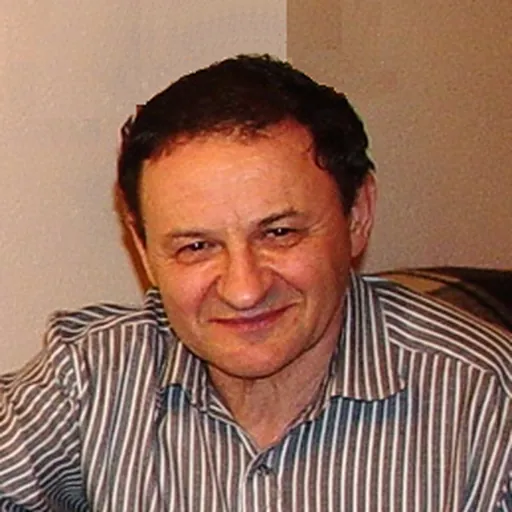
About Grigoriy Yablonsky
Born 1940. Grigoriy Yablonsky is an American chemist, engineer, mathematician and university teacher.
Grigoriy Yablonsky (or Yablonskii) is a Russian expert in the area of chemical kinetics and chemical engineering, particularly in catalytic technology of complete and selective oxidation, which is one of the main driving forces of sustainable development.
His theory of complex steady-state and non-steady-state catalytic reactions is widely used by research teams in many countries of the world (the USA, UK, Belgium, Germany, France, Norway, and Thailand).
Yablonsky previously served as an associate research professor of chemistry at Saint Louis University's Parks College of Engineering, Aviation and Technology and college of arts and sciences. Since 2017, he has served as a Senior Researcher and Adjunct Professor at the McKelvey School of Engineering at Washington University in St. Louis, as part of the Department of Energy, Environmental and Chemical Engineering.
Since 2006, Yablonsky has also been an editor of the Russian-American Middle West.
Scientific contributions
Yablonsky, together with Lazman, developed the general form of steady-state kinetic description (the kinetic polynomial'), which is a non-linear generalization of many theoretical expressions proposed previously (the Langmuir –Hinshelwood and Hougen–Watson equations). Yablonsky also created a theory of precise catalyst characterization for the advanced worldwide experimental technique (temporal analysis of products) developed by John T. Gleaves at Washington University in St. Louis.
In 2008–2011, Yablonsky, together with Constales and Marin (Ghent University, Belgium), and Alexander Gorban (University of Leicester, UK), obtained new results on coincidences and intersections in kinetic dependences and found a new type of symmetry relation between the observable and initial kinetic data.
Together with Alexander Gorban, Yablonsky developed the theory of chemical thermodynamics and detailed balance in the limit of irreversible reactions.
Yablonsky is a world recognized expert in chemical kinetics and chemical engineering, in particular Temporal analysis of products (TAP) studies. He has authored six monographs and more than 300 peer-reviewed papers on these topics. His research spans heterogeneous catalysis, kinetics of complex chemical reactions (see chemical kinetics), mathematical modeling of chemical reactors and technological processes (see chemical reactor), and the history and methodology of science.
Catalytic trigger and catalytic oscillator
A simple scheme for the nonlinear kinetic oscillations in heterogeneous catalytic reactions has been proposed by Bykov, Yablonsky, and Kim in 1978. The authors have started with the catalytic trigger (1976 ), the simplest catalytic reaction without autocatalysis that allows multiplicity of steady states.
Then they have supplemented this classical adsorption mechanism of catalytic oxidation by a "buffer" step
Here, A2, B, and AB are gases (for example, O2, CO, and CO2), Z is the "adsorption place" on the surface of the solid catalyst (for example, Pt), AZ and BZ are the intermediates on the surface (adatoms, adsorbed molecules, or radicals), and (BZ) is an intermediate that does not participate in the main reaction.
Let the concentration of the gaseous components be constant. Then the law of mass action gives for this reaction mechanism a system of three ordinary differential equations that describe kinetics on the surface.
where is the concentration of the free places of adsorption on the surface ("per one adsorption center"), x and y are the concentrations of AZ and BZ, correspondingly (also normalized "per one adsorption center"). and s is the concentration of the buffer component (BZ).
This three-dimensional system includes seven parameters. The detailed analysis shows that there are 23 different phase portraits for this system, including oscillations, multiplicity of steady states, and various types of bifurcations.
Reactions without the interaction of different components
Let the reaction mechanism consist of reactions.
where are symbols of components, r is the number of the elementary reaction and are the stoichiometric coefficients (usually they are integer numbers). (The components that are present in excess and the components with almost constant concentrations are not included.)
The Eley–Rideal mechanism of CO oxidation on PT provides a simple example of such a reaction mechanism without interaction of different components on the surface:
Let the reaction mechanism have the conservation law
and let the reaction rate satisfy the mass action law:
where is the concentration of . Then the dynamic of the kinetic system is very simple: the steady states are stable and all solutions with the same value of the conservation law monotonically converge in the weighted norm: the distance between such solutions ,
monotonically decreases in time.
This quasithermodynamic property of the systems without interaction of different components is important for the analysis of the dynamics of catalytic reactions: nonlinear steps with two (or more) different intermediate reagents are responsible for nontrivial dynamical effects like multiplicity of steady states, oscillations, or bifurcations. Without interaction between different components, the kinetic curves converge into a simple norm, even for open systems.
The extended principle of detailed balance
The detailed mechanism of many real physico-chemical complex systems includes both reversible and irreversible reactions. Such mechanisms are typical in homogeneous combustion, heterogeneous catalytic oxidation, and complex enzyme reactions. The classical thermodynamics of perfect systems is defined for reversible kinetics and has no limit for irreversible reactions. ) The model of real systems should satisfy some restrictions. Under the standard microscopic reversibility requirement, these restrictions should be formulated as follows: A system with some irreversible reactions should be at the limit of the systems with all reversible reactions and the detailed balance conditions. (2014) STAR's Award "10 years of service NSF research mentor program" (2013) Lifetime Achievement Award, in recognition of outstanding contributions to the research field of chemical kinetics, Mathematics in Chemical Kinetics and Engineering, MaCKiE (2013) Fellow of Academy of Sciences- St. Louis (2013) James B. Eads Award, Academy of Science of St. Louis Outstanding Scientist Award (2013). Member of the Scientific Council on Catalysis at the Russian Academy of Sciences (2011) Chevron Chair Professorship at the Indian Institute of Technology (IIT), Madras (2011) Honorary Fellow of the Australian Institute of High Energetic Materials, Gladstone, Australia (2011) Honorary Professor and Doctorate for Ghent University in Belgium (2010) Honorary Professor of the Wuhan University of Technology in Chemical Technology, People's Republic of China (2001) Two Silver Medals of the Exhibition of Nat. Econ. Achiev. of the U.S.S.R. (1971-1973)
Professional memberships and associations Yablonsky has numerous international designations as an honorary professor, fellow, doctor, and member of prestigious science academies and universities in Belgium, India, China, Russia, and Ukraine. 1996–present: American Institute of Chemical Engineers 2011–present: American Chemical Society 2011–present: Member of the Scientific Council on Catalysis at the Russian Academy of Sciences 2013–present: Fellow, Academy of Science of St. Louis
Notable publications Yablonsky is the author of seven books as of 2026, and more than 200 papers. His books include
Marin, G.B, G.S. Yablonsky, and D. Constales, (2019) Kinetics of Chemical Reactions: Decoding Complexity, Wiley-VCH, 2019, 2nd ed, 442 pp G. Yablonsky, "Chemistry for Engineers", Kendall Hunt Publishing Company, p.115. (2012) D. Constales. G.S. Yablonsky, Y. Thibeaut, D.R. D'hooge and G. B. Marin "Advanced Data Analysis and Modeling in Chemical Engineering", Elsevier, p. 399 (2017) V.I. Bykov, S.B. Tsybenova, G.S. Yablonsky, "Chemical Complexity via Simple Models: MODELICS", De Gruyter, Berlin (2018) 374 pp G. Yablonsky, R. Fushimi, G. Marin (2021). "Kinetic Measurements in Heterogeneous Catalysis", in: Kirk‐Othmer Encyclopedia of Chemical Technology Notable publications by Yablonsky include
Fei Xia, G.S. Yablonsky, and R. Axelbaum (2013). "Numerical study of flame structure and soot inception interpreted in carbon-to-oxygen atom ratio space", Proceedings of the Combustion Institute, 34, 1 A.N. Gorban, E. Mirkes, and G. Yablonsky (2013). "Thermodynamics in the Limit of Irreversible Reactions", Physica A 392 1318–1335 K. Morgan, N. Maguire, J.T. Gleaves, E. Redekop, G. S. Yablonsky, D. Constales, P.A. Ramachandran, J. T. Gleaves, and G. B. Marin (2014). "Elucidating complex catalytic mechanisms based on transient pulse-response kinetic data", Chemical Engineering Science 110 20-31 R. Fushimi, A. Goguet, M.P. Harold, E.V. Kondratenko, U. Menon, Y. Schuurmann, and G. S. Yablonsky (2017). "Forty Years of Temporary Analysis of Products", Catalysis Science & Technology, 7, 2416-2439 G. S Yablonsky, D. Constales and G. B Marin (2020). "Joint Kinetics: a New Paradigm for Chemical Kinetics and Chemical Engineering", Current Opinion in Chemical Engineering, 29 (2020) 83–88 A. Fеdorоw, G. S. Yablonsky (2024). "Critical Situations and Prevention of Accidents in Chemico-Technological Systems (Methodological Aspects)", 12(1), Processes 161 J Sachs, M Bui, J McCarthy, G Yablonsky (2025). "Conservatively Perturbed Equilibrium and Perturbation: Linear Case", Chem. Eng. J., 510 161284 N. Turaeva, G. Yablonsky and R. Fushimi (2025).;Fermi based kinetic model for theSabatier reaction: Sabatier Principle and beyond it", J. of Phys. Chem., 129 (16) (2025) 7730-7739 M.R. Kunz, R. Fushimi, G.S. Yablonsky (2025). "Statistical distributions for transient transport", Chem. Eng. J, 519
Courses Taught Over his long teaching career Yablonsky has taught many courses across the fields of Chemical engineering and Philosophy of science. Some notable ones include
Chemical Kinetics in Heterogeneous Catalysis, 1994 Ecole Polytechnique, 1997 Ecole Polytechnique Federale de Lausanne Modeling in Chemical Technology, 1998 Kasetsart University Chemical Sciences and Mathematics, 2002 National University of Singapore Science as Adventure and Challenge, 2002-2003 Washington University in St. Louis Chemical Technology in Everyday Life, 2003 National University of Singapore Transport in the Environment, 2003 -2005 Washington University in St. Louis Chemical Kinetics in Heterogeneous Catalysis, 2005 Queen's University Belfast Chemistry I, 2006-2013 Saint Louis University Engineering Chemistry, 2007-2014 Saint Louis University Chemistry II, 2009-2015 Saint Louis University Mathematic Models of Complex Catalytic Reactions, 2009 Åbo Akademi University Kinetics of Complex Reactions, 2010-2026 Washington University in St. Louis Sustainable Engineering, 2011 Saint Louis University Chemical Kinetics of Complex Catalytic Reactions, 2012 University of Oslo Kinetics of Chemical Reactions: Decoding Complexity (based on the book ), 2012 Ghent University Kinetics of Chemical Reactions, 2014 Fritz Haber Institute of the Max Planck Society Kinetics of Complex Reactions: Decoding Complexity, 2015 Fritz Haber Institute of the Max Planck Society Energy and Technology: From Industry to Daily Life, 2016 Saint Louis University Kinetics of Chemical Reactions, 2019-2020 IIT Bombay Historical and Philosophical Aspects of Science, Engineering and Technology, 2021-2026 Washington University in St. Louis
Don’t just read it —
keep it.
Full-length biographies made to live with: read them, listen on the way to work, watch them tonight.
- E-book
- Audio
- Video
Instant download · yours to keep · every purchase keeps this site free
Important facts
People in Grigoriy Yablonsky's life
Named in this biography and alive at the same time


Related people
Same field, nearest in time




Contemporaries
People whose lives overlapped Grigoriy Yablonsky's

Frequently asked questions
Who is Grigoriy Yablonsky?
American chemist
When was Grigoriy Yablonsky born?
Grigoriy Yablonsky was born on 7 September 1940 in Yessentuki.
What is Grigoriy Yablonsky's occupation?
Grigoriy Yablonsky is a chemist, engineer, mathematician and university teacher.
What nationality is Grigoriy Yablonsky?
Grigoriy Yablonsky is American.
Sources & further reading
· Wikipedia: Grigoriy Yablonsky
Cite this page
APA: Biography.guide. (2026). Grigoriy Yablonsky. https://biography.guide/grigoriy-yablonsky/
MLA: "Grigoriy Yablonsky." Biography.guide, https://biography.guide/grigoriy-yablonsky/.
Chicago: "Grigoriy Yablonsky." Biography.guide. https://biography.guide/grigoriy-yablonsky/.
Data last updated: 2026-09-22 · Spot an error? Report a correction.
Portrait: Wikimedia Commons · author & licence
Page generated 2026-09-27 05:02 UTC