
About Grigorije Samojlov
Lived 1904 – 1989 (aged 85). Grigorije Samojlov was a Russian architect.
Grigorije Ivanovič Samojlov (Russian Cyrillic: Григорий Иванович Самойлов; Taganrog, Imperial Russia, 8 September 1904 - Belgrade, Serbia, Yugoslavia, 15 October 1989) was a Russian architect, designer and painter who lived and worked in Serbia. He was one of the many academically trained Russian émigrés who after settling in Serbia contributed the architectural landscape of the Kingdom of Serbs, Croats and Slovenes. He built in the spirit of academism, Serbo-Byzantine style, modernism and art deco. He distinguished himself not only with his high skills in designing various types of building, from monumental public buildings to family houses, but also as the author of some of the most beautiful interiors of Belgrade palaces of this period. Also, he painted the likenesses of King Alexander I of Yugoslavia, and scientist Milutin Milanković among the most notable, as well as teaching the art of design and painting.
He is the author of numerous works such as the chapel of Jovan Savić at Novo Groblje (Belgrade New Cemetery), the iconostasis and interior of the former Church of the Holy Trinity (now the Cathedral of Christ the Savior in Banja Luka), the Church of the Holy Archangel Gabriel at Topčider Cemetery (1939), the factory and villas of the Teokarović family, as well as the Church of the Nativity of St. John in Vučje, Palace of the Pension Fund of Officials and Employees of the NationalBank of the Kingdom of Yugoslavia (1938 and the Faculty of Technology in Belgrade.
Early biography He was born on 8 September 1904, in Taganrog, a small town on the coast of the Sea of Azov, in a wealthy Russian, Cossack family. He studied painting in high school with the famous painter Serafima Blonskaya (Russian: Серафима Блонская). At the end of the Civil War in Russia in 1921, when he was 17, he emigrated with his father to the Kingdom of the Serbs, Croats and Slovenes. Upon his arrival, his father died, and he then continued his education at the Don Military School in Bileća, where he graduated, after which he enrolled in studies at the Architectural Department of the Technical Faculty at the University of Belgrade. He graduated in 1930.
Vasilija Vana Teokarević (widow of Serbian industrialist Dimitrije "Mita" Teokarević) commissioned Samojlov to build a kilometre from Vučje, along the canyon of the river Vučjanka, on the place where the medieval church used to be, the endowment of Nikola Skobaljić, which was destroyed by the Turks and around whose ruins the people gathered for centuries. Samojlov designed the Crkva Rođenja Jovana Krstitelja (the Church of the Nativity of St. John the Baptist in 1936). Built in 1938, the church is considered by many to be one of the most significant and original achievements of recent Serbian church architecture. The consecration of the church was attended by 20,000 people, and among those present were: the Minister of Justice and the envoy of the Vardar Banovina. In Leskovac, he designed the house of the industrialist Vojvodić, one of his most important works outside Belgrade.
He also designed a residential building with a pharmacy on the ground floor for Miko Maznić of Leskovac.
He designed the Church of the Holy Archangel Gabriel in Humska Street, the endowment of the married couple Radmila and Milan S. Vukičević, the then MP, in memory of the victims of the Balkan Wars and the First World War, on land donated by the municipality in 1937–1939. For this modern temple, he used knowledge from medieval Serbia and Russia, with a great deal of individuality.
The capital work from this period, which is quite different from all his previous works, is the palace of the former pension fund of the National Bank on the corner of Nikola Pašić Square and Terazije, better known as the Palace of Cinema "Belgrade", designed in 1938 and completed in 1941.
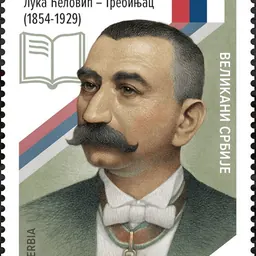
One of his unfinished projects from 1940 is the forerunner of today's Belgrade woman, the Teokarović Palace, a twelve-storey skyscraper, the construction of which was prevented by the Luftwaffe 6 April 1941 bombing of Belgrade. At the beginning of 1940, an endowment of Luka Ćelović was completed, a five-story building on the corner of the then Krunska and Ferdinandova, today's address is Kneza Miloš No. 2. One of his private commissions is the Villa of the actress Marica Popović in Belgrade.
Second World War In World War II, the Germans captured Grigorije Samojlov near Srebrenica, as an officer of the army of the Kingdom of Yugoslavia. He spent four years in captivity, first in the Bad Sulza concentration camp, and then, after breaking his leg and unable to work, was transferred to the Stalag IX-C concentration camp in Buchenwald. For the needs of the Orthodox chapel in the camp, in 1943, one of the barracks was converted into a chapel for which he did the painting and woodcarving work. Oak sleepers from the old railway track were used for the wooden construction. Samojlov was assisted by inmates who renounced packages and tracks in exchange for tools made from steel scrap and horseshoes. On the iconostasis, he painted Saint Sava and Christ, whose hands were tied with ropes, but they were also separated, indicative of the upcoming liberation. He remodelled the interior of the old General Staff building in Kneza Miloša Street (1951), the halls and halls of the JNA House in Niš (1953).
He is the author of the artistic design of the Order of the War Flag, according to the competition from 1953.
One of the most significant projects in the post-war period was the Faculty of Mechanical Engineering in Belgrade. The conceptual design (1955) included one of the first solutions with large façade steel surfaces. The interior solution is also interesting, especially the visibility and lighting of the hall, which gives the impression that the staircase is hovering over thin concrete pillars. He is the author of stained glass on Serbian glass, in the corridors, based on Russian motifs.
Throughout his career, Samojlov authored about 180 projects.
Don’t just read it —
keep it.
Full-length biographies made to live with: read them, listen on the way to work, watch them tonight.
- E-book
- Audio
- Video
Instant download · yours to keep · every purchase keeps this site free
Important facts
People in Grigorije Samojlov's life
Named in this biography and alive at the same time

Related people
Same field, nearest in time
Contemporaries
People whose lives overlapped Grigorije Samojlov's




Frequently asked questions
Who was Grigorije Samojlov?
Russian architect
When was Grigorije Samojlov born?
Grigorije Samojlov was born on 8 September 1904 in Taganrog.
When did Grigorije Samojlov die?
Grigorije Samojlov died on 15 October 1989.
What was Grigorije Samojlov's occupation?
Grigorije Samojlov was an architect.
What nationality was Grigorije Samojlov?
Grigorije Samojlov was Russian.
Sources & further reading
· Wikipedia: Grigorije Samojlov
Cite this page
APA: Biography.guide. (2026). Grigorije Samojlov. https://biography.guide/grigorije-samojlov/
MLA: "Grigorije Samojlov." Biography.guide, https://biography.guide/grigorije-samojlov/.
Chicago: "Grigorije Samojlov." Biography.guide. https://biography.guide/grigorije-samojlov/.
Data last updated: 2026-09-20 · Spot an error? Report a correction.
Page generated 2026-09-27 05:21 UTC