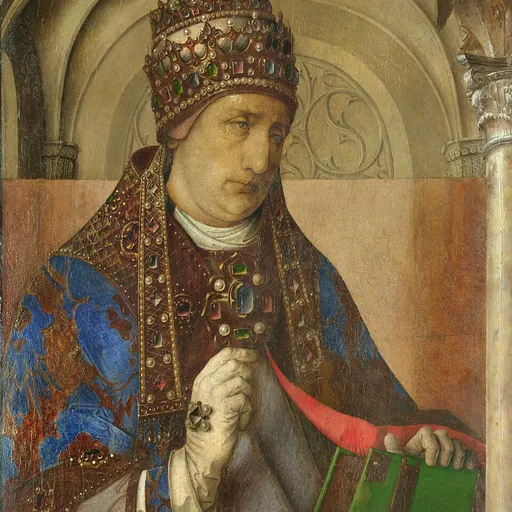
About Gregory XII
Lived 1335 – 1417 (aged 82). Gregory XII was an Italian catholic priest.
Early life Angelo Corraro was born in Venice of a noble family, about 1327, son of Niccolò di Pietro Correr and wife Polissena, He was uncle of cardinal Antonio Correr and cardinal Gabriele Condulmer, future Pope Eugene IV.
On 1 December 1390, he was made titular Latin Patriarch of Constantinople. On 12 June 1405, he was created cardinal and the Cardinal-Priest of San Marco by Pope Innocent VII. He was Apostolic Administrator of Constantinople from 30 November 1406 to 23 October 1409.
Pontificate
Gregory XII was chosen at Rome on 30 November 1406 by a conclave consisting of only fifteen cardinals under the express condition that, should Antipope Benedict XIII (1394–1423), the rival papal claimant at Avignon, renounce all claim to the papacy, he would also renounce his, so that a fresh election might be made and the Western Schism (1378–1417) ended. Malatesta went to Pisa in person during the process of the council to support Gregory XII. At the fifteenth session, 5 June 1409, the Council of Pisa declared that it deposed both Gregory and Benedict as schismatical, heretical, perjured, and scandalous; they pronounced that they had elected Alexander V (1409–10) later that month. Gregory XII, who had meanwhile created ten more cardinals, had convoked a rival council at Cividale del Friuli, near Aquileia; but only a few bishops appeared. Gregory XII's cardinals pronounced Benedict XIII and Alexander V schismatics, perjurers, and devastators of the Church, but their pronouncement went unheeded. Gregory XII was very saddened by the way he was treated; he also had some adventures while barely escaping from enemies and former friends.
Resolution of the schism The Council of Constance finally resolved the situation. Gregory XII appointed Carlo Malatesta and Cardinal Giovanni Dominici of Ragusa as his proxies. The cardinal then convoked the council and authorized its succeeding acts, thus preserving the formulas of papal supremacy.
Thereupon on 4 July 1415, Gregory XII's resignation was pronounced in his name by Malatesta and accepted by the cardinals. As they had agreed previously, they retained all the cardinals created by Gregory XII, thus satisfying the Corraro clan, and appointed Gregory XII Bishop of Frascati, Dean of the College of Cardinals and perpetual legate at Ancona. The Council then set aside Antipope John XXIII (1410–15), the successor of Alexander V. After the former follower of Benedict XIII appeared, the council declared him deposed, ending the Western Schism. A new Roman pontiff, Martin V, was elected after the death of Gregory XII, which many took as an indication that Gregory had been the true pope. Therefore, the papacy was vacant for two years.
Retirement and death The rest of the life of the former pope was spent in peaceful obscurity in Ancona. He was the last pope to resign until Benedict XVI did so on 28 February 2013, almost 600 years later.
Historiography The Annuario Pontificio has historically recognized the decisions of the Council of Pisa (1409). Until the mid-20th century, the Annuario Pontificio listed Gregory XII's reign as 1406–1409, followed by Alexander V (1409–1410) and John XXIII (1410–1415). However, the Western Schism was reinterpreted when Pope John XXIII (1958–1963) chose to reuse the ordinal XXIII, citing "twenty-two Johns of indisputable legitimacy". This is reflected in modern editions of the Annuario Pontificio, which extend Gregory XII's reign to 1415. Alexander V and the first John XXIII are now considered to be antipopes.
Don’t just read it —
keep it.
Full-length biographies made to live with: read them, listen on the way to work, watch them tonight.
- E-book
- Audio
- Video
Instant download · yours to keep · every purchase keeps this site free
Important facts
People in Gregory XII's life
Named in this biography and alive at the same time


Related people
Same field, nearest in time



Contemporaries
People whose lives overlapped Gregory XII's

Frequently asked questions
Who was Gregory XII?
pope of the Catholic Church from 1406 to 1415
When was Gregory XII born?
Gregory XII was born on 13 May 1335 in Venice.
When did Gregory XII die?
Gregory XII died on 18 October 1417 in Recanati.
What was Gregory XII's occupation?
Gregory XII was a catholic priest.
What nationality was Gregory XII?
Gregory XII was Italian.
Sources & further reading
Cite this page
APA: Biography.guide. (2026). Gregory XII. https://biography.guide/gregory-xii/
MLA: "Gregory XII." Biography.guide, https://biography.guide/gregory-xii/.
Chicago: "Gregory XII." Biography.guide. https://biography.guide/gregory-xii/.
Data last updated: 2026-09-23 · Spot an error? Report a correction.
Portrait: Wikimedia Commons · author & licence
Page generated 2026-09-27 05:07 UTC