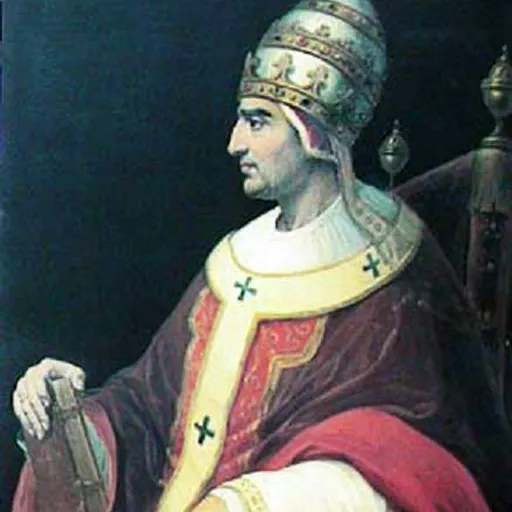
About Gregory XI
Lived 1329 – 1378 (aged 48–49). Gregory XI was a French catholic priest.
Pope Gregory XI (; born Pierre Roger de Beaufort; c. 1329 – 27 March 1378) was head of the Catholic Church from 30 December 1370 to his death, in March 1378. He was the seventh and last Avignon pope and the most recent French pope. In 1377, Gregory XI returned the papal court to Rome, ending nearly 70 years of papal residency in Avignon, in modern-day France. His death was swiftly followed by the Western Schism involving two Avignon-based antipopes.
Early life Pierre Roger de Beaufort was born at Maumont, France, around 1330. His uncle, Pierre Cardinal Roger, Archbishop of Rouen, was elected pope in 1342 and took the name Clement VI. Clement VI bestowed a number of benefices upon his nephew and in 1348, created the eighteen-year-old a cardinal deacon. The young cardinal attended the University of Perugia, where he became a skilled canonist and theologian.
Conclave 1370
After the death of Pope Urban V (December 1370), eighteen cardinals assembled at Avignon entered the conclave on 29 December. Cardinal Roger was unanimously elected on 30 December. Though initially opposing his own election, Roger eventually accepted and took the name of Gregory XI. On 4 January 1371 he was ordained to the priesthood by the Dean of the College of Cardinals, Guy de Boulogne, and on 5 January was consecrated Bishop of Rome and crowned by the new protodeacon Rinaldo Orsini in the cathedral Notre Dame des Doms in Avignon.
Papacy (1370 – 1378) Immediately on his accession he attempted to reconcile the Kings of France and England, but failed. Gregory confirmed a treaty between Sicily and Naples at Villeneuve-lès-Avignon on 20 August 1372, which brought about a permanent settlement between the rival kingdoms, which were both papal fiefs.
Gregory also tried to undertake a crusade due to pleas from Catherine of Siena in 1376 by continuing Pope Urban V's call for Christians to stop fighting other Christians, which Urban called for in November 1366. Efforts were also made to reform corrupt practices in the various monastic orders, such as collecting fees from persons visiting holy sites and the exhibiting of faux relics of saints. Before moving to Rome, however, he had to give his entire attention to the turbulent affairs of Italy. Lord Bernabo Visconti of Milan, had, in 1371, made himself master of Reggio and other places that were feudatory to the Holy See. Gregory XI excommunicated him and later declared war on him in 1372 against a Florentine-led coalition of Italian city states, which later became known as the War of the Eight Saints (1375–1378). After war broke out, Gregory excommunicated the city and placed the city under interdict on 31 March 1376 in an attempt to quell the rebellion. Catherine of Siena tried to convince Gregory to stop the war on behalf of the Florentine state.
Gregory was constantly receiving pleas from Catherine of Siena through letters. In total, she wrote 14 letters between 1375 and 1378 until Gregory died. These letters dealt with different matters such as peace, church reform, and moving the papacy back to Rome. Catherine persuaded him by saying that it was easier to achieve Gregory's goal of peace among the city states in Italy by expanding the influence of the Papal states if the papacy were back in Rome.
Death Gregory XI did not survive much longer after his move to Rome. He died on 27 March 1378 aged 48–49. Pope Urban VI, an Italian, was elected to the papacy after his death. However, his decision to move the papacy back to Rome led to the Western Schism and the rise of the Antipopes. Most of Europe supported the Avignonian Clement VII (now considered an antipope) as the true pope.
Subsequently, the Western Schism created by the selection of rival popes forced Europe into a dilemma of papal allegiance. This schism was not resolved fully until the Council of Constance (1414–1418), with the election of Pope Martin V.
Don’t just read it —
keep it.
Full-length biographies made to live with: read them, listen on the way to work, watch them tonight.
- E-book
- Audio
- Video
Instant download · yours to keep · every purchase keeps this site free
Important facts
more
pape Grégoire XI, Gregorius XI. Papa, Papa Gregorius XI, Pope Gregoire XI, pape Gregoire XIPeople in Gregory XI's life
Named in this biography and alive at the same time
Related people
Same field, nearest in time




Contemporaries
People whose lives overlapped Gregory XI's
Frequently asked questions
Who was Gregory XI?
pope of the Catholic Church from 1370 to 1378
When was Gregory XI born?
Gregory XI was born in 1329 in Rosiers-d'Égletons.
When did Gregory XI die?
Gregory XI died on 27 March 1378 in Rome.
What was Gregory XI's occupation?
Gregory XI was a catholic priest.
What nationality was Gregory XI?
Gregory XI was French.
Sources & further reading
Cite this page
APA: Biography.guide. (2026). Gregory XI. https://biography.guide/gregory-xi/
MLA: "Gregory XI." Biography.guide, https://biography.guide/gregory-xi/.
Chicago: "Gregory XI." Biography.guide. https://biography.guide/gregory-xi/.
Data last updated: 2026-09-21 · Spot an error? Report a correction.
Portrait: Wikimedia Commons · author & licence
Page generated 2026-09-27 04:59 UTC