
About Gregory of Utrecht
Lived 700 – 780. Gregory of Utrecht was a German catholic priest and missionary.
Life Gregory of Utrecht was born around the year 700 of a noble family at Trier. His father Alberic was the son of Addula, who in her widowhood was Abbess of Pfalzel (Palatiolum) near Trier. (Because of the similarity of names and also because of a forged will, Addula has been frequently confused with Saint Adela of Pfalzel, daughter of Dagobert II of Austrasia, thus wrongly imputing to Gregory membership of the royal house of the Merovingians).
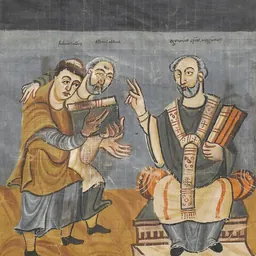
He received his early education at Pfalzel. When, in 722, Boniface passed through Trier on his way from Frisia to Hesse and Thuringia, he stayed at this convent. Abbess Addula called on her fifteen years old grandson to read the scriptures at the meals. Saint Boniface gave an explanation of them and expanded upon the merits of an apostolic life, by which Gregory was inspired to accompany him.
He now became a disciple of Boniface, who sent him to the Monastery of Saint Michael at Ohrdruf to continue his studies. Gregory later became Boniface's helper, and accompanied him in all his missionary tours. Franks, Frisians, Saxons, even Bavarians and Swabians. England too, though it had splendid schools of its own, sent scholars. Among his disciples, Saint Ludger is perhaps the best known, later to be the first Bishop of Münster and author of the Life of Gregory, in which he describes Gregory's virtues, his contempt of riches, his sobriety, his forgiving spirit and his deeds of alms.
When the murderers of Gregory's two half-brothers were sent to him by the civil magistrates to be put to what death he should think fit, according to the custom of the country at that age, which left the punishment of the assassins to the direction of the relations of the deceased person; he gave every one of them a suit of clothes with an alms, and dismissed them with good advice. In 767 Gregory, who did not wish to receive episcopal consecration himself, sent Alubert, who had come from England to assist him in his missionary work, to York to be consecrated bishop.
Some three years before Gregory's death, paralysis attacked his left side and gradually spread over his entire body. Gregory died at Maastricht on August 25, 776. At the approach of death he had himself carried into church, where he died. He was succeeded by his nephew, Alberic of Utrecht, prior of St. Martin's.
Veneration His relics were kept at Utrecht, and in 1421 and 1597 were examined at episcopal visitations. A large portion of his head is in the church of Saint Amelberga at Susteren, where an official recognition took place on 25 September 1885 under the supervision of the Bishop of Roermond. A letter written by Saint Lullus, Bishop of Mainz, to Saint Gregory is still extant.
Don’t just read it —
keep it.
Full-length biographies made to live with: read them, listen on the way to work, watch them tonight.
- E-book
- Audio
- Video
Instant download · yours to keep · every purchase keeps this site free
Important facts
People in Gregory of Utrecht's life
Named in this biography and alive at the same time


Related people
Same field, nearest in time


Contemporaries
People whose lives overlapped Gregory of Utrecht's

Frequently asked questions
Who was Gregory of Utrecht?
Frankish bishop and saint
When was Gregory of Utrecht born?
Gregory of Utrecht was born in 700 in Trier.
When did Gregory of Utrecht die?
Gregory of Utrecht died in 780 in Utrecht.
What was Gregory of Utrecht's occupation?
Gregory of Utrecht was a catholic priest and missionary.
What nationality was Gregory of Utrecht?
Gregory of Utrecht was German.
Sources & further reading
· Wikipedia: Gregory of Utrecht
Cite this page
APA: Biography.guide. (2026). Gregory of Utrecht. https://biography.guide/gregory-of-utrecht/
MLA: "Gregory of Utrecht." Biography.guide, https://biography.guide/gregory-of-utrecht/.
Chicago: "Gregory of Utrecht." Biography.guide. https://biography.guide/gregory-of-utrecht/.
Data last updated: 2026-09-20 · Spot an error? Report a correction.
Page generated 2026-09-27 05:25 UTC