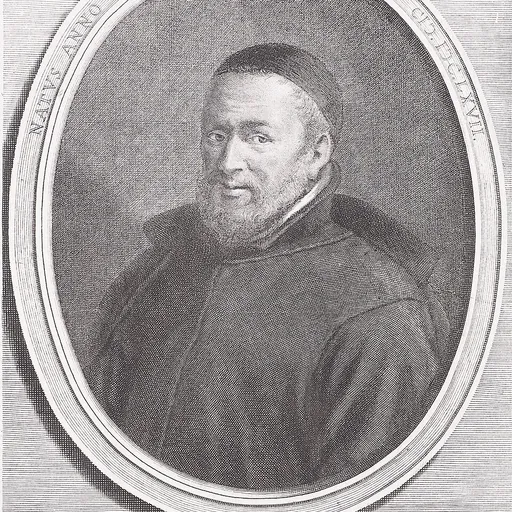
About Grégoire de Saint-Vincent
Lived 1584 – 1667 (aged 82). Grégoire de Saint-Vincent was a mathematician, professor, catholic priest and catholic theologian.
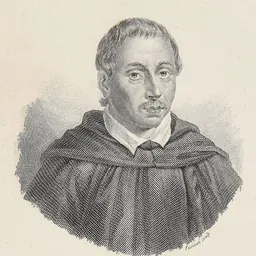
Grégoire de Saint-Vincent (; , ; 8 September 1584 Bruges – 5 June 1667 Ghent) was a Flemish Jesuit and mathematician. He is remembered for his work on quadrature of the hyperbola. He is also known as Gregorio a San Vincente. He also resolved Zeno's paradox by showing that the time intervals involved formed a geometric progression and thus had a finite sum. The mathematical thinking of Sancto Vincentio underwent a clear evolution during his stay in Antwerp. Starting from the problem of trisection of the angle and the determination of the two mean proportional, he made use of infinite series, the logarithmic property of the hyperbola, limits, and the related method of exhaustion. Sancto Vincentio later applied this last method, in particular to his theory ducere planum in planum, which he developed in Louvain in the years 1621 to 24. In the matter of quadrature of the hyperbola, "Grégoire does everything save give explicit recognition to the relation between the area of the hyperbolic segment and the logarithm."
Quadrature of the hyperbola illustrated as the area under the curve from to If is less than the area from to is counted as negative. Saint-Vincent found that the area under a rectangular hyperbola (i.e. a curve given by ) is the same over as over when
This observation led to the hyperbolic logarithm. The stated property allows one to define a function which is the area under said curve from to , which has the property that This functional property characterizes logarithms, and it was mathematical fashion to call such a function a logarithm. In particular when we choose the rectangular hyperbola , one recovers the natural logarithm.
A student and co-worker of Saint-Vincent, A. A. de Sarasa noted that this area property of the hyperbola represented a logarithm, a means of reducing multiplication to addition. The property may be observed as invariance of area of hyperbolic sectors under squeeze mapping.
In 1651 Christiaan Huygens published his Theoremata de Quadratura Hyperboles, Ellipsis, et Circuli which referred to the work of Saint-Vincent.
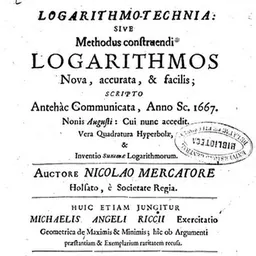
The quadrature of the hyperbola was also addressed by James Gregory in 1668 in True Quadrature of Circles and Hyperbolas While Gregory acknowledged Saint-Vincent's quadrature, he devised a convergent sequence of inscribed and circumscribed areas of a general conic section for his quadrature. The term natural logarithm was introduced that year by Nicholas Mercator in his Logarithmo-technia.
Saint-Vincent was lauded as Magnan and "Learned" in 1688: “It was the great Work of the Learned Vincent or Magnan, to prove that distances reckoned in the Asymptote of an Hyperbola, in a Geometrical Progression, and the Spaces that the Perpendiculars, thereon erected, made in the Hyperbola, were equal one to the other.”
A historian of the calculus noted the assimilation of natural logarithm as an area function at that time: As a consequence of the work of Gregory St. Vincent and de Sarasa, it seems to have been generally known in the 1660s that the area of a segment under the hyperbola is proportional to the logarithm of the ratio of the ordinates at the ends of the segment.
Works
Don’t just read it —
keep it.
Full-length biographies made to live with: read them, listen on the way to work, watch them tonight.
- E-book
- Audio
- Video
Instant download · yours to keep · every purchase keeps this site free
Important facts
People in Grégoire de Saint-Vincent's life
Named in this biography and alive at the same time
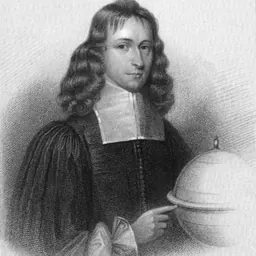

Related people
Same field, nearest in time

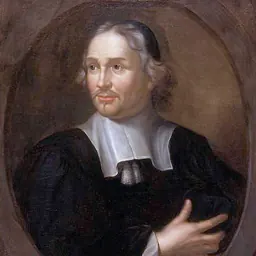



Contemporaries
People whose lives overlapped Grégoire de Saint-Vincent's


Frequently asked questions
Who was Grégoire de Saint-Vincent?
Jesuit, mathematician
When was Grégoire de Saint-Vincent born?
Grégoire de Saint-Vincent was born on 8 September 1584 in Bruges.
When did Grégoire de Saint-Vincent die?
Grégoire de Saint-Vincent died on 27 January 1667 in Ghent.
What was Grégoire de Saint-Vincent's occupation?
Grégoire de Saint-Vincent was a mathematician, professor, catholic priest and catholic theologian.
Sources & further reading
· Wikipedia: Grégoire de Saint-Vincent
· DBpedia: Grégoire de Saint-Vincent
Cite this page
APA: Biography.guide. (2026). Grégoire de Saint-Vincent. https://biography.guide/gregoire-de-saint-vincent/
MLA: "Grégoire de Saint-Vincent." Biography.guide, https://biography.guide/gregoire-de-saint-vincent/.
Chicago: "Grégoire de Saint-Vincent." Biography.guide. https://biography.guide/gregoire-de-saint-vincent/.
Data last updated: 2026-09-22 · Spot an error? Report a correction.
Portrait: Wikimedia Commons · author & licence
Page generated 2026-09-27 05:03 UTC