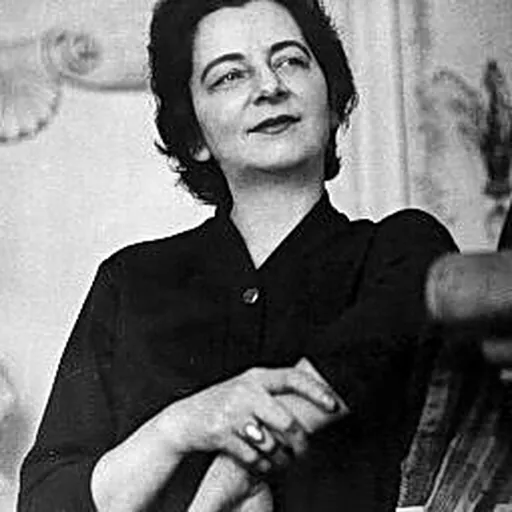
About Grażyna Bacewicz
Lived 1909 – 1969 (aged 59). Grażyna Bacewicz was a Polish composer, choreographer, musicologist, music educator, pianist and concertmaster.
Grażyna Bacewicz Biernacka (; 5 February 1909 – 17 January 1969) was a Polish composer and violinist of Lithuanian origin. She is the second Polish female composer to have achieved national and international recognition, the first being Maria Szymanowska in the early 19th century.
Life Bacewicz was born in Łódź on February 5, 1909 to parents Maria and . Her father, having been from Lithuania, instilled a deep connection to their Lithuanian heritage, despite changing his name from the Lithuanian Bacevičius to Bacewicz. He also was her first music teacher, and insisted all four of their children study violin, piano, and fundamental music theory from a young age.
Grażyna was the third of four children, with two older brothers, and Vytautas, and one younger sister, Wanda. Vytautas identified as Lithuanian, using his father's original last name (Bacevičius), and also became an accomplished pianist and composer. Grażyna performed her first concert at the age of seven, alongside her brothers, and she wrote her first piece at around thirteen years old.
In 1928, she began studying at the Warsaw Conservatory, where she studied violin with Józef Jarzębski and composition with Kazimierz Sikorski; she also studied piano with Józef Turczyński for two semesters. After graduating in 1932, she attended composition classes led by Nadia Boulanger at the École Normale de Musique. During this time, she continued to play violin, and studied with André Touret and Carl Flesch.
After completing her studies, Bacewicz continued her musical career as both a composer and performer, appearing as a soloist and acting as a jury member for competitions. She served as the concertmaster of the Polish National Radio Symphony Orchestra, directed by Grzegorz Fitelberg from 1936-1938. During this time, the orchestra performed her first violin concerto, as well as her Three Songs for tenor and orchestra. She married her husband, physician and medical professor Adrzej Biernacki, in 1936, and the couple had a daughter, Alina Biernacka, in 1942.
During World War II, Bacewicz moved to Warsaw, where she continued to compose and perform in secretive underground concerts, which is where she premiered her Suite for Two Violins. Following the Warsaw uprising, Bacewicz and her family escaped the destroyed city and temporarily settled in Lublin.
After the war, she took up a position as a professor at the State Conservatoire of Music in Łódź. “Bacewicz’s reputation grew during the post-war era, despite the general censorship resulting from political realisation of socialist cultural reforms”. Despite the ideological control of arts, Bacewicz continued composing from 1945 to 1955, even though it was difficult to perform many of them. With her rising recognition, as well as growing number of awards and commissions, she began to shift her focus towards composition. In 1954, she was involved in a car accident, causing her family minor injuries, but breaking Bacewicz's pelvis and some of her ribs, hospitalizing her for an extended period. This forced her to consider composition as her only occupation, as she was no longer able to perform.
In 1956, the first Warsaw Autumn Festival featured three of her compositions, and at each of the Autumn Festivals in subsequent years, her music became a signature of the events. Her output became prolific during this time, and was widely acclaimed. She continued to compose until her death in 1969 in Warsaw.
Compositions Many of her compositions feature the violin. Among them are seven violin concertos, five sonatas for violin with piano, three for violin solo (including an early, unnumbered one from 1929), a Quartet for four violins, seven string quartets, and two piano quintets. Her orchestral works include four numbered symphonies (1945, 1951, 1952, and 1953), a Symphony for Strings (1946), and two early symphonies, now lost.
Works for solo instruments Four Preludes for piano (1924) Sonata (for solo violin) (1929) – early work, no number Children's Suite for piano (1933) 3 Groteski for piano (1935) Sonata for violin (1941) – premiered at an underground concert in Warsaw Polish Capriccio for solo violin (1949) Piano Sonata No. 1 (1949) (published in 2022 by PWM) Capriccio No. 2 for solo violin (1952) Piano Sonata No. 2 (premiered 1953) Rondino for piano (1953) Two Etudes in Double Notes for piano (1955) Sonatina for piano (1955) 10 Concert Etudes for Piano (1956) Sonata No. 2 (for solo violin) (1958) Mały tryptyk [Little Triptych] for piano (1965) Esquisse for organ (1966) Rybki [Fish] for piano (1967) 4 Capriccios for violin (also trans. for viola) (1968)
Chamber music
Quintet for flute, oboe, clarinet, bassoon and horn (1932) – First Prize in the Concours de la Société "Aide aux femmes de professions libres", Paris, 1933 Variations on a Lithuanian Folksong for violin and piano (1934) Trio for oboe, violin and cello (1935) 1949: Second prize (no first awarded) in the Composition Competition. Frederick Chopin, organized by the Polish Composers' Union in Warsaw for the Piano Concerto 1951: First Prize at the International Composition Competition in Liege for String Quartet No. 4 1956 Second Prize at the International Composition Competition in Liege for String Quartet No. 5 1960: III deposit at the International Rostrum of Composers in Paris for Music for strings, trumpet and percussion 1965: Prize of the Belgian Government and the gold medal at the International Competition for Composers in Brussels for Violin Concerto No. 7
In addition, Bacewicz received awards for lifetime achievement. These included the Order of the Banner of Work Class II (1949) and class I (1959), Order of Polonia Restituta Cavalier (1953) and Commander's Cross (1955), and the 10th Anniversary Medal of the Polish People's Republic (1955).
On the centenary of her birth, Polish Post issued a stamp, with a portrait of the artist.
Recordings The Silesian String Quartet's recording of all seven of Bacewicz's string quartets was selected as Gramophone'''s "Recording of the Month" in August 2016. Richard Bratby writes, "it's difficult not to be convinced that these works constitute an achievement worthy to stand alongside the quartet cycles of Tippett, Britten, Shostakovich and Bartók." The CPO and Chandos labels have both been issuing surveys of her orchestral pieces.
Don’t just read it —
keep it.
Full-length biographies made to live with: read them, listen on the way to work, watch them tonight.
- E-book
- Audio
- Video
Instant download · yours to keep · every purchase keeps this site free
Important facts
People in Grażyna Bacewicz's life
Named in this biography and alive at the same time


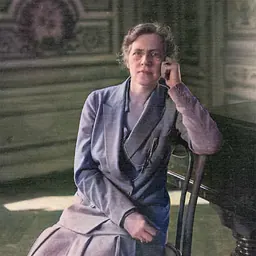
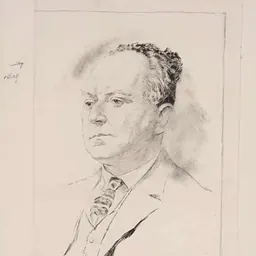
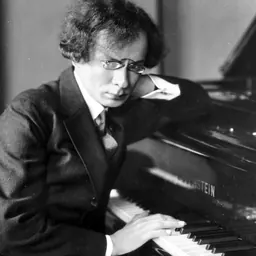
Related people
Same field, nearest in time



Contemporaries
People whose lives overlapped Grażyna Bacewicz's




Frequently asked questions
Who was Grażyna Bacewicz?
Polish composer and violinist (1909–1969)
When was Grażyna Bacewicz born?
Grażyna Bacewicz was born on 5 February 1909 in Łódź.
When did Grażyna Bacewicz die?
Grażyna Bacewicz died on 17 January 1969 in Warsaw.
What was Grażyna Bacewicz's occupation?
Grażyna Bacewicz was a composer, choreographer, musicologist, music educator, pianist and concertmaster.
What nationality was Grażyna Bacewicz?
Grażyna Bacewicz was Polish.
Sources & further reading
Cite this page
APA: Biography.guide. (2026). Grażyna Bacewicz. https://biography.guide/grazyna-bacewicz/
MLA: "Grażyna Bacewicz." Biography.guide, https://biography.guide/grazyna-bacewicz/.
Chicago: "Grażyna Bacewicz." Biography.guide. https://biography.guide/grazyna-bacewicz/.
Data last updated: 2026-09-23 · Spot an error? Report a correction.
Portrait: Wikimedia Commons · author & licence
Page generated 2026-09-27 05:05 UTC