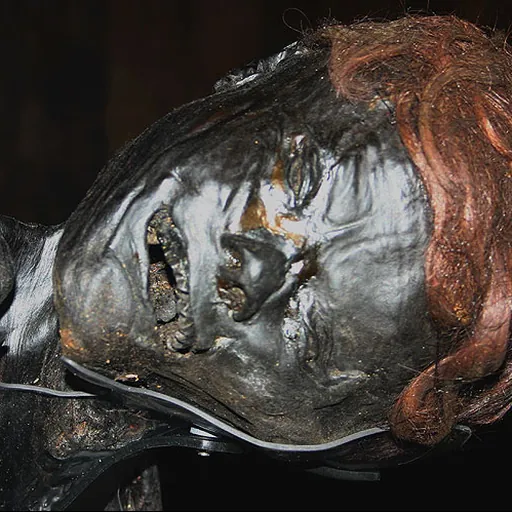
Grauballe Man
Iron Age bog body found in Denmark
About Grauballe Man
Grauballe Man is an Iron Age bog body discovered on 26 April 1952 in a peat bog near the village of Grauballe in Jutland, Denmark. The body, which dates to between 321 and 261 BCE during the early Germanic Iron Age, is one of the best-preserved bog bodies ever discovered. His naturally preserved skin, hair, and internal soft tissues have made him one of the most intensively studied human remains from prehistoric Europe.
Grauballe Man died after his throat was cut in a single deep wound that severed his trachea and oesophagus. His naked body was deposited in the bog, where the cool, acidic, oxygen-poor conditions preserved it for more than two millennia. Although the circumstances of his death remain uncertain, archaeologists have variously interpreted it as an execution, judicial punishment, or human sacrifice, reflecting wider debates about violence and ritual in Iron Age northwestern Europe.
Following his discovery, Grauballe Man became one of Denmark's best-known archaeological finds. After pioneering conservation treatment, he went on permanent display at Moesgaard Museum near Aarhus, where he remains one of the museum's most important exhibits.
Discovery leftThe Grauballe Man's body was discovered buried in the bog on 26 April 1952 by a team of peat diggers. One of the workers, Tage Busk Sørensen, stuck his spade into something that he knew was not peat; upon revealing more, they discovered the head protruding from the ground, and the local postman, who was passing, alerted the local doctor as well as an amateur archaeologist named Ulrik Balslev.
With the body still in the peat, various locals came to visit it the next day, one of whom accidentally stepped on its head. The following morning Professor Peter Glob from the Prehistory Museum at Aarhus came to visit the body and arranged for it to be moved to the museum, still encased in a block of peat.
The corpse was not found with any artefacts or any evidence of clothing, indicating that when he died he was entirely naked or his clothing had deteriorated, something that had also happened with the Tollund Man.
Condition
The cool, acidic and oxygen-poor conditions of the peat bog naturally preserved Grauballe Man's skin, hair and other soft tissues for more than 2,000 years. As a result, when his body was excavated in 1952, it remained remarkably lifelike.
Exhibition
Despite warnings from some scientists that the body should first undergo conservation, Grauballe Man was placed on public display within days of his discovery due to intense public interest. Nearly 50 years later, he was removed from exhibition again between 2001 and 2002 while researchers carried out a new programme of scientific examination. He was then returned to public display.
Grauballe Man's stomach and intestinal contents were first analysed in 1952 and substantially re-evaluated in 2007. These studies concluded that his final meal consisted primarily of weed seeds, together with smaller quantities of grain and meat.
Specialists at the Moesgaard Museum note that the cut appears to have been delivered in a single, forceful action. The blow was strong enough to sever the major vessels of the neck and leave a mark on the upper vertebrae. The direction and depth of the cut suggest it was made from behind, possibly while he was lowered or held in place.
Modern culture The Grauballe Man is the subject of the eponymous poem in Seamus Heaney's 1975 poetry collection North, while the Tollund Man figures in his 1972 volume Wintering Out.
Don’t just read it —
keep it.
Full-length biographies made to live with: read them, listen on the way to work, watch them tonight.
- E-book
- Audio
- Video
Instant download · yours to keep · every purchase keeps this site free
Frequently asked questions
Who was Grauballe Man?
Iron Age bog body found in Denmark
Sources & further reading
Cite this page
APA: Biography.guide. (2026). Grauballe Man. https://biography.guide/grauballe-man/
MLA: "Grauballe Man." Biography.guide, https://biography.guide/grauballe-man/.
Chicago: "Grauballe Man." Biography.guide. https://biography.guide/grauballe-man/.
Data last updated: 2026-09-21 · Spot an error? Report a correction.
Portrait: Wikimedia Commons · author & licence
Page generated 2026-09-27 04:59 UTC