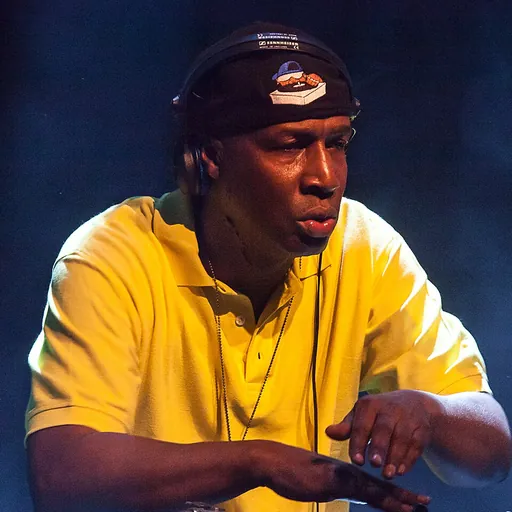
About Grandmaster Flash
Born 1958. Grandmaster Flash is a musician, rapper, disc jockey, record producer, composer and DJ.
Joseph Robert Saddler (born January 1, 1958), known by his stage name Grandmaster Flash, is a Barbadian-American DJ. He created a DJ technique called the Quick Mix Theory. He also invented the slipmat.
He is the founder and creator of Grandmaster Flash and the Furious Five, the first rap group to be inducted into the Rock and Roll Hall of Fame in 2007. On May 21, 2022, he acquired an honorary doctorate in Fine Arts from Buffalo State University. On June 1, 2023, he was awarded an honorary doctorate in music from Lehman College in the Bronx, NY. On August 4, 2023, Saddler was issued a proclamation from the city of New York stating that August 4 is Grandmaster Flash Day.
Early life, family, and education Saddler's family immigrated to the United States from Barbados. He was born and raised in the Bronx, New York City, where he attended Samuel Gompers High School, a public vocational school. There, he learned how to repair electronic equipment. Saddler's parents played an important role in his interest in music. His father was a fan of Caribbean and African American recordings.
During his childhood, Joseph Saddler was fascinated by his father's record collection. In an interview, he reflected: "My father was a very heavy record collector.... I used to open his closets and just watch all the records he had. I used to get into trouble for touching his records, but I'd go right back and bother them." After high school, he became involved in the earliest New York DJ scene, attending parties set up by early luminaries like DJ Kool Herc and Disco King Mario.
Saddler's uncle Sandy Saddler was a featherweight boxing champion.
Innovations A Technics SL-1200MK2 turntable formerly belonging to Grandmaster Flash is exhibited as a symbol for hip-hop culture in the National Museum of American History. Grandmaster Flash observed the styles of the smooth transitions of a disco DJ versus the non-fluid non-BPM-matched transitions of early DJing. He chose to complete his studies with the former. Grandmaster Flash came up with a fingertip-to-vinyl and crossfader technique called the Quick Mix Theory. In doing this, he figured out a mathematical way to cut, paste, repeat, and extend a very minuscule piece of an existing composition. The combination of these two materials cut into the size of a record and placed on the turntable (at that time referred to as a "wafer") allowed the record to move fluidly. The end result of that was the creation of what we today call the slipmat.
Grandmaster Flash and the Furious Five
1970s Grandmaster Flash played parties and collaborated with rappers such as Kurtis Blow and Lovebug Starski. In the late 1970s, he formed his own group. The original lineup consisted of Cowboy (Keef Cowboy), Melle Mel (Melvin Glover), and Kidd Creole (Nathaniel Glover), and the ensemble went by the name "Grandmaster Flash & the 3 MCs". Cowboy created the term hip hop. He created the term while teasing a friend who had just joined the U.S. Army, by scat singing the words "hip/hop/hip/hop" in a way that mimicked the rhythmic cadence of soldiers marching. Cowboy later worked the "hip hop" cadence into a part of his stage performance.
Mel was the first rapper to call himself "MC" (Master of Ceremony). Two other rappers briefly joined, but they were replaced more permanently by Rahiem (Guy Todd Williams, previously in the Funky Four) and Scorpio (Eddie Morris, a.k.a. Mr. Ness) to make Grandmaster Flash and the Furious Five. Quickly gaining recognition for their skillful raps, Grandmaster Flash and the Furious Five pioneered MCing and freestyle battles. Some of the staple phrases in MCing have their origins in the early shows and recordings of the group. A 1977 documentary film, Simpson Street, includes a hip-hop party on the roof of Casita Maria in the Bronx, with Grandmaster Flash in attendance; this is the earliest known footage of the hip-hop scene. In 1978, the new group began performing regularly at Disco Fever in the Bronx, one of the first times a hip-hop group was given a weekly gig at a well-known venue.
Grandmaster Flash and the Furious Five were signed to Bobby Robinson's Enjoy Records and in 1979 released their first single, "Superrappin'".
1980s In 1980 they signed to Sugar Hill Records and began touring and releasing numerous singles. The seminal "The Adventures of Grandmaster Flash on the Wheels of Steel", released in 1981, is a 7-minute solo showcase of Grandmaster Flash's virtuosic turntable skills, combining elements of Blondie's "Rapture", Michael Viner's Incredible Bongo Band's "Apache", Queen's "Another One Bites the Dust", Chic's "Good Times", and the group's own "Freedom". It is also the first documented appearance of scratching on a record. That year, the group opened for The Clash and were poorly received by an audience unaccustomed to the new style. The group's most significant hit was the electro rap song "The Message" (1982), which was produced by in-house Sugar Hill producer Clifton "Jiggs" Chase and featured session musician Duke Bootee. Unlike earlier rap tunes, "The Message" featured a grim narrative about inner city violence, drugs, and poverty. In 2002, it was one of 50 recordings chosen by the Library of Congress to be added to the National Recording Registry, the first hip hop recording to receive this honor. Critics praised the song's social awareness, calling the chorus "a slow chant seething with desperation and fury."
Other than Melle Mel, no members of the group actually appear in the song. Rahiem lip-synced Duke Bootee's vocal in the music video. The same year, Grandmaster Flash appeared in the movie "Wild Style" and sued Sugar Hill over the non-payment of royalties. Tensions mounted as "The Message" gained in popularity, eventually leading to a rupture between Melle Mel and Grandmaster Flash. Soon the group disintegrated entirely. Grandmaster Flash, Kidd Creole, and Rahiem left Sugar Hill, signed with Elektra Records, and continued on as simply "Grandmaster Flash", while Melle Mel and the others continued on as "Grandmaster Melle Mel & the Furious Five".
Grandmaster Flash was also interviewed in the 1986 cult documentary Big Fun in the Big Town.
Although frequently credited on the records, Grandmaster Flash does not actually appear on "The Message", "Freedom", or many of the other Furious Five songs.
2000 and beyond In 2008, he released a memoir, The Adventures of Grandmaster Flash: My Life, My Beats, in which he talks about the origins of his fascination with scratching records and creating new beats. From a young age, Flash talks about how he would sneak into his father's record room to watch the record player spin, and then get punished for touching the records. He found inspiration even from things not associated with music. The spokes of his bicycle caused an interest in how record players create music just by rotating a grooved disc. Flash continued to experiment by taking apart any machine he could get his hands on to figure out how it worked. His early work shows the innovative ways in which his artistic abilities led to what is considered the first evolution of hip hop culture.
Grandmaster Flash and the Furious Five were the first hip-hop/rap group inducted into the Rock & Roll Hall of Fame on March 12, 2007, by Jay-Z.
It has been said that "his pioneering mixing skills transformed the turntable into a true 'instrument', and his ability to get a crowd moving has made his DJ sets legendary."
Grandmaster Flash appears in the video game DJ Hero as a playable character along with original mixes created for the game.
In December 2011, Grandmaster Flash was reported to be at work on his 12th album.
Aired in 2016, the Netflix original series The Get Down features a version of Grandmaster Flash that is played by Mamoudou Athie. The series takes place in 1977 New York City and follows the genesis of the DJing, B-boying, graffiti, and emceeing, the four element cultures of hip-hop. After the premiere of The Get Down, Netflix premiered Hip-Hop Evolution, a music documentary discussing the history of hip hop in which Grandmaster Flash talks about the evolution of his art.
In 2023, Grandmaster Flash competed in season nine of The Masked Singer as "Polar Bear". He was eliminated on "New York Night". As part of his encore, some DJ equipment was brought out so that Grandmaster Flash can scratch along to Chic's "Good Times".
Discography
Albums Album informationThe Message Released: 1982 Last RIAA certification: Platinum Singles: "The Message", "It's Nasty"Greatest Messages Released: 1984 Last RIAA certification: Singles:They Said It Couldn't Be Done Released: 1985 Chart Positions: No. 35 Top R&B/Hip Hop Last RIAA certification: Gold Singles: "Girls Love the Way He Spins", "Sign of the Times", "Alternate Groove", "Larry's Dance Theme"The Source Released: 1986 Chart positions: No. 145 US, No. 27 Top R&B/Hip-Hop Albums, Last RIAA certification: Gold Singles: "Style (Peter Gunn Theme)", "Behind Closed Doors"Ba-Dop-Boom-Bang Released: 1987 Chart positions: No. 197 US, No. 43 Top R&B/Hip-Hop Albums Last RIAA certification: Gold Singles: "U Know What Time It Is", "All Wrapped Up"On the Strength Released: 1988 Chart positions: No. 189 US Last RIAA certification: Gold Singles: "Gold", "Magic Carpet Ride"Salsoul Jam 2000 Released: 1997 Chart positions: did not chart Last RIAA certification: Singles: "Spring Rain"Flash Is Back Released: 1998 Chart Positions: did not chart Last RIAA certification: Singles:The Official Adventures of Grandmaster Flash Released: January 29, 2002 Chart positions: did not chart Last RIAA certification: Singles:Essential Mix: Classic Edition Released: May 7, 2002 Chart positions: did not chart Last RIAA certification: Singles:The Bridge (Concept of a Culture) Released: February 24, 2009 Chart positions: U.S. Sales: 2,607 Last RIAA certification: Singles: Swagger feat. Red Cafe, Snoop Dogg & Lynn Carter Singles: Shine All Day feat. Q-Tip, Jumz & Kel Spencer
Singles 1979 – Superappin' (Enjoy 6001) Side A – Superappin'; Side B – Superappin' Theme 1980 – Freedom (Sugar Hill SH-549) Side A – vocal; Side B – instrumental 1981 – The Adventures of Grandmaster Flash on the Wheels of Steel (Sugar Hill SH-557) 1981 – Scorpio (Sugar Hill SH 118) Side A – vocal; Side B – instrumental 1982 – Flash To The Beat (Sugar Hill SH 574) 1984 – Jesse (Sugar Hill SH 133) Side A – vocal; Side B – instrumental 1984 – We Don't Work For Free (Sugar Hill SH 136) Side A – vocal; Side B – instrumental 1988 – Gold (edit) (Elektra EKR 70) 1996 – If U Wanna Party (feat. Carl Murray) (JAM 1002-8)
Honors and awards Grammys
Lifetime Achievement Award Urban Music Awards 2009, Lifetime Achievement Award Rock and Roll Hall of Fame 2007, Inductee BET Hip Hop Awards 2006, I Am Hip Hop Icon Award Polar Music Prize 2019, awarded Sweden's Polar Music Prize Honorary Doctorates Degree 2022, Buffalo State University
Filmography
+ Year Title Role Notes 2001 Scratch Himself (archive footage) (as Grand Master Flash) 2017 The Get Down Played by Mamoudoudou Athie (Fictional portrayal of The Grandmaster of Hip-Hop)
Don’t just read it —
keep it.
Full-length biographies made to live with: read them, listen on the way to work, watch them tonight.
- E-book
- Audio
- Video
Instant download · yours to keep · every purchase keeps this site free
Important facts
People in Grandmaster Flash's life
Named in this biography and alive at the same time






Related people
Same field, nearest in time

Contemporaries
People whose lives overlapped Grandmaster Flash's



Frequently asked questions
Who is Grandmaster Flash?
American DJ and rapper
When was Grandmaster Flash born?
Grandmaster Flash was born on 1 January 1958 in Bridgetown.
What is Grandmaster Flash's occupation?
Grandmaster Flash is a musician, rapper, disc jockey, record producer, composer and DJ.
What nationality is Grandmaster Flash?
Grandmaster Flash's recorded nationality: Barbados.
Sources & further reading
· Wikipedia: Grandmaster Flash
Cite this page
APA: Biography.guide. (2026). Grandmaster Flash. https://biography.guide/grandmaster-flash/
MLA: "Grandmaster Flash." Biography.guide, https://biography.guide/grandmaster-flash/.
Chicago: "Grandmaster Flash." Biography.guide. https://biography.guide/grandmaster-flash/.
Data last updated: 2026-09-20 · Spot an error? Report a correction.
Page generated 2026-09-27 05:10 UTC