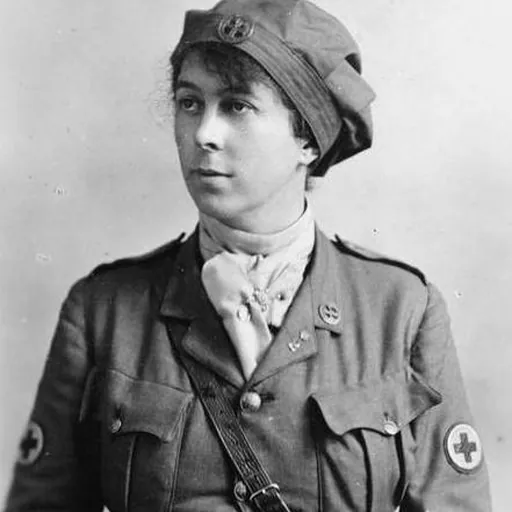
About Grace McDougall
Lived 1887 – 1963 (aged 76). Grace McDougall was a British ambulance driver, nurse and author, known for First Aid Nursing Yeomanry.
Grace McDougall (3 June 1887 – 19 January 1963) née Grace Alexandra Smith, renamed Grace Ashley-Smith, was a British officer of the First Aid Nursing Yeomanry (FANY). She is credited with reinventing that organisation and with being the first khaki bride. She gained British, French and Belgian medals for her pioneering work with the FANY in World War 1.
Early life McDougall was born in Aberdeen on 3 June1887, fifth of a family of four girls and two boys, children of Charles Smith and Isobel Copland. Her birth name was Grace Alexandra Smith but she created the surname of Ashley-Smith after the family home Ashley Lodge, in Aberdeen. She attended Albyn School before spending a year at Aberdeen University, where she applied herself to physical training, fencing and horse-riding, in all of which she was highly accomplished. After her time at university, McDougall spent two years at a Belgian convent to learn French. The intention was that the FANY would both rescue the wounded and administer first aid from horseback. Their founder felt that a single rider could get to a wounded soldier faster than a horse-drawn ambulance. Each woman was trained not only in first aid but signalling and drilling in cavalry movements.
She won the Empire cup for shooting at Bisley in 1911. McDougall was at sea en route to Cape Town, to visit her sister, when war was declared on 4 August 1914. She immediately booked her passage home and spent only 4 hours ashore before the return journey.
In the face of this discouragement, McDougall took herself to a British military hospital in Antwerp and drove a Belgian ambulance. The Germans rapidly over-ran Belgium. When Ghent was taken by the German army, the British left. However McDougall refused to be evacuated, so that she could care for a fatally-injured British soldier. Surrounded by enemy soldiers, she tended him until he died and saw to his burial. McDougall's brothers Charles and Bill were killed in the war in 1915 and 1916.
The British refused to engage the FANY for some time. In summer 1917, McDougall offered the services of the corps to the French. Many FANY units were established along the Western Front, under McDougall’s overall direction. By 1917, however, the War Office and the British Red Cross Society moved to close these down. McDougall’s solution was to elide British authority by enlisting with her staff as soldiers in the transport corps of the Belgian army.
Recognition McDougall's outstanding service was recognised by the French and the Belgians. She received the following honours:
Ordre de la Couronne (Belgium)
Ordre de Leopold II (Belgium) Mons medal 1914–18 service medal Victory medal Croix de Guerre (silver star; France) Médaille d'honneur (France) Médaille des épidémies Médaille secours des blessés militaires Médaille de la reine Élisabeth (Belgium) She was one of the few women to earn the rosette to the Mons star.
Later Life At the end of the war, many members of the FANY in Belgium were reluctant to leave their life together and return home. McDougall's decision was made for her because her mother was critically ill and she had to return. It fell to McDougall's second in command, Mary Baxter Ellis, to demobilize the FANY and send them back to civilian life at home. The decision was made after seeing soldiers returning from the war and unable to get work as mechanics and it was felt that men should have the jobs.
McDougall emigrated to Southern Rhodesia (now Zimbabwe), where she and her husband unsuccessfully tried to run a farm and her husband subsequently worked as a surveyor on the railway. In the decade after the end of the war, they had three children. She died in Sussex.
Don’t just read it —
keep it.
Full-length biographies made to live with: read them, listen on the way to work, watch them tonight.
- E-book
- Audio
- Video
Instant download · yours to keep · every purchase keeps this site free
Important facts
People in Grace McDougall's life
Named in this biography and alive at the same time


Related people
Same field, nearest in time

Contemporaries
People whose lives overlapped Grace McDougall's


Frequently asked questions
Who was Grace McDougall?
(1887–1963), officer of the FANY
When was Grace McDougall born?
Grace McDougall was born on 17 January 1887 in Aberdeen.
When did Grace McDougall die?
Grace McDougall died on 17 January 1963.
What was Grace McDougall's occupation?
Grace McDougall was an ambulance driver, nurse and author.
What was Grace McDougall known for?
Grace McDougall was known for First Aid Nursing Yeomanry.
What nationality was Grace McDougall?
Grace McDougall was British.
Sources & further reading
Cite this page
APA: Biography.guide. (2026). Grace McDougall. https://biography.guide/grace-mcdougall/
MLA: "Grace McDougall." Biography.guide, https://biography.guide/grace-mcdougall/.
Chicago: "Grace McDougall." Biography.guide. https://biography.guide/grace-mcdougall/.
Data last updated: 2026-09-22 · Spot an error? Report a correction.
Portrait: Wikimedia Commons · author & licence
Page generated 2026-09-27 05:01 UTC