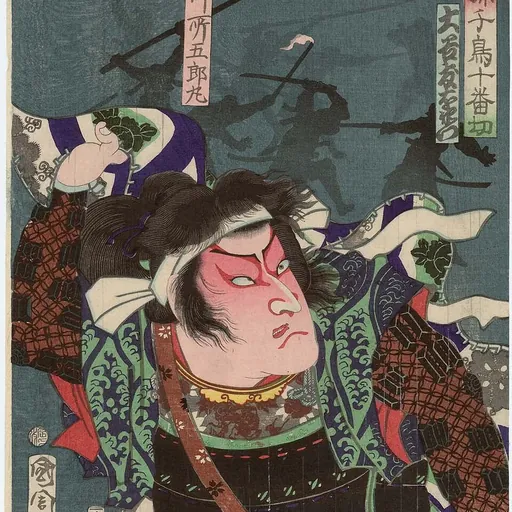
About Gosho no Gorōmaru
Lived 1176 – 1193 (aged 16–17). Gosho no Gorōmaru was a Japanese military commander and samurai.
Gosho no Gorōmaru (御所 五郎丸) was a Japanese samurai and retainer of the Kamakura Shogunate in the late Heian and early Kamakura period. He is best known for saving the shogun Minamoto no Yoritomo during the Revenge of the Soga Brothers incident in 1193 by capturing Soga Tokimune. According to legend, he was the lord of Tobe. His legacy survives in noh and kabuki drama and in place names in Kanagawa Prefecture. In kabuki he is known as Gosho no Gorozō. His imina is Shigemune (重宗) but he is best known by his azana Gorōmaru.
Life According to Soga Monogatari, Gorōmaru was born in Heian-kyō (present-day Kyoto). He served as a samurai at the Enryaku-ji temple, but left the capital at the age of 16 after avenging the death of his lord. He then moved to Amari Manor in Kai Province (present-day Nirasaki, Yamanashi Prefecture), On June 28, 1193, the Soga brothers killed Kudō Suketsune at the event and planned an attack on the shogun, an incident known as the Revenge of the Soga Brothers. The brothers began a bloodbath at the event, defeating ten samurai and slashing many others, during which the elder brother Soga Sukenari was killed by Nitta Tadatsune. The younger brother Soga Tokimune set off to find the shogun and stormed into the shogun's mansion. Gorōmaru, who had been keeping an eye on the situation at the mansion, apprehended Tokimune before he could attack the shogun. According to Soga Monogatari, Gorōmaru locked Tokimune's elbows, tried to bring him down with his own weight and shouted that he had apprehended the enemy. It is said that Tokimune struggled and tried to find his sword, but gave up when he could not find it. Tokimune was tied up for questioning and executed the next day. Gorōmaru's apprehension of Tokimune marked an end to the Revenge of the Soga Brothers incident. However, apart from legend, it remains uncertain who succeeded the Mutō clan's domains in Musashi Province.
Gorōmaru is said to have been an excellent horse-rider and a man of valor with "the strength of seventy-five people". During Tokimune's questioning, Tokimune is said to have explained that he had mistaken Gorōmaru for a regular retainer, and would have attacked him right away had he recognized him.
Genealogy Gorōmaru is an ancestor to the Gosho family. The name Gosho originated from the Atsuta Palace (Atsuta Gosho) where a member of the family lived in as the daikan of Atsuta Shrine in Owari Province. Gorōmaru's descendants later went to Kyushu with Ōtomo Yoshinao.
Historic sites The remains of Gorōmaru's mansion and a stone monument can be found in Gosho no Gorōmaru Park located in Goshogaoka, Koshigoe, Kamakura, Kanagawa Prefecture. There are large stones which are said to be garden stones of the mansion. The place names Goshogaoka, Goshogayatsu and Goshonoyato in the Koshigoe area derive from the mansion. There is also Gosho Tanuki Park nearby in Gosho, Koshigoe.
In Goshoyama, Yokohama, there is a tomb of Gosho no Gorōmaru, which is protected by the Goshoyama Town Council. It is said that Gorōmaru lived in the Goshoyama area. and Gorōmaru Association. A number of human bones were discovered near the tomb, and the area may be a gravesite of Daikyō-ji temple whose time of foundation and closing are unknown.
Soga Moyōtateshi no Gosho-zome (曽我綉侠御所染), commonly known as Gosho no Gorozō; the protagonist Gosho no Gorozō is modeled after Gosho no Gorōmaru. Soga Kyōgen (曽我狂言) is a story about the Revenge of Soga Brothers in which Gosho no Gorozō is a supporting character.
Film
Soga-kyōdai Fuji no Yashū (曽我兄弟 富士の夜襲), Toei film, Fushimi Sentarō as Gosho no Gorōmaru, Director: Yasushi Sasaki, (1956)
Art Gosho no Gorōmaru has been the subject of several ukiyo-e paintings. The most famous include the following:
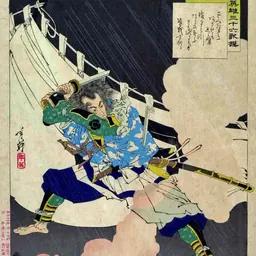
Soga Gorō and Gosho no Gorōmaru (1794) by Sharaku Warriors Trembling with Courage: Soga Tokimune and Gosho no Gorōmaru (1886) by Tsukioka Yoshitoshi Buei Moyu Kagami by Utagawa Kuniyoshi
Gallery
Don’t just read it —
keep it.
Full-length biographies made to live with: read them, listen on the way to work, watch them tonight.
- E-book
- Audio
- Video
Instant download · yours to keep · every purchase keeps this site free
Important facts
People in Gosho no Gorōmaru's life
Named in this biography and alive at the same time



Related people
Same field, nearest in time



Frequently asked questions
Who was Gosho no Gorōmaru?
Warrior in Japan
When was Gosho no Gorōmaru born?
Gosho no Gorōmaru was born in 1176 in Heian-kyō.
When did Gosho no Gorōmaru die?
Gosho no Gorōmaru died in 1193.
What was Gosho no Gorōmaru's occupation?
Gosho no Gorōmaru was a military commander and samurai.
What nationality was Gosho no Gorōmaru?
Gosho no Gorōmaru was Japanese.
Sources & further reading
· Wikipedia: Gosho no Gorōmaru
Cite this page
APA: Biography.guide. (2026). Gosho no Gorōmaru. https://biography.guide/gosho-no-goromaru/
MLA: "Gosho no Gorōmaru." Biography.guide, https://biography.guide/gosho-no-goromaru/.
Chicago: "Gosho no Gorōmaru." Biography.guide. https://biography.guide/gosho-no-goromaru/.
Data last updated: 2026-09-22 · Spot an error? Report a correction.
Portrait: Wikimedia Commons · author & licence
Page generated 2026-09-27 05:01 UTC