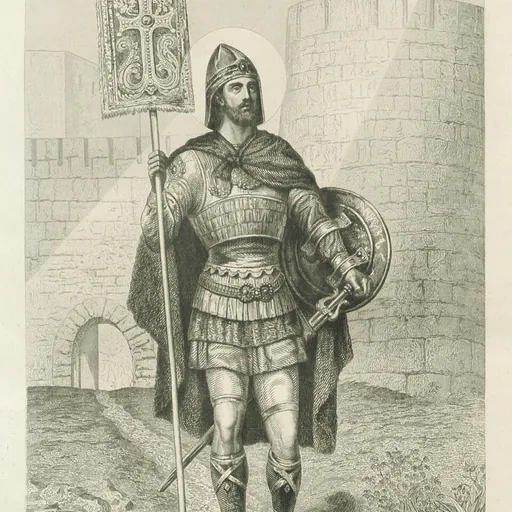
Gobron
Christian Georgian military commander
About Gobron
Gobron , also known as Mikel-Gobron or Michael-Gobron (; died 17 November 914), was a Georgian Christian military commander who led the defense of the fortress of Q'ueli against the forces of the Sajid emir of Azerbaijan. After the fortress fell following a 28-day siege, Gobron was captured and beheaded after refusing repeated demands to convert to Islam. Shortly after his death, he became the subject of a hagiographical work authored by Bishop Stephen of T'beti and was later canonized as a saint of the Georgian Orthodox Church, which commemorates him on 17 November (O.S., corresponding to 30 November in the Gregorian calendar). His martyrdom is also mentioned in medieval Georgian and Armenian chronicles.
Biography Gobron is the subject of The Passion of the Holy Martyr Gobron, Who Was Taken from the Fortress of Q'ueli (წამებაჲ წმიდისა მოწამისა გობრონისი, რომელი განიყვანეს ყუელის ციხით), composed by Bishop Stephen of T'beti (Stepane Mtbevari) at the behest of the Georgian Bagratid prince Ashot I of Tao between 914 and 918.
According to medieval Georgian sources, Yusuf ibn Abi'l-Saj invaded Georgia from Armenia, passing through the Muslim Emirate of Tiflis into Kakheti. He then advanced through Kartli into Samtskhe and Javakheti. After failing to capture the fortress of Tmogvi, he laid siege to Q'ueli, which was held by the Georgian Bagratid prince Gurgen of Tao. Q'ueli resisted for 28 days under the command of Gobron, whose original name, according to his Passion, was Mikel (Michael). He organized a determined defense and launched repeated sorties against the besiegers, but was ultimately forced to surrender. Although Gurgen sent a substantial ransom, Yusuf refused to release Gobron and 133 other captives.
A parallel account preserved in Georgian hagiographical tradition states that, impressed by Gobron's courage, Abu al-Qasim initially ordered that he be treated with respect. King Adarnase sent a substantial ransom, and some captives were released, but Gobron, anticipating his fate, prepared himself for martyrdom. The emir offered him worldly honors and wealth in exchange for apostasy, but Gobron refused. In response, Abu al-Qasim ordered that the Christian captives be executed before his eyes. Despite witnessing their deaths, Gobron remained steadfast. After twice compelling him to bow his head beneath the sword, the emir again demanded that he renounce Christianity, but Gobron declared: "I am a Christian and will never retreat from the name of my Christ!" Abu al-Qasim then ordered his execution. The bodies of Gobron and the 133 martyrs were buried in three large pits, and Christians were forbidden to approach the site. According to tradition, however, the graves shone at night with a divine light visible to both Christians and non-Christians alike.
Michael-Gobron and the 133 martyrs were subsequently recognized as saints by the Georgian Orthodox Church, which commemorates them on 17 November, the date traditionally associated with their martyrdom.
Don’t just read it —
keep it.
Full-length biographies made to live with: read them, listen on the way to work, watch them tonight.
- E-book
- Audio
- Video
Instant download · yours to keep · every purchase keeps this site free
Important facts
Frequently asked questions
Who was Gobron?
Christian Georgian military commander
When did Gobron die?
Gobron died on 17 November 914.
Sources & further reading
Cite this page
APA: Biography.guide. (2026). Gobron. https://biography.guide/gobron/
MLA: "Gobron." Biography.guide, https://biography.guide/gobron/.
Chicago: "Gobron." Biography.guide. https://biography.guide/gobron/.
Data last updated: 2026-09-23 · Spot an error? Report a correction.
Portrait: Wikimedia Commons · author & licence
Page generated 2026-09-27 05:05 UTC