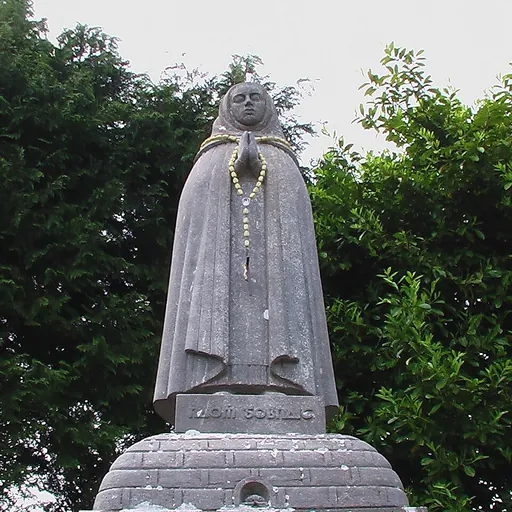
Gobnait
Irish saint
About Gobnait
Lived AD 6 – 501.
Saint Gobnait (?), also known as Gobnat or Mo Gobnat or Abigail or Deborah, is the name of an early medieval female Irish saint whose church was Móin Mór, later Bairnech, in the village of Ballyvourney , County Cork in Ireland. She is associated with the Múscraige and her church and convent lay on the borders between the Múscraige Mittine and Eóganacht Locha Léin. In early Christian times St Gobnait was said to be the only woman allowed on the island. While on Inisheer, an angel appeared and told her that she was not destined to remain there, and that she should look for a place where she would find nine white deer grazing. She found the deer at the place now known as St. Gobnet's Wood. Saint Abban is said to have worked with her on the foundation of the convent and to have placed Saint Gobnait over it as abbess.
Celtic lore held bees in high esteem, believing the soul left the body as a bee or a butterfly. Gobnait is said to have added beekeeping to her life's work, developing a lifelong affinity with them. She started a religious order and dedicated her days to helping the sick. It has been speculated that she used honey as a healing aid. She is credited with saving the people at Ballyvourney from the plague.
Well
St Gobnait's well is situated to the north of Ballyagran in a high field to the left of the road to Castletown. Rounds were made and a pattern was held on 11 February until around 1870. The well has now dried up but the site is still known. It is said that a white stag could sometimes be seen at the well. There is also a well in Dún Chaoin County Kerry and is visited on 11 February every year by locals.
Veneration and depictions in art
In 1601 Pope Clement VIII granted a special indulgence to those who, on Gobnait's day, visited the parish church, went to Confession and Communion and prayed for peace among 'Christian princes', expulsion of heresy and the exaltation of the church. Gobnait was originally a patron of ironworkers. Excavation at the church in Ballyvourney yielded considerable evidence of ironworking on the site.
St. Gobnet's Church, Inisheer; although the church is 11th century, it claims to derive from a foundation by Gobnait and to contain the remains of her beehive hut. The saint is still locally venerated today,
Former churches dedicated to Gobnait are commemorated in townlands and other places named Kilgobnet ( "church of Gobnait"): in counties Kerry (at Dunquin and at Kilgobnet near Milltown
Don’t just read it —
keep it.
Full-length biographies made to live with: read them, listen on the way to work, watch them tonight.
- E-book
- Audio
- Video
Instant download · yours to keep · every purchase keeps this site free
Important facts
Contemporaries
People whose lives overlapped Gobnait's

Frequently asked questions
Who was Gobnait?
Irish saint
When was Gobnait born?
Gobnait was born in AD 6 in County Clare.
When did Gobnait die?
Gobnait died in 501.
Sources & further reading
Cite this page
APA: Biography.guide. (2026). Gobnait. https://biography.guide/gobnait/
MLA: "Gobnait." Biography.guide, https://biography.guide/gobnait/.
Chicago: "Gobnait." Biography.guide. https://biography.guide/gobnait/.
Data last updated: 2026-09-20 · Spot an error? Report a correction.
Portrait: Wikimedia Commons · author & licence
Page generated 2026-09-27 04:58 UTC