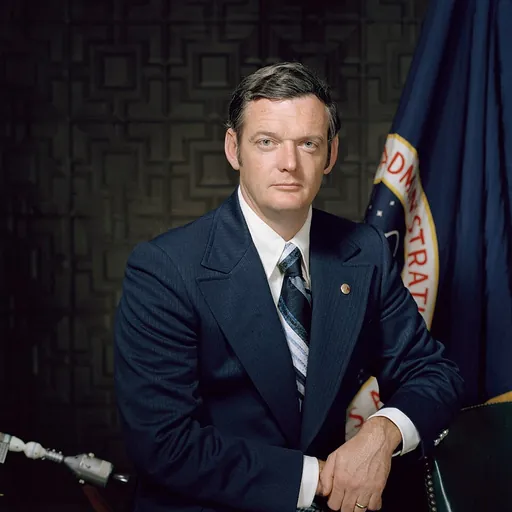
About Glynn Lunney
Lived 1936 – 2021 (aged 84). Glynn Lunney was an American military flight engineer, engineer, flight controller and NASA.
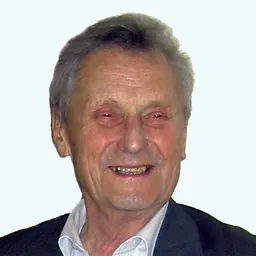
Glynn Stephen Lunney (November 27, 1936 – March 19, 2021) was an American NASA engineer. Lunney was an employee of NASA since its creation in 1958, a flight director during the Gemini and Apollo programs. Lunney was on duty during historic events such as the Apollo 11 lunar ascent and the pivotal hours of the Apollo 13 crisis. At the end of the Apollo program, he became manager of the Apollo–Soyuz Test Project, the first collaboration in spaceflight between the United States and the Soviet Union. Later, he served as manager of the Space Shuttle program before leaving NASA in 1985 and later becoming a vice president of the United Space Alliance.
Lunney was a key figure in the US human spaceflight program from Project Mercury through the coming of the Space Shuttle. He received numerous awards for his work, including the National Space Trophy, which he was given by the Rotary Club in 2005. Chris Kraft, NASA's first flight director, described Lunney as "a true hero of the space age", saying that he was "one of the outstanding contributors to the exploration of space of the last four decades".
Early life and NACA career Glynn Stephen Lunney was born in the coal city of Old Forge, Lackawanna County, Pennsylvania, on November 27, 1936, the eldest son of William Lunney, a welder and former miner who encouraged his son to get an education and to find a job beyond the mines, and his wife Helen Glynn Lunney. He graduated from the Scranton Preparatory School in 1953.
A childhood interest in model airplanes prompted Lunney to study engineering in college. After attending the University of Scranton (1953–1955), he transferred to the University of Detroit, where he enrolled in the cooperative training program run by the Lewis Research Center in Cleveland, Ohio. The center was a part of the National Advisory Committee for Aeronautics (NACA), a United States federal agency founded to promote aeronautical research. Cooperative students at NACA took part in a program that combined work and study, providing a way for them to fund their college degrees while gaining experience in aeronautics. Lunney graduated from college in June 1958, with a Bachelor of Science degree in aerospace engineering.
Apollo–Soyuz Test Program In 1970, while still a flight director, Lunney was selected as one of the members of a NASA delegation to the Soviet Union, which was to discuss the possibility of cooperation between the two countries in the field of human spaceflight. "For me it was out of the clear blue sky", said Lunney, who was told of the plans while at a conference in early October. "I did not know anything about [the proposed talks] until that time."
The trip took place in late October. While in Moscow, Lunney gave a presentation to Soviet engineers on the techniques that NASA used for orbital rendezvous, and on the compromises that would have to be made in order to achieve a rendezvous between American and Soviet spacecraft. The technical agreement that he helped to draft laid the groundwork for the mission which was to become the Apollo–Soyuz Test Project (ASTP). It was intended to be a joint mission, whose highlight was to be a docking between an American Apollo spacecraft and a Soviet Soyuz.
Lunney was named technical director of the ASTP in the following year. As technical director, he made several more trips to the Soviet Union, helping to negotiate the seventeen-point agreement that would govern the conduct of the mission. He also took part in working groups in Houston that dealt with the technical details of the project. A New York Times profile reported that he was taking Russian lessons in order to be better prepared for the role.
On June 13, 1972, Lunney was given overall responsibility for the test project; henceforth he would be in charge not only of building a partnership with the Soviets, but also of mission planning and of negotiating with North American Rockwell, the spacecraft contractor. According to the official history of the ASTP, Lunney's performance during Apollo 13 and during the Soviet negotiations had recommended him to Chris Kraft, who was by then director of Johnson Space Center. In 1973, Lunney became manager of the Apollo Spacecraft Program Office, a position which gave him responsibility for the Apollo spacecraft used during Skylab missions, as well giving him more authority in his role as head of the ASTP.
The ASTP mission took place in July 1975. It was criticized by some journalists as a "costly space circus", who felt that it wasted NASA funds that could have been better spent on projects such as Skylab. However, Lunney supported the project, saying in a later interview that he did not believe the cooperation necessary to build the International Space Station would have been possible if ASTP had not laid the groundwork for it.
Space Shuttle After the ASTP mission was completed, Lunney became manager of the Shuttle Payload Integration and Development Program. During this period, it was anticipated that NASA's space shuttle fleet would be flying very frequent missions, and carrying commercial payloads as well as flying missions for government organizations such as the Department of Defense and the Jet Propulsion Laboratory. The payload integration program was responsible for determining how the various demands of these customers could be satisfied, and how mixed payloads could best be physically accommodated within the cargo bay of the shuttle. During these years Lunney also spent time working at NASA Headquarters in Washington, D.C., as Deputy Associate Administrator for Space Flight and later as Acting Associate Administrator for Space Transportation Operations.
Many of his colleagues had expected Lunney to succeed his mentor, Kraft, as director of Johnson Space Center; Neil Hutchinson, a fellow flight director, later commented that Lunney "was sort of the anointed one". However, when Kraft retired in 1982, former Apollo flight director Gerry Griffin was offered the position instead.
In 1985, Lunney decided to leave NASA, feeling that the Space Shuttle program had worn him out physically and mentally and that he was ready for a new type of challenge. Although he had retired from NASA the year before, he was called to testify before the U.S. House Committee on Science and Technology in the aftermath of the Challenger accident. While still manager of the shuttle program, he had signed the "Criticality 1" waiver that allowed Challenger to launch even though the joints of its solid rocket boosters had recently been redefined as non-redundant systems. His actions were not unusual in the context of NASA practice at the time, which allowed a "walk through" of such potentially controversial waivers if no debate was expected.
Career at Rockwell Upon leaving NASA in 1985, Lunney took a position at Rockwell International, the contractor responsible for the construction, operation, and maintenance of the Space Shuttle. At first he worked in California, managing a Rockwell division that was building satellites for the Global Positioning System; this was his first experience with satellites. In 1990, he returned to Houston as President of the Rockwell Space Operations Company, which provided support for flight operations at Johnson Space Center and employed about 3,000 people. For Lunney, this represented a return to his roots in mission operations, which he had left twenty years before.
In 1995, Rockwell joined forces with its competitor Lockheed Martin to form the United Space Alliance, a jointly owned organization created to provide operations support for NASA, as well as to take over some of the functions previously performed by NASA employees. At this point, Lunney became Vice President and Program Manager of the United Space Alliance's spaceflight operations in Houston; he stayed in this position until his retirement in 1999. Lunney and his son Bryan were the first multi-generational flight directors to have served NASA.
Described as "legendary" by NASA, Lunney died on March 19, 2021, at his home in Clear Lake, Texas, at the age of 84. but according to his family he succumbed to stomach cancer.
Awards and honors Lunney was a Fellow of the American Astronomical Society and of the American Institute of Aeronautics and Astronautics. In 1971, he was awarded an honorary Doctorate from the University of Scranton. He received many awards from NASA, including three Group Achievement Awards, two Exceptional Service Medals and three Distinguished Service Medals.
In 2005, he received the National Space Trophy from the Rotary National Award for Space Achievement Foundation. The award is given to individuals who have made an outstanding and career-spanning contribution to America's space program. Previous winners have included Chris Kraft and Neil Armstrong. "Lunney's innovation and dedication to the U.S. space flight program", said the RNASA Advisor General, "has set a standard for current and future generations of space explorers. As a manager, he inspired his employees to do their best work and offered direction and encouragement to his team when challenges arose; as an explorer, he always looked toward the future and saw the endless possibilities and benefits of man's journey into space."
In films In the 1995 film Apollo 13, Glynn Lunney was portrayed by Marc McClure. McClure had a relatively minor role leading writer Charles Murray to lament that Lunney was "barely visible in the movie", being overshadowed by the focus on Lunney's fellow flight director Gene Kranz. "Without slighting Kranz's role", Murray commented, "the world should remember that it was Glynn Lunney ... who orchestrated a masterpiece of improvisation that moved the astronauts safely to the lunar module while sidestepping a dozen potential catastrophes that could have doomed them." "They didn't give me credit for any of the work that I did," Lunney said in 2019. "As a matter of fact, if you watch the movie, you'll see I'm sort of portrayed as a flunky."
Select publications Lunney, G. S. and K. C. Weston. (1959). "Heat-Transfer Measurements on an Air-Launched, Blunted Cone-Cylinder Rocket Vehicle to Mach 9.7". NASA-TM X-84. Cleveland, Ohio: NASA Lewis Research Center. Lunney, G. S., L. C. Dunseith, and J. F. Dalby. (1960). "Project Mercury: Methods and Pertinent Data for Project Mercury Flight Computing Requirements". NASA-TM-X-69335. Hampton, Virginia: NASA Langley Research Center. Lunney, G. S. (1964). "Launch-Phase Monitoring". In Manned Spacecraft: Engineering Design and Operation. Ed. Paul E. Purser, Maxime A. Faget, and Norman F. Smith. New York: Fairchild Publications, Inc.
Footnotes
Don’t just read it —
keep it.
Full-length biographies made to live with: read them, listen on the way to work, watch them tonight.
- E-book
- Audio
- Video
Instant download · yours to keep · every purchase keeps this site free
Important facts
People in Glynn Lunney's life
Named in this biography and alive at the same time


Related people
Same field, nearest in time

Contemporaries
People whose lives overlapped Glynn Lunney's






Frequently asked questions
Who was Glynn Lunney?
NASA engineer (1936-2021)
When was Glynn Lunney born?
Glynn Lunney was born on 27 November 1936 in Old Forge.
When did Glynn Lunney die?
Glynn Lunney died on 19 March 2021 in Clear Lake City.
What was Glynn Lunney's occupation?
Glynn Lunney was a military flight engineer, engineer, flight controller and NASA.
What nationality was Glynn Lunney?
Glynn Lunney was American.
Sources & further reading
Cite this page
APA: Biography.guide. (2026). Glynn Lunney. https://biography.guide/glynn-lunney/
MLA: "Glynn Lunney." Biography.guide, https://biography.guide/glynn-lunney/.
Chicago: "Glynn Lunney." Biography.guide. https://biography.guide/glynn-lunney/.
Data last updated: 2026-09-22 · Spot an error? Report a correction.
Portrait: Wikimedia Commons · author & licence
Page generated 2026-09-27 04:58 UTC