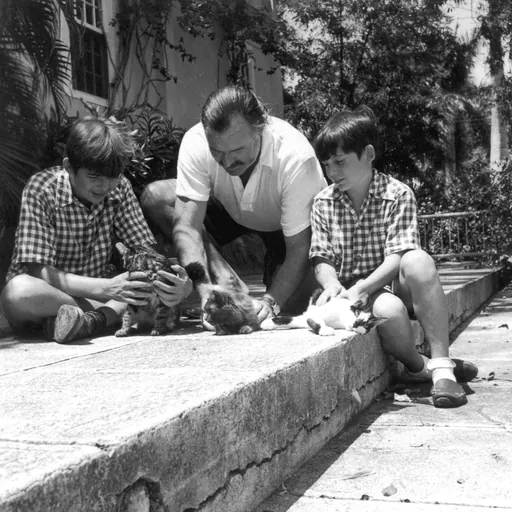
About Gloria Hemingway
Lived 1931 – 2001 (aged 69). Gloria Hemingway was an American physician.
Gloria Hemingway (born Gregory Hancock Hemingway, November 12, 1931 – October 1, 2001) was an American physician and writer who was the third and youngest child of author Ernest Hemingway. Although she was assigned male at birth and lived most of her life publicly as a man, she struggled with her gender identity from a young age. In her 60s, she underwent gender transition surgery, and preferred the name Gloria.
A good athlete and a crack shot, she trained as a professional hunter in Africa, but her alcoholism prevented her from gaining a license, and later led to the loss of her medical license in the United States. Hemingway maintained a long-running feud with her father, stemming from a 1951 incident when her arrest for entering a women's bathroom in a Los Angeles movie theater dressed in women's clothing caused an argument between Ernest and Pauline Pfeiffer, Gloria's mother. Pfeiffer died from a stress-related condition the following day, which Ernest blamed on Gloria.
In 1976, she authored a bestselling memoir of her father, Papa: A Personal Memoir, which was seen by some to reflect troubles of her own. These included wearing women's clothes, which she ascribed to gender dysphoria.
Early life and education Born in Kansas City, Missouri, to novelist Ernest Hemingway and his second wife Pauline Pfeiffer, she was called 'Gigi' or 'Gig' in childhood and was, according to a close observer, "a tremendous athlete" and a "crack shot". As an adult, she preferred the name 'Greg'. At the age of 12, she was wearing her stepmother Martha Gellhorn's stockings almost daily. Ernest caught her wearing them, and had an outburst of anger that left an impression on her for decades. However, a few days later he said to her, "Gigi, we come from a strange tribe, you and I." Hemingway attended the Canterbury School, a Catholic prep school in Connecticut, graduating in 1949. She dropped out of St. John's College, Annapolis, after one year and worked for a time as an aircraft mechanic before moving to California in 1951.
In April 1951, Hemingway married Jane Rhodes. The two had not known each other long, and Rhodes was pregnant. Ernest objected to 19-year-old Hemingway marrying, because of her financial and mental instability. The same year, Hemingway met with L. Ron Hubbard and was quite taken by Scientology.
In September 1951, Hemingway was arrested for entering a women's bathroom in a Los Angeles movie theater dressed in women's clothing. Ernest blamed Hemingway for Pauline's death, and she was deeply disturbed by the accusation. It would be years before she and Ernest spoke to each other again, and their relationship would be tense for the rest of Ernest's life. in 1964.
Career Hemingway practiced medicine in the 1970s and 1980s, first in New York and then as a rural family doctor in Montana, first in Fort Benton and later as the medical officer for Garfield County, based in Jordan, Montana.
Hemingway and her brothers tried to protect their father's name and their inheritance by taking legal action to stop the popular local celebrations called "Hemingway Days" in Key West, Florida.
Personal life Gender identity Throughout her life, Hemingway experienced gender dysphoria and wore women's clothes often, mostly privately and occasionally going out. When Hemingway was 12 years old, Ernest walked in on her dressed in her stepmother Martha Gellhorn's stockings, a near-daily activity at the time, and went berserk. A biographer of Hemingway's, Donald Junkins, stated that when Hemingway was 60 years old, she told him that "[she] never got over it: the raging wrath of [her] father". She tried conversion therapy to no avail. In a 1986 interview with The Washington Post, Hemingway stated "I've spent hundreds of thousands of dollars trying not to be a transvestite." Meyer's 2020 biography noted that "despite psychiatric help and shock treatments...[Hemingway]...remained an obsessive transvestite." presenting as male since same-sex marriage in Washington was illegal at the time.
While she was sometimes open with the media about her struggles with gender dysphoria and had been seen in women's clothing numerous times, Hemingway's public persona generally remained male, as she never gained the acceptance of her family or society, and repeatedly attempted conversion therapy. Using the name Gregory, she gave interviews about her father as late as 1999. In July of that year she attended events marking the centenary of Ernest Hemingway's birth in Oak Park, Illinois. She also spoke at the dedication of the Hemingway-Pfeiffer Museum in her mother's family home in Piggott, Arkansas, when it opened on July 4, 1999.
In addition to bottom surgery, Hemingway had breast implant surgery on one breast and then had it reversed; the autopsy and police report both noted the presence of breasts.
Relationship with Ernest Hemingway
In addition to the conflict over him finding her in Martha Gellhorn's clothing, Ernest and his child were estranged for many years, beginning when she was 19 and arrested for entering a women's bathroom in women's clothes. Ernest blamed Pauline, and the enormous stress triggered an underlying condition and caused her death, which he then blamed on his daughter. Ernest also said Gloria had "the biggest dark side in the family except me".
Hemingway wrote a short account of her father's life and their strained relationship, Papa: A Personal Memoir, that became a bestseller. When it appeared in 1976, Norman Mailer wrote in the preface, "There is nothing slavish here....For once, you can read a book about [Ernest] Hemingway and not have to decide whether you like him or not." Hemingway wrote of her own ambitions in the shadow of her father's fame: "What I really wanted to be was a Hemingway hero." Time magazine criticized the author's "churlishness" and called her work "a bitter jumble of unsorted resentments and anguished love." Her daughter Lorian responded to Papa with a letter to Time that said, "I would also like to know what type of person the author is ... I haven't seen [her] for eight years ... I think it sad that I learn more about [her] by reading articles and gossip columns than from my own communication".
According to her wife Valerie, Hemingway enjoyed her father's portrayal of her as Andrew in Islands in the Stream (1970) and later used the text as the epigraph to her memoir of her father.
In the course of her first three marriages, Hemingway had eight children including Vanessa , John, and Lorian. One of her marriages, to Valerie Danby-Smith, Ernest's secretary, lasted almost 20 years. Hemingway's fourth marriage, to Ida Mae Galliher, ended in divorce in 1995 after three years, though they continued to live together and remarried in 1997. The gravestone reads: "Dr. Gregory Hancock Hemingway 1931–2001".
The media response to Hemingway's death has been condemned for not referring to her as "Gloria" and for portraying gender variance as inherently pathological. Shortly after Hemingway died, the LGBT magazine The Advocate published an article discussing the coverage of her death. In it, Vanessa Edwards Foster, spokeswoman for the National Transgender Advocacy Coalition, discussed how family rejection contributes to depression, how Hemingway had to fight for years to be recognized, especially growing up as Ernest's son, and how transgender people felt the coverage was lurid, degrading, and dehumanizing. Hemingway's daughter Lorian sympathized, and stated "I am proud of [her] for going through with it" and that she hoped it brought Hemingway "some peace in the years [she] had left". She said that it was good that Hemingway's life ended "in the women's cell, where [she] would have chosen to be."
She left two wills. One will left most of the $7 million estate to Galliher. The other left most of it to Hemingway's children. The children challenged the will that named Galliher as heir, claiming that Galliher was not legally Hemingway's widow given that Hemingway's home state of Florida did not recognize same-sex marriages. The parties eventually reached an undisclosed settlement.
Hemingway's daughter Lorian Hemingway wrote about Hemingway in the 1999 book Walk on Water: A Memoir. Hemingway's son Edward, an author and artist, has written or illustrated 11 books, including the children's books Bad Apple, Tough Cookie, and Pigeon and Cat. Her son John wrote the memoir Strange Tribe: A Family Memoir.
Don’t just read it —
keep it.
Full-length biographies made to live with: read them, listen on the way to work, watch them tonight.
- E-book
- Audio
- Video
Instant download · yours to keep · every purchase keeps this site free
Important facts
Family & relationships
People in Gloria Hemingway's life
Named in this biography and alive at the same time



Related people
Same field, nearest in time


Contemporaries
People whose lives overlapped Gloria Hemingway's

Frequently asked questions
Who was Gloria Hemingway?
American physician (1931-2001)
When was Gloria Hemingway born?
Gloria Hemingway was born on 12 November 1931 in Kansas City.
When did Gloria Hemingway die?
Gloria Hemingway died on 1 October 2001 in Key Biscayne.
What was Gloria Hemingway's occupation?
Gloria Hemingway was a physician.
What nationality was Gloria Hemingway?
Gloria Hemingway was American.
Sources & further reading
Cite this page
APA: Biography.guide. (2026). Gloria Hemingway. https://biography.guide/gloria-hemingway/
MLA: "Gloria Hemingway." Biography.guide, https://biography.guide/gloria-hemingway/.
Chicago: "Gloria Hemingway." Biography.guide. https://biography.guide/gloria-hemingway/.
Data last updated: 2026-09-23 · Spot an error? Report a correction.
Portrait: Wikimedia Commons · author & licence
Page generated 2026-09-27 05:06 UTC