
Giuseppe Musolino
Italian brigand
About Giuseppe Musolino
Lived 1876 – 1956 (aged 79). Giuseppe Musolino was an Italian brigand.
Giuseppe Musolino (September 24, 1876 – January 22, 1956), also known as the "Brigante Musolino" or the "King of Aspromonte," was an Italian brigand and folk hero. Musolino received great notoriety and admiration in Calabria for escaping prison and committing a string of murders in retaliation for what he considered to be false testimony delivered against him while on trial; his later, second, trial after his recapture was subject to extensive international media coverage and attention.
Early life Musolino was born on September 24, 1876, in Santo Stefano in Aspromonte, a rugged area in the Calabria region of southern Italy.
Musolino worked as a woodcutter, like his father, spending all of his early life in the mountains of Calabria. He grew up a peasant, and had at least four close relatives who'd previously been convicted of crimes.
Initial crimes and first trial On October 27, 1897, Musolino was at his father's tavern when he engaged in a massive brawl with brothers and picciotteria members Vincenzo and Stefano Zoccali; it has been speculated that this fight was over a hazelnut delivery gone awry, with matters being complicated by Musolino's tumultuous prior relationship with the Zoccalis' sister, Virginia. Vincenzo stabbed Musolino in the limbs 40 times during the fight. While Musolino lay gravely ill from his injuries, Zoccali was shot in an ambush. Despite his condition, Musolino was accused of the crime and forcibly taken from his sickbed to prison. experts noted that his conviction was largely based on circumstantial evidence. Many witnesses were said to have lied during their testimonies, and Musolino's lawyers had been barred from calling several witnesses to the stand on his behalf.
After his sentencing, Musolino was imprisoned in Gerace, a town in Calabria.
Escape from prison and arrest Seeking to exact revenge on those who had testified against him (most of whom he felt had done so in bad faith) Musolino escaped from his prison in Gerace on January 19, 1899. He went on a killing spree throughout the countryside, being accused of murdering anywhere between seven and twenty-five individuals, almost all of whom had testified against him during his trial. Musolino believed at the time that his patron saint, Saint Joseph, was guiding and protecting him while on the run.
In early 1901, police officer Vincenzo Mangione was dispatched to Santo Stefano to implement a more effective strategy than the futile efforts of chasing Musolino through the mountains and bribing informants for leads. Mangione produced a series of reports describing the picciotteria in Musolino’s home village as a "genuine criminal institution." The organization had been founded in the early 1890s by Musolino's father and uncle, both of whom served on its "supreme council." In total, 166 individuals in Santo Stefano were identified as picciotteria affiliates. The attack on Zoccali had been ordered by the organization as punishment for his failure to fulfill his duties as a picciotto. Based on this intelligence, authorities adopted a two-pronged strategy to capture Musolino: first, by dismantling his support network; second, by prosecuting the entire picciotteria in Santo Stefano. This led to a wave of arrests in the spring and summer of 1901. With many of his allies behind bars, Musolino found it increasingly difficult to secure refuge in his home territory.
Meanwhile, Musolino began travelling to Rome at the public's behest to seek pardon from Victor Emmanuel III of Italy. However, on October 9, 1901, Musolino was captured in Acqualagna, near Urbino. Examples cited included his refusal to participate in the trial as long as he was being forced to wear standard convict (which he already was, as a prison escapee) attire; instead, he demanded the right to dress formally. Additionally, he interrupted witnesses and the judge on several occasions as they were speaking, often to applause as well as tears from Calabrians present at the trial who were moved by Musolino's story. Musolino also did not directly answer any questions asked of him when they were posed during the trial; instead, he would respond by retelling very long stories of his crimes and early life that were perceived by observers to have been out-of-context, again eliciting a great emotional response. Lombroso wrote that the family histories of epilepsy and criminality were intertwined and greatly contributed to Musolino's epileptic attacks and the resulting violent acts he committed. He also attributed Musolino's criminality to his falling into a group of southern Calabrians of Albanian and Greek heritage who were naturally predisposed to living lives of violence. Nevertheless, Musolino remained there for 44 years, until he was declared mentally insane by Italian authorities in 1946. At this point, he was transferred to an asylum in Reggio Calabria. He was kept there for the final 10 years of his life; although he was under close surveillance, he also experienced much more comfortable conditions than the ones he'd endured in prison. He was buried in his hometown of Santo Stefano. Cicciu Busacca also dedicated an entire album to Musolino, named La storia di lu briganti Musulinu.
Don’t just read it —
keep it.
Full-length biographies made to live with: read them, listen on the way to work, watch them tonight.
- E-book
- Audio
- Video
Instant download · yours to keep · every purchase keeps this site free
Important facts
Related people
Same field, nearest in time


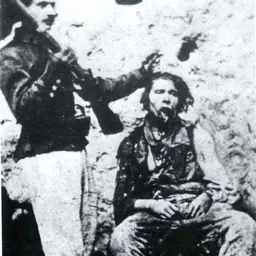


Contemporaries
People whose lives overlapped Giuseppe Musolino's

Frequently asked questions
Who was Giuseppe Musolino?
Italian brigand (1876-1956)
When was Giuseppe Musolino born?
Giuseppe Musolino was born on 24 September 1876 in Santo Stefano in Aspromonte.
When did Giuseppe Musolino die?
Giuseppe Musolino died on 22 January 1956 in Reggio Calabria.
What was Giuseppe Musolino's occupation?
Giuseppe Musolino was a brigand.
What nationality was Giuseppe Musolino?
Giuseppe Musolino was Italian.
Sources & further reading
· Wikipedia: Giuseppe Musolino
Cite this page
APA: Biography.guide. (2026). Giuseppe Musolino. https://biography.guide/giuseppe-musolino/
MLA: "Giuseppe Musolino." Biography.guide, https://biography.guide/giuseppe-musolino/.
Chicago: "Giuseppe Musolino." Biography.guide. https://biography.guide/giuseppe-musolino/.
Data last updated: 2026-09-25 · Spot an error? Report a correction.
Page generated 2026-09-27 05:12 UTC