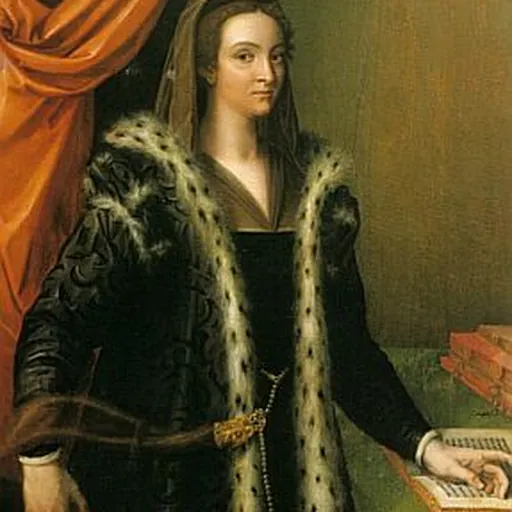
About Giulia Gonzaga
Lived 1513 – 1566 (aged 52–53). Giulia Gonzaga was an aristocrat.
Giulia Gonzaga (1513 – 16 April 1566) was an Italian countess and letter writer of the Renaissance. She was the countess regnant of Rodigo as the heir of her late spouse between 1528 and 1541.
Biography
Giulia was born in Gazzuolo (near Mantua) in 1512 the daughter of Ludovico Gonzaga, lord of Sabbioneta and Bozzolo, and Countess Francesca Fieschi.
In 1526 (at age 14) she was married to Count Vespasiano Colonna (1480–1528), count of Fondi and duke of Traetto (present-day Minturno). In 1528 her husband died, leaving the County of Rodigo to her upon the condition that she not remarry. Giulia organized her palace as a center of culture, attracting the attention of many of her contemporaries as much for these activities as for her famous beauty, though she refused to marry again. She had a liaison with Cardinal Ippolito de' Medici of Florence, who died in Itri (southern Lazio) after a meeting with her.
In the night of 8–9 August 1534, the town of Fondi was attacked by the corsair Barbarossa, who was seeking to kidnap and deliver her to Suleiman the Magnificent. Barbarossa had been ordered to kidnap (enslave) her by Ibrahim Pasha, the Ottoman Grand Vizier. Pasha's plan was to add her to the sultan's Ottoman Imperial Harem (as a slave concubine) and supplant Roxelana, the sultan's wife. She escaped, and Barbarossa, frustrated, massacred the populations of Fondi and nearby Sperlonga, though he was repulsed at nearby Itri. She fled into the night, accompanied by a single knight. James Reston alleges that Gonzaga later had the knight killed because she had been nearly nude during her escape, and he had seen too much, though he provides no reference for this claim. There is also speculation that Barbarossa's attempt may have been motivated by members of the Colonna family wishing to recover their lands after Vespasiano Colonna's death.
Giulia Gonzaga joined a convent in Naples in 1535 (at age 22); she did not become a nun, but lived in the convent as a laywoman and kept her domain as countess of Rodigo. In the convent she met Juan de Valdés in 1536. This encounter and subsequent correspondence brought her to the attention of the Inquisition, for example leading her to write a letter in 1553 to cardinal Ercole Gonzaga to express her lack of agreement with the later writings of de Valdés.
In 1541, she left her fief to her nephew Vespasiano I Gonzaga.
Giulia Gonzaga died at age 53 in 1566. After her death, her correspondence with Pietro Carnesecchi led to the latter's being burned at the stake for heresy (in 1567).
Don’t just read it —
keep it.
Full-length biographies made to live with: read them, listen on the way to work, watch them tonight.
- E-book
- Audio
- Video
Instant download · yours to keep · every purchase keeps this site free
Important facts
Family & relationships
People in Giulia Gonzaga's life
Named in this biography and alive at the same time


Related people
Same field, nearest in time




Contemporaries
People whose lives overlapped Giulia Gonzaga's






Frequently asked questions
Who was Giulia Gonzaga?
Italian noblewoman of the Renaissance
When was Giulia Gonzaga born?
Giulia Gonzaga was born in 1513 in Gazzuolo.
When did Giulia Gonzaga die?
Giulia Gonzaga died on 19 April 1566 in Naples.
What was Giulia Gonzaga's occupation?
Giulia Gonzaga was an aristocrat.
Sources & further reading
Cite this page
APA: Biography.guide. (2026). Giulia Gonzaga. https://biography.guide/giulia-gonzaga/
MLA: "Giulia Gonzaga." Biography.guide, https://biography.guide/giulia-gonzaga/.
Chicago: "Giulia Gonzaga." Biography.guide. https://biography.guide/giulia-gonzaga/.
Data last updated: 2026-09-20 · Spot an error? Report a correction.
Portrait: Wikimedia Commons · author & licence
Page generated 2026-09-27 04:57 UTC