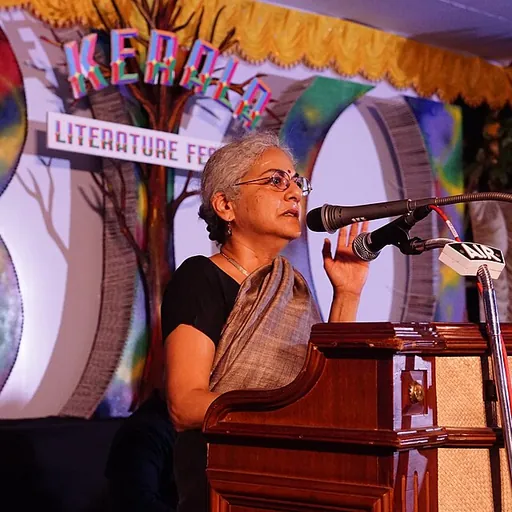
About Githa Hariharan
Born 1954. Githa Hariharan is an Indian journalist, novelist, writer and editing staff, known for I Have Become the Tide.
Githa Hariharan (born 1954) is an Indian writer and editor based in New Delhi. Her first novel, The Thousand Faces of Night, won the Commonwealth Writers' Prize for the best first novel in 1993. Her other works include the short story collection The Art of Dying, the novels The Ghosts of Vasu Master (1994), When Dreams Travel (1999), In Times of Siege (2003), Fugitive Histories (2009) and I Have Become the Tide (2019), and a collection of essays entitled Almost Home: Cities and Other Places (2014).
Githa Hariharan has also written children's stories and co-edited a collection for children called Sorry, Best Friend! (1997). She has also edited a collection of translated short fiction, A Southern Harvest (1993), the essay collection From India to Palestine: Essays in Solidarity (2014) and co-edited Battling for India: A Citizen’s Reader (2019).
Biography Githa Hariharan was born in 1954 in Coimbatore, Madras State (now Tamil Nadu), India. She was raised in a Tamil Brahmin home in Bombay and Manila with two siblings. Her father was a journalist for the Times of India in 1977. George Washington University, the University of Kent, Nanyang Technological University, Jamia Millia Islamia and Goa University.
Githa Hariharan is also a founder member of the Indian Writers' Forum.
Writing career According to The Atlantic Companion to Literature, "Githa Hariharan's works belong to the renaissance of Indo-English literature which began in the early 1980s when Salman Rushdie's novel Midnight's Children appeared." which she wrote while on maternity leave from work. According to Meenakshi Bharat, this book "questions the confining code of patriarchy and brings to light the survival strategies of three generations of women" and Hariharan "makes concerted use of myth and folktale to enlarge the space of the lives of "real" people, especially women." According to Hariharan, her interest as a writer was "not in the story of how the 1001 nights began or happened, but where that tale ends. What happens in stories after the moment when people live happily ever after."
Githa Hariharan has described In Times of Siege (2003) as her "first overtly political novel." According to The Atlantic Companion to Literature, it "is in fact a radical book which discusses the ruling political parties' attempt to rewrite history [...] to give the educational system a Hindu slant."
In 2014, her edited volume of nonfiction essays From India to Palestine: Essays in Solidarity was published and includes essays by herself, Meena Alexander, Aijaz Ahmad, Ritu Menon and Nayantara Sehgal. Her 2016 collection Almost Home is described by Kirkus Reviews as "essays on identity, place, and the pervasiveness of the past in the present, by a global literary citizen" and "an uneven collection—never just travel writing or political analysis—that nonetheless seems to map new territory of its own." In a review for The Hindu, Latha Anantharaman writes "the essay on Algeria stands out [...] Hariharan discusses the psychology of colonialism, what happens to the identity of a people when you occupy their land and force them to speak French, think in French, and dress like the French, what happens when you indoctrinate them in French principles and philosophy and yet deny that they are French" and further states "It is in her essay on Palestine that Hariharan best evokes the living voices of people under occupation."
Her sixth novel I Have Become the Tide was published in 2019 and is the third with a focus on contemporary India. In 2020, a Malayalam translation of the novel was published by Mātr̥bhūmi Buks.
Githa Hariharan co-edited the 2019 essay collection Battling for India: A Citizen’s Reader with Salim Yusufji. In a review for The Wire, Priyanka Tripathi writes, "Drawing its vision from Ambedkar's democracy, the book reiterates that an Indian citizen’s political democracy (full rights to the nation) becomes null and void in the absence of social (discrimination on the basis of caste and age) and economic (freeing all Indians from poverty) democracy."
Her work has been translated into Dutch, French, German, Greek, Italian, Spanish, Malayalam, Urdu and Vietnamese. The case, Hariharan v. Reserve Bank of India was filed with her husband also as a petitioner and led to a Supreme Court of India judgment protecting the rights of children and finding both the mother and father can be natural guardians of the child. The Supreme Court stated, "[the father] cannot be ascribed to have a preferential right over the mother in the matter of guardianship".
Don’t just read it —
keep it.
Full-length biographies made to live with: read them, listen on the way to work, watch them tonight.
- E-book
- Audio
- Video
Instant download · yours to keep · every purchase keeps this site free
Important facts
People in Githa Hariharan's life
Named in this biography and alive at the same time




Related people
Same field, nearest in time






Contemporaries
People whose lives overlapped Githa Hariharan's



Frequently asked questions
Who is Githa Hariharan?
Indian writer
When was Githa Hariharan born?
Githa Hariharan was born in 1954 in Coimbatore.
What is Githa Hariharan's occupation?
Githa Hariharan is a journalist, novelist, writer and editing staff.
What is Githa Hariharan known for?
Githa Hariharan is known for I Have Become the Tide.
What nationality is Githa Hariharan?
Githa Hariharan is Indian.
Sources & further reading
Cite this page
APA: Biography.guide. (2026). Githa Hariharan. https://biography.guide/githa-hariharan/
MLA: "Githa Hariharan." Biography.guide, https://biography.guide/githa-hariharan/.
Chicago: "Githa Hariharan." Biography.guide. https://biography.guide/githa-hariharan/.
Data last updated: 2026-09-22 · Spot an error? Report a correction.
Page generated 2026-09-27 05:09 UTC