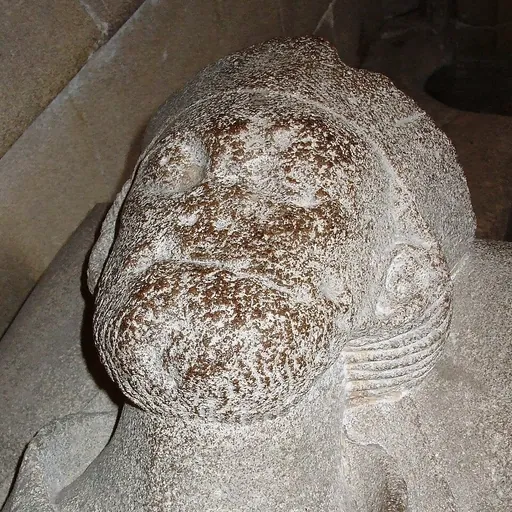
About Giso
Giso was a latin Catholic priest and catholic bishop.
Gisa (also written Giso; died 1088) was Bishop of Wells from 1060 to 1088. A native of Lorraine, Gisa came to England as a chaplain to King Edward the Confessor. After his appointment to Wells, he travelled to Rome rather than be consecrated by Stigand, the Archbishop of Canterbury. As bishop, Gisa added buildings to his cathedral, introduced new saints to his diocese, and instituted the office of archdeacon in his diocese. After the Norman Conquest, Gisa took part in the consecration of Lanfranc, the new Archbishop of Canterbury, and attended Lanfranc's church councils. His tomb in Wells Cathedral was opened in the 20th century and a cross was discovered in his tomb.
Life
Gisa was born in Lorraine, probably the village of St Trond in modern Belgium, and was among a number of foreign churchmen brought to England by King Edward the Confessor. At first he held the position of king's chaplain, but in January 1060 or possibly January 1061 and travelled in company with another bishop—Walter of Lorraine, the Bishop of Hereford-elect—and Tostig Godwinson. The Vita Edwardi says that he was "most suitably and excellently trained".
On Gisa's arrival in the see he found the church there quite poor. He constructed cloisters to the north of Wells Cathedral and communal buildings to the south for the canons. He ordered the canons to live together under a rule, but exactly which rule it was is unknown. After the Norman Conquest, he introduced the veneration of new saints into his cathedral, as well as setting up an archdeacon in the diocese for the first time.
Gisa obtained land grants for the upkeep of the church and canons from King Edward the Confessor and the later kings Harold Godwinson and William I of England. He is mentioned many times in the Domesday Book of 1086 as the holder of land for the see, and was notorious for acquiring land throughout his bishopric.
After the Norman Conquest, Gisa supported William, the new king of England. He helped consecrate Lanfranc as Archbishop of Canterbury in 1070, and attended the Council of Windsor in 1072 and the Council of London in 1075. At a later church council, Giso asserted his authority over the abbots of Muchelney and Athelney, but failed to uphold the same claim in regards to Thurstan, Abbot of Glastonbury. Previously, he was credited as the author of Historiola de primordiis episcopatus Somersetensis, a history of the bishops of Wells, but he is no longer considered the author of that work. His tomb was opened in 1979,
Don’t just read it —
keep it.
Full-length biographies made to live with: read them, listen on the way to work, watch them tonight.
- E-book
- Audio
- Video
Instant download · yours to keep · every purchase keeps this site free
Important facts
Related people
Same field, nearest in time



Frequently asked questions
Who was Giso?
bishop of the Roman Catholic Church
When was Giso born?
Giso was born in Duchy of Lorraine.
When did Giso die?
Giso died in 1088.
What was Giso's occupation?
Giso was a latin Catholic priest and catholic bishop.
Sources & further reading
· DBpedia: Gisa (bishop of Wells)
Cite this page
APA: Biography.guide. (2026). Giso. https://biography.guide/giso/
MLA: "Giso." Biography.guide, https://biography.guide/giso/.
Chicago: "Giso." Biography.guide. https://biography.guide/giso/.
Data last updated: 2026-09-20 · Spot an error? Report a correction.
Portrait: Wikimedia Commons · author & licence
Page generated 2026-09-27 04:58 UTC